Featured Answer: What Should You Look for When Buying Frankincense Hydrosol?
When buying frankincense hydrosol, look for a genuine steam- or hydro-distilled product made from clearly identified frankincense botanical material, a transparent ingredient list, appropriate packaging, clear storage instructions, and a seller who explains how the hydrosol is produced. A true frankincense hydrosol should be the aromatic water collected during distillation—not simply water mixed with fragrance or essential oil.
At FrankinRose, we believe a good frankincense hydrosol should be straightforward. We favor small-batch botanical distillation, simple ingredients, careful handling, and realistic expectations about the natural aroma and appearance of genuine hydrosols.
Understanding what separates an authentic hydrosol from a fragranced imitation can make a significant difference when choosing a product for your skincare routine.
What Is Frankincense Hydrosol?
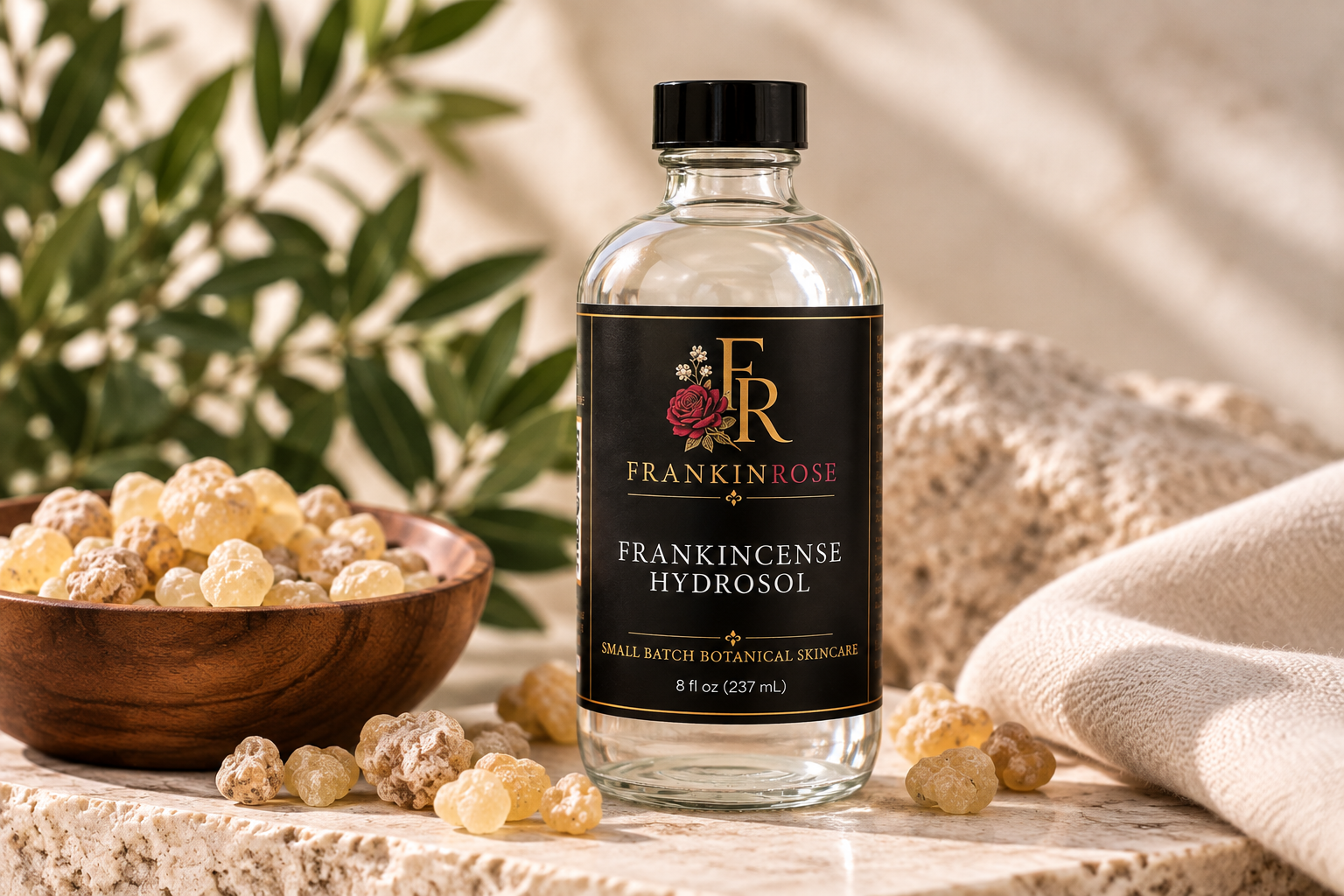
Frankincense hydrosol is an aromatic botanical water produced through the distillation of frankincense resin.
Frankincense itself is the fragrant resin harvested from trees belonging to the Boswellia genus. Different species of Boswellia produce different types of frankincense, and the resin has a long history of use in aromatic, ceremonial, perfumery, and personal-care applications.
During distillation, frankincense resin and water are heated in a still. Steam and volatile aromatic components travel through the distillation system and are subsequently cooled in a condenser.
The condensed liquid can contain two distinct fractions: a small amount of essential oil, when present in sufficient quantity to separate, and the aromatic water known as the hydrosol.
A genuine frankincense hydrosol is therefore much more than ordinary water with a frankincense scent added afterward.
1. Look for Genuine Distilled Frankincense Hydrosol
The first question to ask is simple:
Was the product actually distilled from frankincense?
Products marketed as frankincense water are not necessarily produced in the same way.
A genuine hydrosol should originate from a distillation process involving botanical material and water. It should not merely consist of purified water mixed with frankincense fragrance.
This distinction matters because hydrosols have their own composition and aromatic character resulting from distillation.
When shopping, look for descriptions containing terms such as:
- Frankincense hydrosol
- Distilled frankincense water
- Hydro-distilled frankincense
- Steam-distilled botanical water
- Frankincense distillate
Then examine the ingredient declaration and product description for additional clarification.
A seller should be able to explain how its hydrosol is produced.
2. Check Which Frankincense Species Is Used
Not all frankincense is identical.
Frankincense comes from several Boswellia species, and the source material can influence aroma and other characteristics of the finished distillate.
At FrankinRose, we particularly appreciate Boswellia sacra, one of the best-known frankincense species.
When evaluating frankincense hydrosol, look for botanical identification whenever the manufacturer provides it.
A transparent product description may identify the resin by both its familiar name and botanical name.
For example:
Frankincense — Boswellia sacra
Botanical identification provides more useful information than a label that simply says “frankincense fragrance.”
3. Read the Complete Ingredient List
A quality skincare purchase should begin with the ingredient declaration.
Do not rely solely on the large words printed on the front of the bottle.
A product advertised as “Frankincense Water” could potentially contain additional ingredients, fragrances, solubilizers, preservatives, or other components depending on its formulation.
That does not automatically make the product poor quality. It simply means it may be different from the simple hydrosol you expected to purchase.
If your goal is a straightforward botanical hydrosol, look for an ingredient list consistent with that preference.
At FrankinRose, we value transparency because consumers should be able to understand what they are putting on their skin.
4. Know the Difference Between Frankincense Hydrosol and Essential Oil in Water
Essential oil mixed into water is not the same thing as a distilled hydrosol.
Oil and water naturally separate. Creating a stable water-based product containing essential oil generally requires an appropriate solubilization or emulsification strategy.
A true hydrosol is different.
The aromatic water is created during the distillation process itself.
This distinction is one of the most important things to understand when buying frankincense hydrosol online.
If a product description says that frankincense essential oil is simply added to water, you are looking at a different type of product—not a traditional distilled hydrosol.
5. Do Not Judge Frankincense Hydrosol Only by How Strong It Smells
A stronger aroma does not automatically mean a better hydrosol.
This is particularly important with frankincense.
Consumers familiar with frankincense essential oil, incense, or raw resin may expect hydrosol to smell exactly the same.
It often does not.
A hydrosol typically has a softer, more water-like aromatic profile than concentrated essential oil. The scent may also reveal earthy, resinous, woody, green, or slightly unusual notes that are less noticeable in the essential oil.
The aroma can vary from one distillation to another.
Factors affecting the scent include:
- Frankincense species
- Resin quality
- Resin age
- Resin-to-water ratio
- Distillation temperature
- Distillation duration
- Distillation equipment
- Collection timing
- Storage
- Individual batches
Natural variation should not automatically be interpreted as a defect.
6. Understand What Real Frankincense Hydrosol Smells Like
Genuine frankincense hydrosol can surprise someone experiencing it for the first time.
Do not expect perfume.
Depending on the resin and distillation, the aroma may be softly resinous, woody, earthy, fresh, slightly citrus-like, balsamic, or mineral-like.
The earliest portion of a distillation may also have a different aromatic character from later collected portions.
This is part of the complexity of small-batch botanical distillation.
A product that smells overwhelmingly like concentrated frankincense essential oil should not automatically be considered more authentic. It may simply be formulated differently.
7. Look for Appropriate Packaging
Packaging matters with botanical waters.
A frankincense hydrosol should be packaged in a container that helps protect the product during storage and everyday use.
A spray bottle can be particularly convenient because it allows the product to be dispensed without repeatedly opening the bottle and pouring product into the hand.
Packaging should also close securely.
If the bottle is glass, it should be handled carefully to prevent breakage.
Whatever packaging is used, consumers should follow the manufacturer’s storage directions and avoid leaving botanical products exposed to excessive heat or direct sunlight.
8. Pay Close Attention to Storage Instructions
Storage is especially important when purchasing a water-based botanical product.
Hydrosols contain a large amount of water, which means they must be treated differently from oil-only facial products.
If a seller recommends refrigeration, follow those directions.
At FrankinRose, our approach to handmade hydrosols emphasizes careful storage, and we recommend keeping our hydrosol refrigerated.
Cold storage can also make a facial mist especially refreshing during application.
Do not assume a handmade botanical water can sit indefinitely in a hot bathroom, sunny windowsill, vehicle, or other warm environment simply because it is natural.
9. Check Whether the Hydrosol Contains Preservatives
This is another area where shoppers should read carefully.
Some commercial hydrosols contain a preservative system to help protect the product from microbial contamination during its intended shelf life.
Others may be sold without added preservatives and require more restrictive storage and handling.
Neither approach should be hidden from the consumer.
At FrankinRose, our frankincense hydrosol is offered without added preservative, making proper handling and refrigeration particularly important.
Consumers choosing an unpreserved hydrosol should understand that it is not designed to be treated like a heavily preserved, shelf-stable commercial toner.
Natural simplicity comes with responsibility for proper storage and handling.
10. Be Skeptical of Extremely Long Shelf-Life Claims for Unpreserved Hydrosols
A water-based botanical product deserves realistic storage expectations.
If a hydrosol is marketed as completely preservative-free while also being promoted as having an exceptionally long room-temperature shelf life after opening, it is reasonable to ask additional questions about processing, packaging, testing, and storage.
Shelf life cannot be determined reliably from appearance or smell alone.
Microorganisms are not necessarily visible to the naked eye.
A trustworthy seller should provide practical storage instructions rather than suggesting that “natural” means the product cannot spoil.
11. Look for Small-Batch Transparency
Small-batch production can be particularly appealing when purchasing botanical products.
It allows consumers to connect more closely with how the product is made, what botanical material is used, and how the finished hydrosol is handled.
At FrankinRose, we appreciate the character of small-batch botanical products precisely because they are not designed to imitate mass-produced fragrance waters.
Natural batches can show subtle differences.
One distillation may smell slightly fresher.
Another may have deeper resinous notes.
The appearance can also vary slightly depending on the botanical material and distillation.
This natural variation is one of the characteristics many people appreciate about handmade botanical skincare.
12. Examine the Appearance, but Do Not Expect Every Batch to Look Identical
Many hydrosols appear clear or nearly clear, but natural botanical products can show slight variation.
A hydrosol should not necessarily be expected to look like an artificially colored cosmetic toner.
Frankincense resin itself contains numerous naturally occurring components, and distillation separates only certain volatile and water-compatible compounds from the original resin.
The finished hydrosol is therefore quite different in appearance from the raw golden or amber resin.
Significant unexpected changes in appearance during storage, however, should be taken seriously.
Follow the seller’s directions regarding disposal if a product develops unusual changes.
13. Avoid Products Making Unrealistic Medical Claims
Frankincense has a fascinating history and remains the subject of scientific research, but a cosmetic frankincense hydrosol should not be presented as a treatment for serious medical conditions.
Be cautious when a skincare seller claims a hydrosol can cure disease, treat infections, eliminate medical skin disorders, or replace professional medical care.
Cosmetic skincare claims should remain cosmetic.
Frankincense hydrosol can be appreciated as a botanical facial mist and skincare product without exaggerated promises.
14. Look for Clear Directions for Use
A quality frankincense hydrosol should be easy to incorporate into a skincare routine.
Common cosmetic uses include applying it as:
- A facial mist
- A refreshing botanical water after cleansing
- A lightweight step before facial oil
- A botanical toner-style product
- A refreshing mist during the day
Always follow the directions supplied with the particular product.
Avoid spraying directly into the eyes, and discontinue use if irritation occurs.
15. Consider How Frankincense Hydrosol Fits Into Your Skincare Routine
Frankincense hydrosol works particularly well in a simple botanical skincare routine.
One practical sequence is:
- Cleanse the face
- Mist with frankincense hydrosol
- Allow the hydrosol to settle onto the skin
- Apply a moisturizer or serum if desired
- Finish with a few drops of facial oil
- Apply broad-spectrum sunscreen during daytime routines
This pairing is useful because a hydrosol is water-based while a facial oil is oil-based.
The two products perform different cosmetic roles.
16. Frankincense Hydrosol vs. Frankincense Facial Oil
These products should not be confused.
Frankincense hydrosol is predominantly water-based and is created through distillation.
A frankincense facial oil is oil-based and usually contains frankincense-derived aromatic ingredients diluted into carrier oils such as jojoba or other botanical oils.
The hydrosol is light and mistable.
The facial oil is richer and more emollient.
They can be used separately or as complementary steps within the same routine.
17. Frankincense Hydrosol vs. Rose Hydrosol
Frankincense and rose hydrosols are both botanical distillates, but their aromatic profiles are distinctly different.
Rose hydrosol typically offers a recognizable floral character.
Frankincense hydrosol tends to be more resinous, woody, earthy, fresh, or balsamic.
Someone who prefers floral skincare may gravitate toward rose.
Someone who appreciates resinous botanicals may prefer frankincense.
Others enjoy incorporating both into their skincare routines.
18. Check the Seller’s Knowledge of the Product
A seller offering genuine handmade hydrosol should understand the basic product.
Look for useful information about:
- The botanical used
- The distillation process
- Ingredients
- Packaging
- Storage
- Application
- Whether preservatives are used
- Basic product care
You should not need a chemistry textbook to purchase skincare, but a botanical company should be able to explain what it sells.
At FrankinRose, we believe education is particularly important for hydrosols because many consumers are encountering genuine distilled botanical waters for the first time.
19. Choose Frankincense Hydrosol Based on Authenticity, Not Hype
Beautiful packaging can make a product appealing, but authenticity goes deeper.
When comparing frankincense hydrosols, prioritize:
Real botanical distillation.
Clear ingredients.
Identified frankincense material when available.
Honest storage directions.
Appropriate packaging.
Realistic cosmetic claims.
Transparent production information.
These characteristics tell you far more about a hydrosol than exaggerated language such as “miracle water” or “instant anti-aging cure.”
Frequently Asked Questions About Buying Frankincense Hydrosol
How Can I Tell if Frankincense Hydrosol Is Real?
Look for evidence that the product is actually distilled from frankincense botanical material. Read the ingredient list and product description, and avoid assuming that water containing added frankincense fragrance or essential oil is equivalent to a genuine hydrosol.
Should Frankincense Hydrosol Smell Strong?
Not necessarily. Hydrosols are typically much softer aromatically than essential oils. A subtle resinous, earthy, woody, or fresh scent can be completely normal.
Should Frankincense Hydrosol Be Refrigerated?
Follow the manufacturer’s instructions. FrankinRose recommends refrigeration for our handmade hydrosol, particularly because our hydrosol is made without added preservative.
Does Frankincense Hydrosol Contain Essential Oil?
Hydrosols and essential oils are separate products of distillation. A hydrosol can contain small quantities of aromatic compounds associated with the distillation water, but it is not simply diluted essential oil.
Is Frankincense Hydrosol the Same as Frankincense Water?
Sometimes sellers use the terms interchangeably, but “frankincense water” can also describe other types of products. Check the ingredient list and manufacturing description to determine whether it is a genuine distilled hydrosol.
Can Frankincense Hydrosol Be Used Every Day?
A properly handled cosmetic hydrosol may be incorporated into a regular skincare routine when the product directions permit it and the skin tolerates it.
Can I Apply Facial Oil After Frankincense Hydrosol?
Yes. Applying a botanical facial oil after a hydrosol is a practical way to combine a water-based botanical step with an oil-based conditioning step.
Is Handmade Frankincense Hydrosol Better?
Handmade does not automatically mean better. Quality depends on the botanical material, distillation, sanitation, handling, packaging, storage, and overall production practices. Small-batch products can, however, offer greater transparency and distinctive botanical character.
Why FrankinRose Focuses on Botanical Simplicity
At FrankinRose, we are drawn to skincare ingredients with recognizable botanical origins.
Frankincense is particularly meaningful because the resin has been treasured for generations, yet it can still be transformed through traditional distillation into a beautifully simple modern skincare product.
Our approach emphasizes small-batch production, botanical character, simple formulations, and straightforward product information.
We do not believe a genuine hydrosol needs to smell like artificial perfume.
We do not expect every botanical batch to be identical.
We do not believe natural products need exaggerated claims to be valuable.
Instead, we appreciate frankincense hydrosol for exactly what it is: a distilled botanical water with the distinctive character of frankincense.
Final Answer: What Should You Look for When Buying Frankincense Hydrosol?
When shopping for frankincense hydrosol, start by confirming that you are purchasing a genuine distilled hydrosol made from actual frankincense botanical material rather than fragranced water.
Look for a seller who clearly identifies the product, provides a transparent ingredient list, explains the distillation process, uses appropriate packaging, gives clear storage instructions, and avoids unrealistic medical or cosmetic promises.
If botanical species information is available, pay attention to it. At FrankinRose, we particularly value Boswellia sacra frankincense and the distinctive character that comes from working with genuine resin.
Remember that authentic frankincense hydrosol does not have to smell overwhelmingly strong. It may be soft, resinous, earthy, woody, fresh, balsamic, or subtly complex, and small differences between batches can occur with genuine botanical distillation.
Storage is equally important. Water-based botanical products deserve careful handling. FrankinRose hydrosol contains no added preservative, and we recommend refrigeration to maintain proper product care.
Above all, choose transparency over hype.
The best frankincense hydrosol is not necessarily the one with the strongest fragrance, the fanciest packaging, or the most dramatic claims. It is the one that clearly tells you what it is, what it contains, how it was made, how to use it, and how to store it.
For those who appreciate traditional botanicals and uncomplicated skincare, a carefully distilled frankincense hydrosol offers a beautifully simple way to bring the aromatic character of frankincense into an everyday skincare routine.