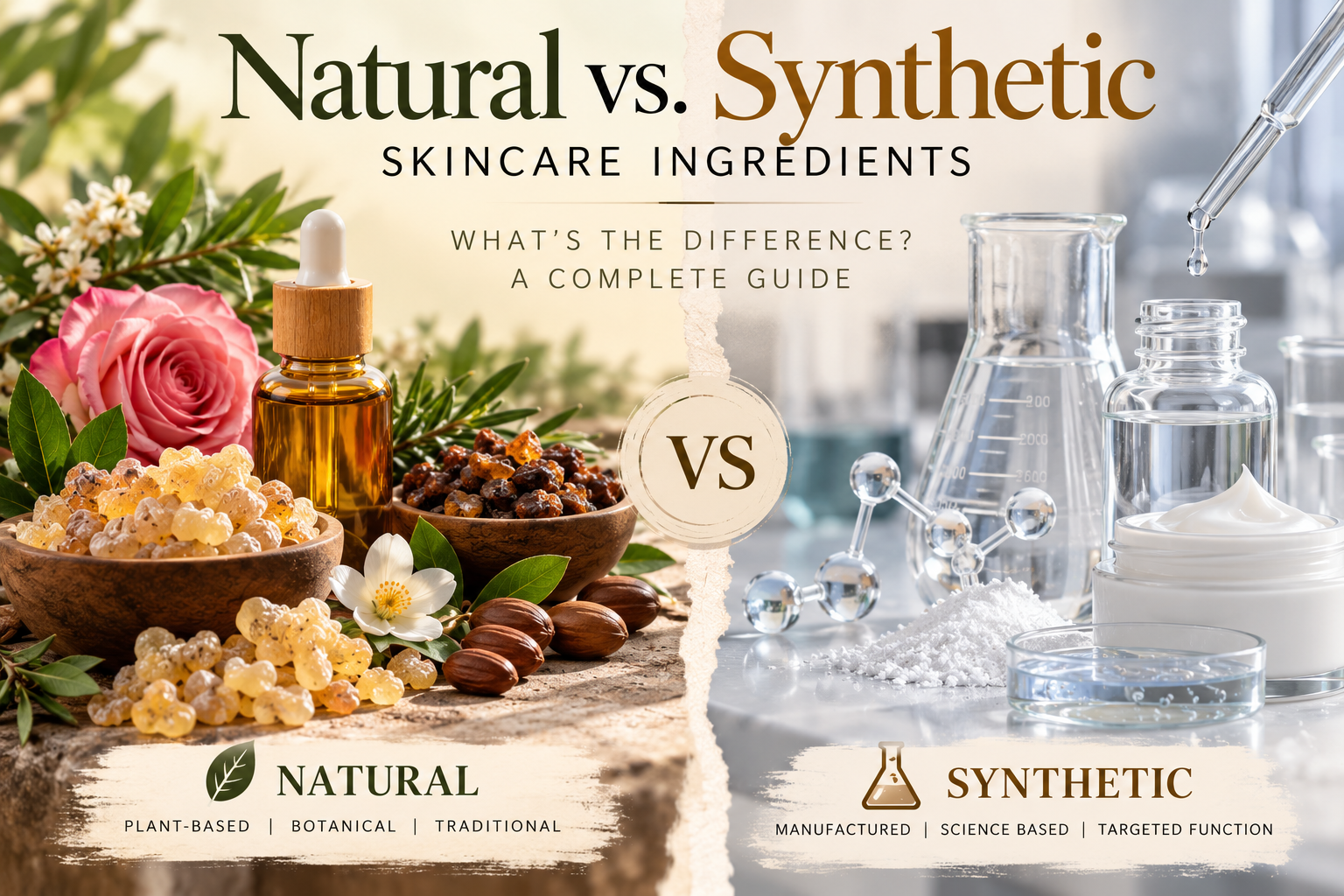
Featured Answer: What Is the Difference Between Natural and Synthetic Skincare Ingredients?
Natural skincare ingredients are obtained from sources found in nature, such as plants, seeds, flowers, fruits, minerals, and botanical resins, while synthetic skincare ingredients are manufactured or chemically synthesized to create specific substances for cosmetic formulations. The distinction does not automatically determine whether an ingredient is safer, gentler, or more effective. Both natural and synthetic ingredients can be useful in skincare, and both can cause irritation or sensitivity depending on the ingredient, concentration, formulation, and individual.
At FrankinRose, we appreciate botanical skincare and straightforward formulations built around ingredients such as frankincense, rose, jojoba oil, myrrh, prickly pear seed oil, coffee oil, carrot seed oil, and botanical hydrosols. We also believe consumers deserve accurate information. “Natural” does not automatically mean safe, and “synthetic” does not automatically mean harmful.
Understanding the difference makes it easier to read ingredient labels, evaluate skincare products, and select formulas that match personal preferences and skincare needs.
What Are Natural Skincare Ingredients?
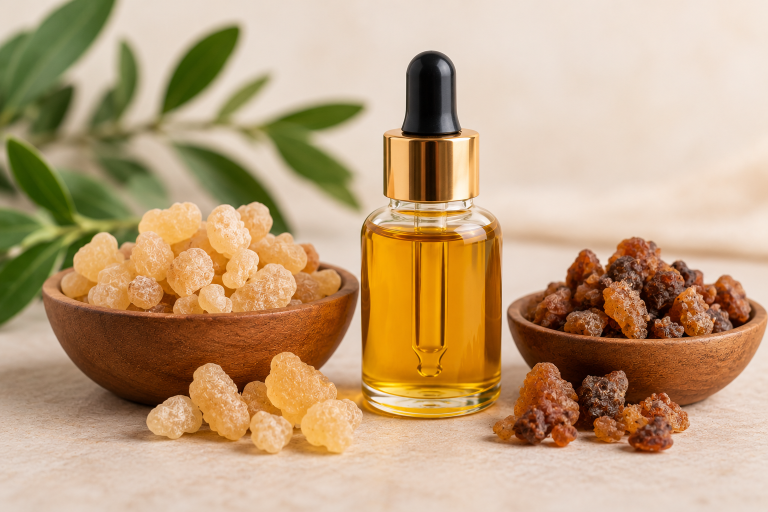
Natural skincare ingredients generally originate from plant, mineral, or other naturally occurring sources and undergo varying degrees of processing before being incorporated into a finished cosmetic product.
Plant-derived skincare ingredients can come from flowers, leaves, roots, bark, seeds, fruits, resins, and other botanical materials.
Common examples include:
- Jojoba oil
- Castor oil
- Prickly pear seed oil
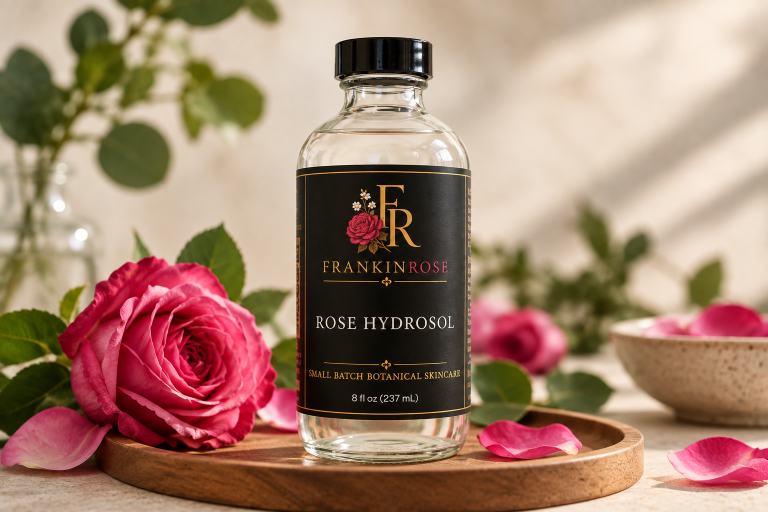
- Rose hydrosol
- Frankincense hydrosol
- Frankincense-derived ingredients
- Myrrh-derived ingredients
- Coffee oil
- Carrot seed oil
- Botanical extracts
- Plant butters
- Essential oils
The term “natural,” however, is broader and more complicated than it may initially appear.
A material can originate in nature while still requiring extraction, distillation, filtration, pressing, purification, or other processing before it becomes suitable for cosmetic use.
A bottle of botanical facial oil, for example, is not equivalent to placing an unprocessed plant directly on the skin. The oil has been separated from the original botanical material and prepared for use as an ingredient.
What Are Synthetic Skincare Ingredients?
Synthetic skincare ingredients are substances produced through controlled chemical manufacturing processes rather than being obtained directly from a natural source in their finished form.
They can be designed to perform very specific functions within skincare formulations.
Synthetic ingredients may be used to:
- Improve product stability
- Control texture and viscosity
- Help ingredients mix together
- Preserve water-containing formulations
- Adjust pH
- Improve spreadability
- Deliver specific cosmetic effects
- Maintain consistency between batches
- Support product performance
The word synthetic should not be interpreted as a synonym for toxic, artificial in a negative sense, or unsafe.
Many synthetic cosmetic ingredients are extensively characterized and can be formulated at established concentrations for specific uses.
Likewise, naturally derived substances contain chemicals. Water is a chemical substance. Botanical oils consist of numerous chemical compounds. The fragrance of a flower or resin results from naturally occurring volatile compounds.
The meaningful question is not simply whether an ingredient sounds natural or synthetic. It is what the ingredient is, how much is present, how it is formulated, and how the skin responds to it.
Natural vs. Synthetic Skincare: Is One Better?
Neither category is universally superior.
Natural skincare may appeal to people who enjoy botanical oils, hydrosols, plant extracts, traditional ingredients, simple formulations, and naturally occurring aromas.
Synthetic ingredients can offer advantages when precise performance, consistency, preservation, texture, or stability is required.
The best choice depends on the product and its intended purpose.
For example, a simple facial oil can be created primarily from plant oils because oils do not require the same formulation strategy as a water-based cream.
A lotion containing significant amounts of water has different stability and microbial considerations. It normally requires a carefully designed preservation system to remain suitable for use throughout its intended shelf life.
Comparing these products solely on whether their ingredients are “natural” or “synthetic” overlooks the much more important differences in their formulations.
Natural Does Not Automatically Mean Safer
One of the most important principles in botanical skincare is that natural does not automatically mean harmless.
Plants naturally contain powerful chemical compounds. Some can irritate skin, cause allergic reactions, increase photosensitivity, or become problematic at inappropriate concentrations.
Essential oils provide an excellent example.
An essential oil may be completely plant-derived, yet it remains a highly concentrated mixture of volatile aromatic compounds. Applying excessive amounts to facial skin can cause irritation or sensitization.
Proper dilution matters.
The same principle applies to other botanical ingredients. The fact that something came from a flower, seed, tree, or resin does not eliminate the need for responsible formulation.
At FrankinRose, we believe botanical skincare is best appreciated without making exaggerated assumptions about natural ingredients.
Synthetic Does Not Automatically Mean Harmful
Synthetic ingredients are sometimes described as though they are inherently undesirable simply because they were manufactured.
That distinction is misleading.
The safety of a cosmetic ingredient depends on factors including identity, purity, concentration, route of exposure, frequency of use, and formulation.
In some cases, synthesizing a substance can provide greater consistency and purity than relying entirely on variable natural sources.
Natural botanical materials can vary because plants themselves vary.
Climate, soil, growing conditions, harvest timing, species, processing, storage, and extraction methods can all influence the characteristics of plant-derived ingredients.
Synthetic manufacturing can sometimes reduce that variability by creating a highly standardized ingredient.
What Does “Naturally Derived” Mean in Skincare?
Consumers may also encounter the phrase naturally derived.
Naturally derived ingredients generally begin with material from a natural source but undergo processing or chemical transformation before becoming the ingredient used in the final cosmetic formula.
This creates an important distinction among:
Natural ingredients — obtained from naturally occurring sources and processed to varying degrees.
Naturally derived ingredients — originating from natural raw materials but subsequently transformed or processed.
Synthetic ingredients — produced through chemical synthesis or manufacturing processes.
These categories can overlap in complicated ways, which is why the ingredient list often provides more useful information than broad marketing terminology on the front of a package.
Are Botanical Oils Natural Skincare Ingredients?
Plant oils are among the most recognizable ingredients associated with natural skincare.
Examples include jojoba, castor, prickly pear seed, coffee, and carrot seed oils.
Each has its own texture, fatty-acid composition, stability, aroma, color, and skin feel.
Jojoba Oil
Jojoba is technically a liquid wax rather than a conventional triglyceride oil. It is valued in facial formulations for its stability, spreadability, and lightweight-to-medium skin feel.
It can also serve as an effective carrier for properly diluted aromatic botanical ingredients.
Castor Oil
Castor oil has a noticeably richer, thicker texture. It can add body to facial-oil formulations and may be blended with lighter oils to create a more balanced application.
Prickly Pear Seed Oil
Prickly pear seed oil is used in botanical skincare because of its distinctive lipid composition and luxurious skin feel. It is commonly incorporated into facial oils and other leave-on cosmetic products.
Coffee Oil
Coffee-derived oils can bring a characteristic aroma, color, and emollient quality to cosmetic formulations. Their sensory profile can vary depending on the raw material and processing method.
Carrot Seed Oil
Carrot seed-derived oils are used in botanical skincare for their distinctive characteristics. As with other plant oils, the exact ingredient identity matters because products marketed using similar names can represent different types of extracts or oils.
Are Hydrosols Natural Skincare Ingredients?
Hydrosols are an important category of botanical skincare, particularly for people looking for lightweight, water-based products.
A hydrosol is the aromatic water produced during the distillation of botanical material.
Examples include:
- Rose hydrosol
- Frankincense hydrosol
Hydrosols are different from essential oils.
During distillation, certain aromatic and water-soluble components of the botanical material become associated with the distillate water. A small amount of essential oil may also separate depending on the botanical and distillation process.
The resulting hydrosol generally has a much softer aromatic profile than the corresponding essential oil.
At FrankinRose, hydrosols represent one of the ways we appreciate traditional botanical ingredients in uncomplicated skincare routines.
Natural Hydrosols Are Not the Same as Fragrance Water
A true distilled hydrosol should not automatically be equated with water to which fragrance has simply been added.
Distillation creates a botanical aromatic water as part of the distillation process.
This distinction is particularly important for consumers looking for rose water or frankincense water because products marketed using similar language can have very different ingredient compositions.
Reading the complete ingredient list helps identify what is actually inside the bottle.
Do Natural Skincare Products Need Preservatives?
Whether a skincare product requires a preservation system depends heavily on its formulation.
Products containing water create very different microbial conditions from an anhydrous product consisting only of oils.
Water-containing cosmetics can potentially support microorganisms if they are not appropriately manufactured, packaged, stored, and preserved.
This includes products such as:
- Creams
- Lotions
- Water-based serums
- Toners
- Botanical waters
- Hydrosol-based blends
Preservation should therefore not be treated as inherently undesirable.
The goal of a preservation strategy is to help protect a susceptible cosmetic product from microbial contamination throughout its intended use.
Oil-only products present different concerns. Without water, microbial growth is generally less favorable, but oils remain susceptible to oxidation and rancidity.
Preservation and oxidation are different formulation issues and should not be confused.
Why Ingredient Labels Matter More Than Marketing Claims
Terms such as natural, clean, botanical, green, pure, and plant-based can influence purchasing decisions, but they do not tell the complete story of a formulation.
The ingredient declaration provides substantially more useful information.
When evaluating skincare, we recommend considering:
- The complete ingredient list
- Ingredient order
- Whether the formula contains water
- The presence of fragrance or essential oils
- Product packaging
- Storage instructions
- Directions for use
- Warnings
- The intended area of application
A product with beautiful botanical packaging can still contain ingredients a particular person prefers to avoid.
Likewise, a product with scientific-sounding ingredient names may contain well-established cosmetic ingredients that serve clear formulation purposes.
Does a Long Chemical Name Mean an Ingredient Is Synthetic?
No.
A complicated ingredient name does not necessarily indicate that a substance is synthetic or dangerous.
Cosmetic labels often use standardized ingredient nomenclature. The technical name may look unfamiliar even when the material originated from a familiar plant.
Consumers should therefore avoid judging ingredients based solely on whether the words sound recognizable.
A simple-sounding name is not proof of safety, just as a complicated name is not proof of danger.
Can Natural Skincare Cause Allergic Reactions?
Yes.
Botanical ingredients can cause allergic or irritant reactions in susceptible individuals.
Potential signs of a reaction can include:
- Redness
- Itching
- Burning
- Swelling
- Rash
- Persistent irritation
Anyone introducing a new botanical product, particularly one containing essential oils or aromatic plant ingredients, may want to patch test the product first according to its directions.
People with known allergies should carefully review ingredient labels.
If significant swelling, breathing difficulty, or another severe reaction occurs, immediate medical attention may be necessary.
Are Synthetic Ingredients More Consistent Than Natural Ingredients?
Synthetic ingredients can often be manufactured to highly standardized specifications.
Natural ingredients inherently contain some degree of variation because they originate from biological materials.
A botanical ingredient can be affected by:
- Plant species
- Geographic origin
- Growing season
- Rainfall
- Temperature
- Soil conditions
- Harvest timing
- Storage
- Extraction method
- Distillation conditions
This variability is not necessarily negative. It is part of working with natural materials.
However, it helps explain why botanical products may occasionally show subtle differences in color, aroma, or sensory character.
Natural Skincare for a Minimalist Routine
One of the strongest appeals of botanical skincare is simplicity.
A routine does not necessarily require ten or fifteen products.
A straightforward routine might include a gentle cleanser, a botanical hydrosol, a facial oil, moisturizer when needed, and sunscreen during the day.
For example:
- Cleanse the skin gently.
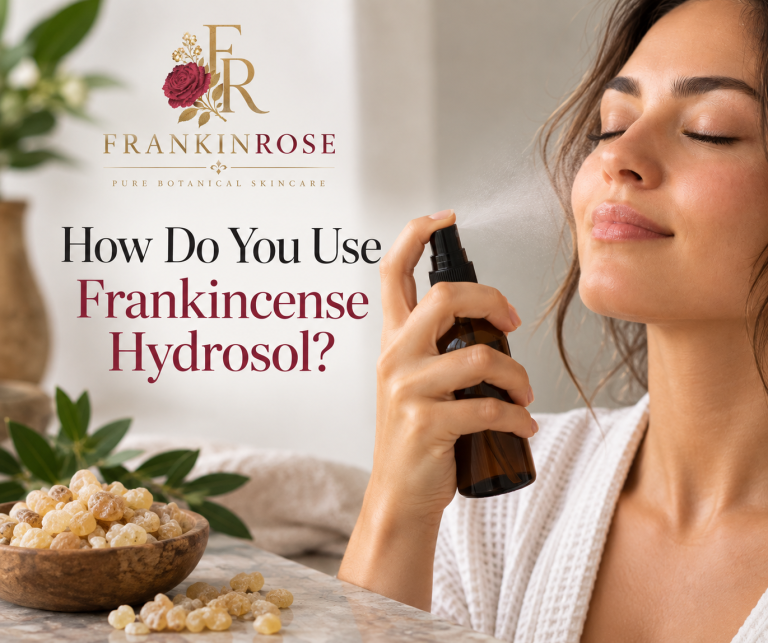
- Apply rose or frankincense hydrosol if desired.
- Apply a water-based moisturizer or serum when needed.
- Press a few drops of botanical facial oil over the skin.
- Use broad-spectrum sunscreen during daytime hours.
This provides a practical way to enjoy botanical skincare while retaining essential elements of responsible skin care.
Natural vs. Synthetic Fragrance in Skincare
Fragrance deserves special attention because both natural and synthetic aromatic materials can cause sensitivity in some individuals.
Natural fragrance can come from essential oils, botanical extracts, or aromatic compounds naturally present in plant ingredients.
Synthetic fragrance materials are manufactured to produce specific aromatic characteristics.
Neither category is automatically non-irritating.
Someone with fragrance-sensitive skin may react to a natural essential oil just as another individual might react to a synthetic fragrance component.
For highly reactive skin, a simpler formula with fewer aromatic ingredients may be preferable regardless of whether those ingredients are natural or synthetic.
Are Natural Skincare Ingredients Better for Sensitive Skin?
Not necessarily.
Sensitive skin does not recognize marketing categories.
It responds to individual substances, concentrations, combinations, and environmental factors.
A minimal botanical formula may work beautifully for one person and irritate another. Similarly, a carefully formulated product containing synthetic ingredients may be exceptionally well tolerated.
People with sensitive skin should prioritize simple formulations, appropriate patch testing, careful introduction of new products, and attention to personal reactions.
Can Natural and Synthetic Ingredients Be Used Together?
Yes.
Many modern skincare products combine natural, naturally derived, and synthetic ingredients.
A formula might contain botanical oils alongside synthetic stabilizers, emulsifiers, humectants, preservatives, or active ingredients.
There is no requirement that skincare must belong exclusively to one category.
Formulation is ultimately about creating a product with the intended texture, stability, sensory profile, and cosmetic function.
How FrankinRose Approaches Botanical Skincare
At FrankinRose, our interest in skincare begins with botanicals.
We appreciate ingredients with recognizable origins and distinctive sensory characteristics, including frankincense, rose, myrrh, jojoba, prickly pear seed, coffee, carrot seed, and castor oil.
We are particularly drawn to straightforward products such as botanical facial oils and hydrosols because they allow individual ingredients to remain central to the skincare experience.
Our approach is not based on portraying every synthetic ingredient as harmful.
Instead, we believe consumers should be able to understand what they are applying to their skin and make choices consistent with their own preferences.
For some people, that means choosing a minimalist botanical routine.
For others, it means combining botanical products with conventional dermatological skincare.
These approaches do not need to be mutually exclusive.
Frequently Asked Questions About Natural and Synthetic Skincare
Are Natural Skincare Ingredients Chemical-Free?
No. Everything is composed of chemicals, including plants, botanical oils, hydrosols, water, and the human body. “Chemical-free skincare” is therefore not a scientifically meaningful description.
Are Synthetic Skincare Ingredients Bad for Your Skin?
Not inherently. Ingredient safety depends on the specific substance, concentration, formulation, and conditions of use, not simply whether the ingredient is synthetic.
Is Botanical Skincare the Same as Natural Skincare?
Botanical skincare specifically emphasizes ingredients obtained or derived from plants. “Natural skincare” is a broader marketing term that may include plant, mineral, and other naturally sourced materials.
Are Essential Oils Natural?
Essential oils are concentrated aromatic materials obtained from botanical sources, commonly through distillation or expression. Although natural, they can still irritate skin and should be used at appropriate concentrations.
Are Hydrosols the Same as Essential Oils?
No. Hydrosols are primarily water-based distillation products, while essential oils are concentrated mixtures of volatile oil-soluble aromatic compounds.
Can I Use Botanical Oils Every Day?
Many botanical facial oils can be incorporated into daily skincare when they are appropriate for the individual’s skin and used according to product directions.
Is Handmade Skincare Better Than Commercial Skincare?
Neither category is automatically superior. Ingredient quality, formulation, sanitation, packaging, stability, storage, and appropriate use matter regardless of the size of the company producing the product.
Choosing Between Natural and Synthetic Skincare Ingredients
Choosing skincare does not have to become a contest between nature and science.
People who appreciate botanical products can select formulas containing plant oils, botanical waters, hydrosols, and resin-derived ingredients while still recognizing that synthetic ingredients have legitimate roles in modern cosmetic science.
The most useful approach is to look beyond broad claims.
Read the ingredient list.
Understand the type of product.
Consider whether it contains water.
Follow storage instructions.
Use essential oils and aromatic ingredients appropriately.
Pay attention to how your skin responds.
And remember that natural does not automatically mean safe, while synthetic does not automatically mean harmful.
Final Answer: Natural vs. Synthetic Skincare Ingredients
The fundamental difference between natural and synthetic skincare ingredients is their source and method of production.
Natural skincare ingredients originate from naturally occurring materials such as plants, seeds, flowers, fruits, minerals, and botanical resins. Synthetic ingredients are manufactured through controlled chemical processes to provide specific characteristics or functions within cosmetic products. Naturally derived ingredients occupy a broad middle ground, beginning with natural raw materials before undergoing additional processing or transformation.
Neither category alone determines quality.
At FrankinRose, we choose to celebrate botanical skincare because we value the character and simplicity of ingredients such as frankincense, rose, myrrh, jojoba, castor oil, prickly pear seed oil, coffee oil, carrot seed oil, and botanical hydrosols.
The goal is not to create fear around unfamiliar ingredients. It is to encourage a more informed relationship with skincare—one where consumers understand the products they use, recognize the differences between botanical and synthetic ingredients, and select formulas that genuinely fit their skin and personal preferences.
Natural skincare can be simple, beautiful, and deeply connected to botanical traditions. Good skincare, however, begins with thoughtful formulation, appropriate use, and accurate information—not merely the words printed on the front of a bottle.