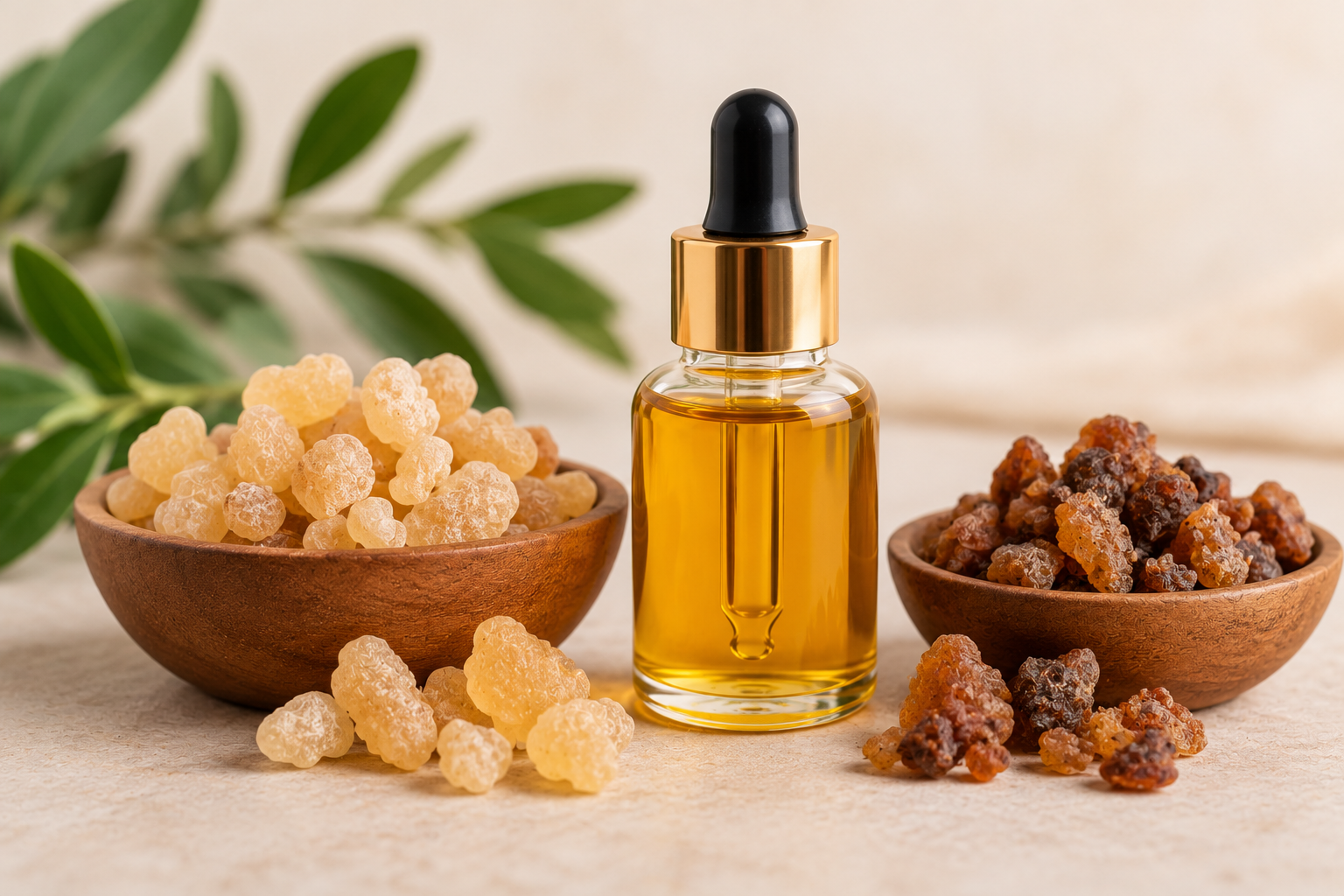
Frankincense and myrrh facial oil can help condition, soften, and moisturize the skin while supporting a smoother, more supple appearance. When these traditional botanical resins are incorporated into a carefully formulated facial oil with emollient carrier oils such as jojoba and castor oil, the finished product can provide a rich yet simple skincare step particularly suited to dry, mature-looking, or moisture-depleted skin.
At FrankinRose, we appreciate botanical skincare that combines time-honored ingredients with straightforward formulations. Frankincense and myrrh have been valued for centuries as aromatic resins, while plant-derived carrier oils provide the emollient foundation necessary for a practical leave-on facial product.
Rather than relying on exaggerated promises, we focus on what a well-formulated facial oil can realistically provide: skin conditioning, moisture retention, softness, improved suppleness, and a smoother-looking surface.
Featured Answer: What Are the Benefits of Frankincense and Myrrh Facial Oil?
Frankincense and myrrh facial oil helps moisturize and condition the skin, reduce the feeling of dryness, soften rough areas, and support a smoother, more supple appearance. When combined with carrier oils such as jojoba and castor oil, frankincense and myrrh can be incorporated into a nourishing oil-based skincare routine for the face and neck. Facial oils are especially useful for helping reduce moisture loss after cleansing or after applying a water-based skincare product.
The exact benefits depend on the complete formulation, including the type of frankincense and myrrh ingredients used, the carrier oils, ingredient concentrations, and the individual’s skin.
What Is Frankincense and Myrrh Facial Oil?
Frankincense and myrrh facial oil is an oil-based skincare product formulated with ingredients derived from frankincense and myrrh resins along with one or more carrier oils.
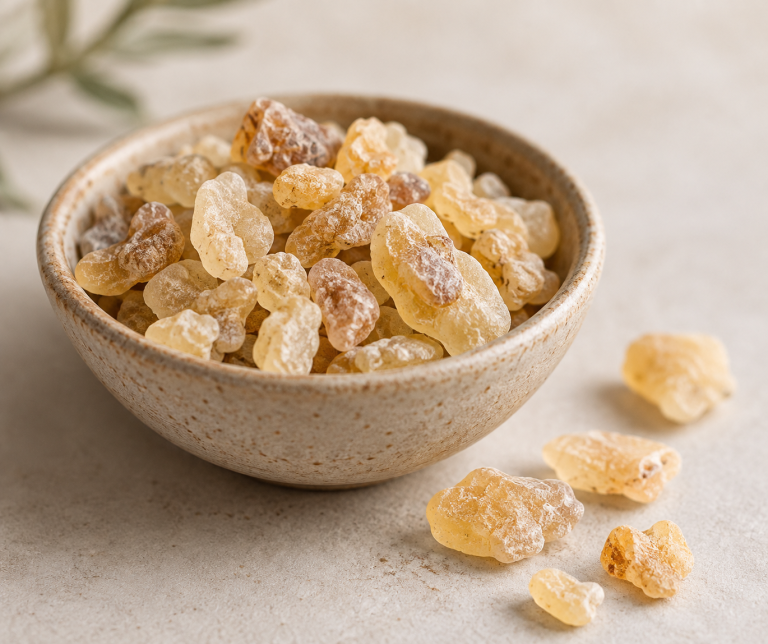
Frankincense comes from trees belonging to the Boswellia genus. Myrrh is an aromatic resin traditionally obtained from trees in the Commiphora genus. Both have extraordinarily long histories of use in aromatic preparations, personal care, incense, and traditional practices.
A modern facial oil makes these botanicals easier to incorporate into a daily skincare routine.
The precise product composition matters. “Frankincense oil” can refer to an essential oil, infused carrier oil, extract, or finished cosmetic blend. The same distinction applies to myrrh.
These forms should not automatically be treated as interchangeable.
What Does Frankincense and Myrrh Facial Oil Do for Your Skin?
A properly formulated facial oil primarily acts as an emollient skincare treatment.
Emollients fill spaces between surface skin cells and create a softer, smoother skin feel. Oil-based products can also help reduce the rate at which moisture evaporates from the skin.
This makes facial oils particularly useful when the skin feels:
- Dry
- Tight after cleansing
- Rough
- Flaky
- Dull
- Weather-exposed
- Less supple
- In need of additional conditioning
A facial oil does not need to make aggressive medical or anti-aging claims to be useful. Improving skin softness and moisture retention can produce a noticeable cosmetic improvement in how the skin looks and feels.
Benefits of Frankincense and Myrrh Facial Oil for Dry Skin
Dry skin is one of the most natural applications for a rich botanical facial oil.
Skin contains its own lipids that help maintain its protective barrier. Cleansing, dry weather, indoor heating, low humidity, sun exposure, and other environmental factors can contribute to a tight or rough skin feel.
An oil-based product can provide an additional emollient layer over the skin.
For especially dry skin, we recommend thinking about facial oil as a moisture-sealing step, rather than treating oil and water as the same thing.
Oil does not directly provide water-based hydration.
Instead, an effective routine may involve applying a water-based product first and following it with facial oil.
A simple routine can look like:
Cleanse → apply hydrosol or water-based moisturizer → apply facial oil
This allows the facial oil to help reduce moisture loss while conditioning the surface.
Frankincense and Myrrh Facial Oil for Mature-Looking Skin
Mature-looking skin can become increasingly prone to dryness, reduced suppleness, and a more noticeable appearance of fine surface lines.
A nourishing facial oil can help by softening and conditioning dry skin.
When the skin is adequately moisturized, its surface often appears smoother and more supple. Fine lines caused or emphasized by dehydration can also appear less pronounced when the skin is properly conditioned.
This should be distinguished from claims that a facial oil permanently eliminates wrinkles or reverses aging.
No cosmetic facial oil can stop the natural aging process.
However, a thoughtfully formulated oil can be an excellent component of a mature-skin routine because it helps address one of the most common concerns associated with mature skin: loss of moisture and increased dryness.
Why Frankincense Is Popular in Facial Skincare
Frankincense has become a familiar ingredient in botanical facial products because of its traditional use, distinctive aroma, and compatibility with many oil-based formulations.
The aromatic resin has been valued for thousands of years, making it one of the world’s best-known traditional botanical materials.
In modern facial oils, frankincense can contribute to the sensory character of a formulation while being paired with carrier oils that provide direct emollient benefits.
The exact properties of the finished product depend heavily on whether the formula uses frankincense essential oil, an infusion, an extract, or another frankincense-derived ingredient.
At FrankinRose, we believe that distinction matters. The word “frankincense” alone does not describe an entire formulation.
What Are the Skincare Benefits of Myrrh?
Myrrh is another resin with a long history in aromatic and personal-care preparations.
Its deep, warm, earthy character pairs naturally with frankincense, which is one reason the two ingredients are so frequently associated.
In an oil-based cosmetic product, myrrh becomes part of a broader formulation designed to condition the skin.
Rather than attributing every benefit of the finished product to one botanical, it is more accurate to consider the complete formula. The carrier oils provide much of the emollient and moisture-retaining action, while the frankincense and myrrh ingredients contribute their own botanical and sensory characteristics.
Benefits of Jojoba Oil in Frankincense and Myrrh Facial Oil
Jojoba is particularly well suited to facial products.
Although commonly called jojoba oil, it is composed largely of liquid wax esters. This gives jojoba a distinctive texture and excellent usefulness as an emollient.
Jojoba can help:
- Soften dry skin
- Improve skin smoothness
- Reduce a tight skin feel
- Provide lightweight conditioning
- Improve the spreadability of a facial oil
- Help reduce moisture loss
Jojoba also balances heavier carrier oils particularly well.
When used alongside a thicker oil such as castor oil, jojoba can help create a facial oil that feels rich without being unnecessarily difficult to spread.
Benefits of Castor Oil in a Frankincense and Myrrh Facial Oil
Castor oil has a substantially richer texture than jojoba.
It is thick, glossy, and highly emollient, making it useful in formulas intended to provide a more substantial conditioning layer.
In facial oil, castor oil can contribute:
- Rich emollience
- A smooth application
- Increased viscosity
- A protective skin feel
- Conditioning for very dry areas
Because pure castor oil can feel heavy to some people, combining it with jojoba can create a more balanced texture.
This combination allows us to benefit from the richness of castor oil while maintaining the smoother spreadability associated with jojoba.
Why Frankincense, Myrrh, Jojoba, and Castor Oil Work Well Together
Each ingredient contributes something different to the overall formulation.
Jojoba oil provides lightweight conditioning and smooth spreadability.
Castor oil adds richness and a more substantial emollient feel.
Frankincense provides the traditional botanical and aromatic character associated with Boswellia resin.
Myrrh complements frankincense with its distinctive resinous profile.
Together, these ingredients can create a simple oil-based skincare product designed to soften, condition, and support moisture retention without requiring an unnecessarily long ingredient list.
Can Frankincense and Myrrh Facial Oil Help With Fine Lines?
Facial oil can help improve the appearance of dry, dehydrated-looking skin, which may make fine surface lines appear softer.
This is primarily a moisturizing and conditioning effect.
Dry skin tends to make texture and fine lines more noticeable. When an emollient facial oil softens the surface and helps maintain moisture, the skin can look smoother and more supple.
We prefer this realistic explanation over claims that frankincense or myrrh “erases wrinkles.”
For long-term skin appearance, facial oil should be combined with a broader routine that includes daily sun protection, gentle cleansing, adequate moisturization, and appropriate evidence-based skincare ingredients according to individual needs.
Does Frankincense and Myrrh Facial Oil Hydrate the Skin?
The terms hydrating and moisturizing are frequently used interchangeably, but there is an important distinction.
Water-based ingredients provide hydration.
Oils primarily provide emollience and help reduce moisture loss.
This is why facial oil can work especially well when applied to slightly damp skin or layered over a hydrosol, serum, or moisturizer.
Instead of expecting facial oil to supply water, we use it to help maintain the moisture already present in the skin.
How to Use Frankincense and Myrrh Facial Oil
Facial oil is highly concentrated in the sense that it contains little or no water, so a large quantity is usually unnecessary.
For most facial routines, begin with a small amount.
After cleansing:
- Gently cleanse the face and neck.
- Leave the skin slightly damp or apply a water-based skincare product.
- Place a few drops of facial oil onto clean fingertips.
- Gently spread the oil over the face and neck.
- Press or massage it into the skin using light movements.
- Allow the product to absorb before applying additional products as needed.
More oil is not necessarily better.
Using enough to lightly condition the skin is usually preferable to coating the face in a thick layer.
Should Frankincense and Myrrh Facial Oil Be Used on Damp Skin?
Applying facial oil to slightly damp skin can be particularly effective.
The water provides hydration while the oil creates an emollient layer that helps slow moisture loss.
At FrankinRose, we particularly like the concept of pairing a botanical hydrosol with a facial oil.
For example:
Cleanse → apply hydrosol → follow with facial oil
The hydrosol provides a lightweight water-based step while the oil provides the richer finishing layer.
Can You Use Frankincense and Myrrh Facial Oil Every Day?
A properly formulated leave-on facial oil may be used daily when it agrees with the individual’s skin.
Some people prefer it once daily at night. Others use a small amount in both their morning and evening routines.
Frequency should depend on skin type, climate, season, and personal preference.
Dry skin may appreciate daily use, while oily or combination skin may require only a very small amount or less frequent application.
The skin’s response should guide the routine.
Is Frankincense and Myrrh Facial Oil Good for Oily Skin?
Oily skin can still benefit from appropriate emollients, but the quantity and formulation matter.
A jojoba-containing facial oil may feel more comfortable than an extremely heavy oil blend for some people.
Start with a very small amount—sometimes one or two drops is sufficient.
People who are acne-prone should introduce any new leave-on oil gradually and monitor for increased congestion, irritation, or breakouts.
If a product consistently causes problems, discontinue use.
Is Frankincense and Myrrh Facial Oil Good for Sensitive Skin?
Sensitive skin requires additional caution.
Botanical does not automatically mean non-irritating. Essential oils, fragrances, and plant-derived ingredients can cause reactions in susceptible individuals.
Before applying a new facial oil broadly, a patch test can help identify obvious sensitivity.
Discontinue use if the product causes:
- Persistent redness
- Burning
- Itching
- Swelling
- Rash
- Significant irritation
Anyone with an existing skin condition or known botanical allergies should discuss new products with an appropriate healthcare professional when needed.
Can Frankincense and Myrrh Facial Oil Be Used Around the Eyes?
The eye area is delicate, and products containing aromatic botanical ingredients should be kept out of the eyes.
Do not apply facial oil directly into the eyes or along the immediate lash line.
If using a facial oil around the orbital area, apply a very small amount and avoid allowing the product to migrate into the eyes.
If irritation or watering occurs, discontinue application around the eye area.
Can You Use Frankincense and Myrrh Facial Oil at Night?
Nighttime is an excellent time to incorporate a nourishing facial oil into a skincare routine.
After cleansing, a water-based moisturizer, serum, or hydrosol can be applied first, followed by facial oil.
A simple evening routine may be:
Gentle cleanser → hydrosol or moisturizer → Frankincense & Myrrh Facial Oil
The oil remains on the skin as an emollient layer overnight.
Can You Use Frankincense and Myrrh Facial Oil During the Day?
Yes, depending on the finished formulation and individual preference.
Only a small quantity may be necessary during daytime use.
Facial oil should not replace sunscreen. When used during the day, an appropriate broad-spectrum sunscreen should remain part of the skincare routine.
Sun protection is particularly important for anyone concerned about premature visible skin aging, uneven pigmentation, or maintaining a smoother-looking complexion.
Does Frankincense and Myrrh Facial Oil Clog Pores?
There is no universal answer because skin responds differently to individual oils and formulations.
A product that works beautifully for one person may feel too rich for another.
Factors include:
- Skin type
- Amount applied
- Complete formulation
- Other skincare products being used
- Individual sensitivity
- Frequency of application
People prone to clogged pores should start with a very small amount and introduce the product gradually.
How Much Facial Oil Should You Use?
A common mistake with facial oils is using too much.
Begin with approximately two or three drops for the face, adjusting as needed based on the product and skin type.
The goal is to create a light, comfortable layer.
If the face remains excessively oily for a long period, reducing the amount may produce a more pleasant result.
Very dry areas can receive an additional drop rather than applying excessive oil everywhere.
How Should Frankincense and Myrrh Facial Oil Be Stored?
Oil-based skincare should generally be stored in a cool, dry place away from direct sunlight and excessive heat.
Close the bottle securely after use and avoid introducing water into the container.
An amber glass bottle can also help reduce unnecessary light exposure.
Check the product periodically for unexpected changes in:
- Aroma
- Color
- Texture
- Clarity
- Packaging condition
Follow the storage and use recommendations provided with the specific finished product.
Does Facial Oil Need Preservatives?
A truly water-free facial oil has different preservation requirements from a water-based cosmetic.
Microorganisms require available water to proliferate, so an anhydrous oil blend generally presents a different microbial risk than a hydrosol, lotion, or water-based serum.
However, an oil product still requires good manufacturing and handling practices.
Water should not be introduced into the container, and packaging should remain clean.
Vitamin E may be included in oil formulations as an antioxidant, helping protect oils against oxidation, but vitamin E should not be confused with a broad-spectrum antimicrobial preservative.
Frankincense and Myrrh Facial Oil vs. Moisturizer
Facial oil and moisturizer do not necessarily need to compete.
They can complement each other.
A conventional moisturizer usually contains water plus humectants, emollients, and other ingredients. Facial oil contains oil-soluble ingredients and provides an emollient finishing layer.
For dry or mature-looking skin, layering can be particularly useful:
Moisturizer first → facial oil second
The moisturizer supplies water-based hydration, while the oil helps condition the skin and reduce moisture loss.
Frankincense and Myrrh Facial Oil vs. Frankincense Hydrosol
These are two very different skincare products.
A frankincense hydrosol is water-based and lightweight.
A frankincense and myrrh facial oil is oil-based and emollient.
They can therefore serve complementary purposes.
Hydrosol can be used first as a refreshing water-based step, followed by facial oil as the conditioning layer.
Because water and oil naturally separate, they should not simply be poured together into a bottle unless the product has been properly formulated with appropriate emulsification and preservation.
Frequently Asked Questions About Frankincense and Myrrh Facial Oil
What Is Frankincense and Myrrh Facial Oil Good For?
It is particularly useful for conditioning dry skin, improving softness, supporting moisture retention, and promoting a smoother, more supple appearance.
Can I Use Frankincense and Myrrh Oil on My Face Every Night?
A properly formulated facial product can be used nightly if your skin tolerates it well. Start with a small amount and adjust frequency according to your skin.
Is Frankincense and Myrrh Oil Good for Mature Skin?
It can be a useful addition to a mature-skin routine because emollient oils help address dryness and support a softer, smoother-looking surface.
Does Frankincense and Myrrh Oil Remove Wrinkles?
Facial oil does not permanently remove wrinkles. By moisturizing and conditioning dry skin, however, it can help the surface look smoother and more supple, which may soften the appearance of dryness-related fine lines.
Should Facial Oil Go Before or After Moisturizer?
Facial oil is generally used after water-based products and moisturizers as a finishing emollient layer.
Can I Use Frankincense and Myrrh Facial Oil With a Hydrosol?
Yes. Apply the hydrosol first and follow with the facial oil.
How Many Drops of Facial Oil Should I Use?
Start with approximately two or three drops and adjust according to your skin and the specific formulation. Oily or combination skin may require less, while very dry skin may prefer slightly more.
FrankinRose Frankincense & Myrrh Facial Oil
At FrankinRose, we favor botanical skincare that respects the character of traditional plant ingredients while keeping modern skincare practical.
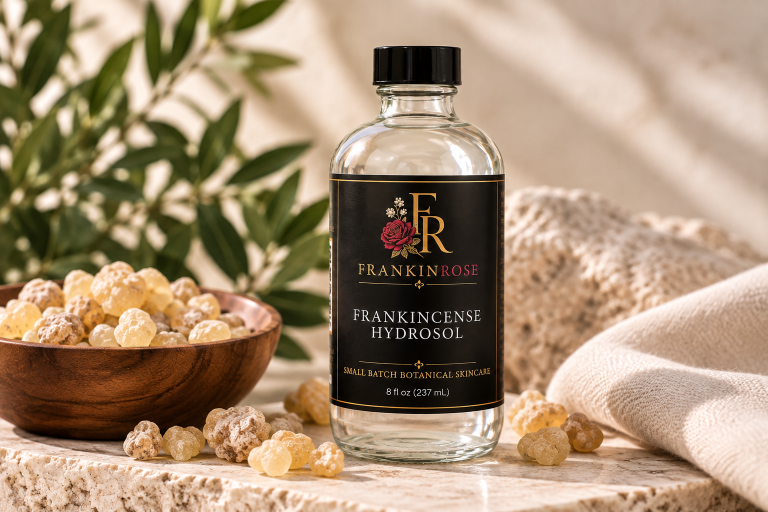
Our approach to a Frankincense & Myrrh Facial Oil centers on a carefully balanced oil-based formula featuring frankincense, myrrh, jojoba oil, and castor oil, with each component serving a purpose within the finished product.
Jojoba contributes lightweight conditioning and smooth application.
Castor oil contributes richness and a substantial emollient feel.
Frankincense and myrrh bring together two of the world’s most historically significant aromatic resins in a simple botanical facial oil.
Used after cleansing, after a hydrosol, or over a moisturizer, this type of facial oil can provide the final conditioning step in a minimalist skincare routine.
The Benefits of Adding Frankincense and Myrrh Facial Oil to Your Routine
The greatest advantage of a well-formulated frankincense and myrrh facial oil is not complexity—it is simplicity.
A few drops can transform the final step of a skincare routine by providing concentrated emollient conditioning without requiring a long list of unnecessary ingredients.
For dry, mature-looking, or moisture-depleted skin, a frankincense and myrrh facial oil can help:
- Soften and condition the skin
- Reduce the feeling of dryness and tightness
- Support moisture retention
- Improve skin suppleness
- Create a smoother-looking surface
- Provide a rich nighttime conditioning treatment
- Complement hydrosols and water-based moisturizers
- Bring frankincense and myrrh into a simple botanical skincare routine
At FrankinRose, we believe the best botanical skincare begins with understanding what each ingredient contributes. Frankincense and myrrh provide the traditional botanical foundation, while jojoba and castor oil create the emollient base that makes the formula practical for everyday skincare.
For anyone asking, “What are the benefits of frankincense and myrrh facial oil?”, the answer is straightforward: a properly formulated facial oil can provide deep-feeling conditioning, improved softness, reduced moisture loss, and a smoother, more supple appearance, making it an excellent finishing step for a simple botanical skincare routine.