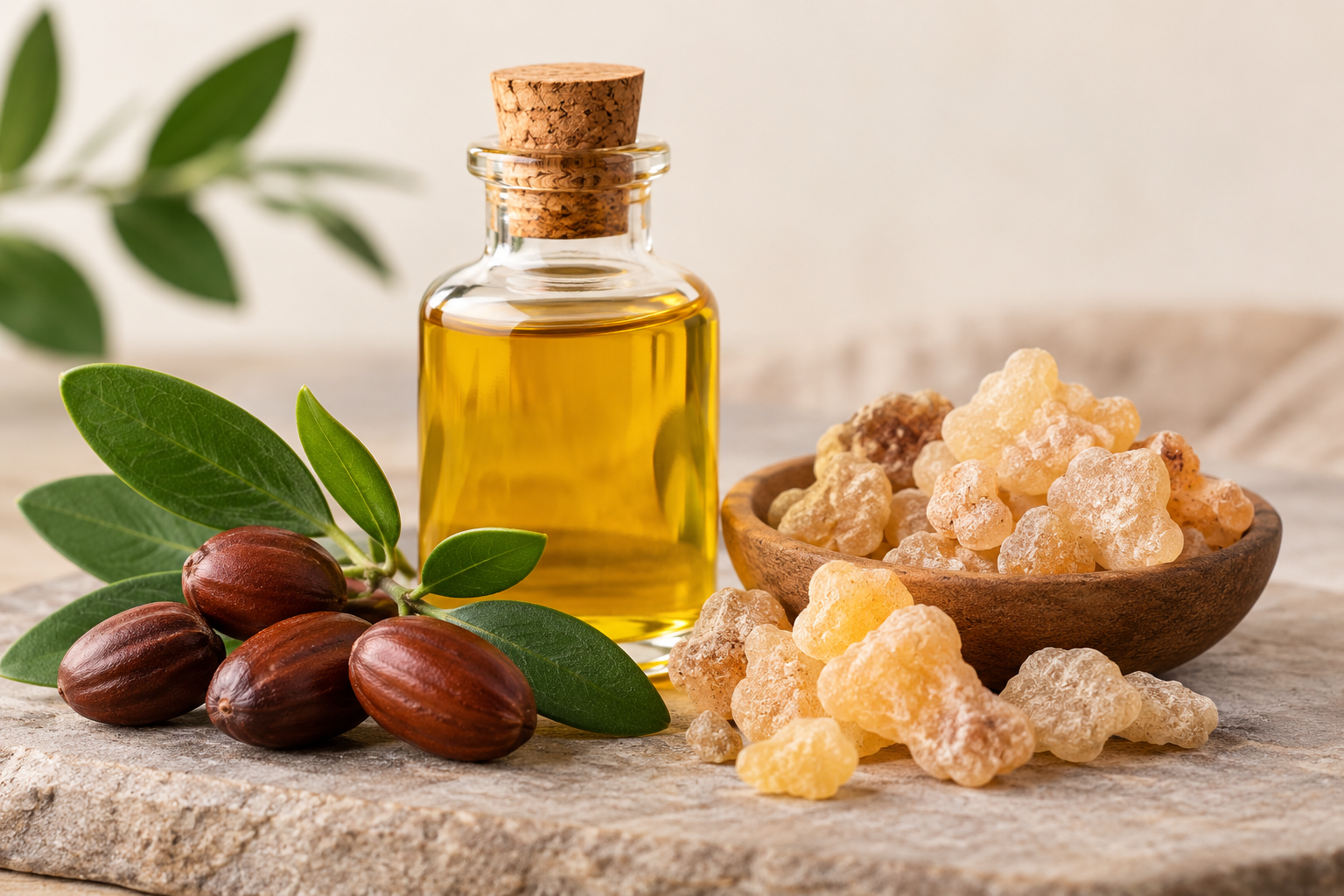
Jojoba oil and frankincense can be an excellent combination for facial and body skincare. Jojoba provides lightweight conditioning and helps reduce moisture loss, while frankincense can be incorporated into an oil-based skincare routine for its aromatic and cosmetic qualities. When frankincense essential oil is used, it should be properly diluted in a carrier such as jojoba oil before being applied to the skin.
At FrankinRose, we appreciate simple botanical skincare formulas built around carefully selected ingredients. Jojoba is particularly useful in facial oils because it spreads easily, has a relatively light skin feel, and works well as a carrier for oil-soluble botanical ingredients.
Understanding how jojoba and frankincense work together—and recognizing the important differences between frankincense essential oil, infused oil, resin, and hydrosol—makes it easier to choose an appropriate formulation and use it correctly.
Featured Answer: Is Jojoba Oil Good With Frankincense?
Yes. Jojoba oil pairs well with frankincense in skincare. Jojoba acts as an emollient that softens and conditions the skin while helping reduce moisture loss. It can also serve as a carrier for properly diluted frankincense essential oil. The combination is especially well suited to facial oils, massage oils, and simple oil-based skincare routines.
Frankincense essential oil should not be applied undiluted simply because it is natural. When essential oil is part of a leave-on facial product, careful dilution is important.
Why Jojoba Oil and Frankincense Work Well Together
Jojoba and frankincense perform different roles in a skincare formula.
Jojoba is commonly called an oil, although chemically it consists largely of liquid wax esters. Its composition contributes to its characteristic slip, stability, and lightweight feel.
Frankincense can refer to several different ingredients. In skincare, the term may describe frankincense essential oil, frankincense-infused carrier oil, frankincense resin extracts, or frankincense hydrosol. These materials are not interchangeable.
When jojoba is combined with an appropriate oil-soluble frankincense ingredient, the result can be a simple facial oil that spreads smoothly and leaves the skin conditioned without requiring a complicated formulation.
What Does Jojoba Oil Do for the Skin?
Jojoba is valued primarily for its emollient properties.
An emollient helps soften and smooth the skin. Applied after cleansing, jojoba can create a light conditioning layer that helps reduce the loss of moisture from the skin’s surface.
This makes jojoba particularly useful when skin feels:
- Dry
- Tight
- Rough
- Flaky
- Weather-exposed
- In need of additional conditioning
Jojoba’s texture also makes it convenient for facial application. Only a small quantity is generally needed to spread across the face and neck.
Rather than thinking of facial oil as adding water to the skin, it is more accurate to view jojoba as helping condition the skin and support moisture retention. Applying it to slightly damp skin or after a water-based product can be especially useful because the oil helps create an emollient layer over existing moisture.
What Does Frankincense Do in a Facial Oil?
Frankincense has a long history of aromatic and cosmetic use.
In modern skincare, frankincense is frequently included in facial oils, serums, balms, and other botanical formulations. Its warm, resinous aroma also makes it appealing in products designed to turn an everyday skincare routine into a more sensory experience.
It is important, however, to distinguish cosmetic use from medical claims. A frankincense facial oil should not be treated as a cure for skin diseases or as a replacement for medical treatment.
At FrankinRose, we prefer a straightforward approach: botanical ingredients should be described according to their appropriate cosmetic purpose without turning traditional ingredients into unrealistic promises.
Jojoba Oil as a Carrier for Frankincense Essential Oil
One of the most common ways to combine jojoba and frankincense is to use jojoba as the carrier oil for frankincense essential oil.
Essential oils are highly concentrated aromatic materials. They should not automatically be applied directly to facial skin at full strength.
Dilution distributes a small quantity of essential oil throughout a much larger quantity of carrier oil.
Jojoba works well for this purpose because it:
- Spreads easily
- Has a lightweight texture
- Conditions the skin
- Works well in leave-on oil formulations
- Has relatively good oxidative stability
- Does not require a complex water-based formulation
For facial products, conservative essential-oil concentrations are generally preferable to aggressive formulas containing large amounts of fragrance-producing essential oils.
More frankincense does not automatically mean a better facial oil.
Frankincense Essential Oil vs. Frankincense-Infused Jojoba Oil
These two products may sound similar, but they are not the same.
Frankincense Essential Oil in Jojoba
This type of product contains distilled frankincense essential oil diluted into jojoba or another carrier.
Essential oil is concentrated and strongly aromatic, so its percentage in the finished product matters.
Frankincense-Infused Jojoba Oil
An infused oil is produced by allowing suitable botanical material to infuse into a carrier oil using an appropriate formulation process.
An infusion is not equivalent to essential oil and should not automatically be assigned the same properties or usage rates.
Consumers should therefore read ingredient lists rather than relying only on the words “frankincense oil.”
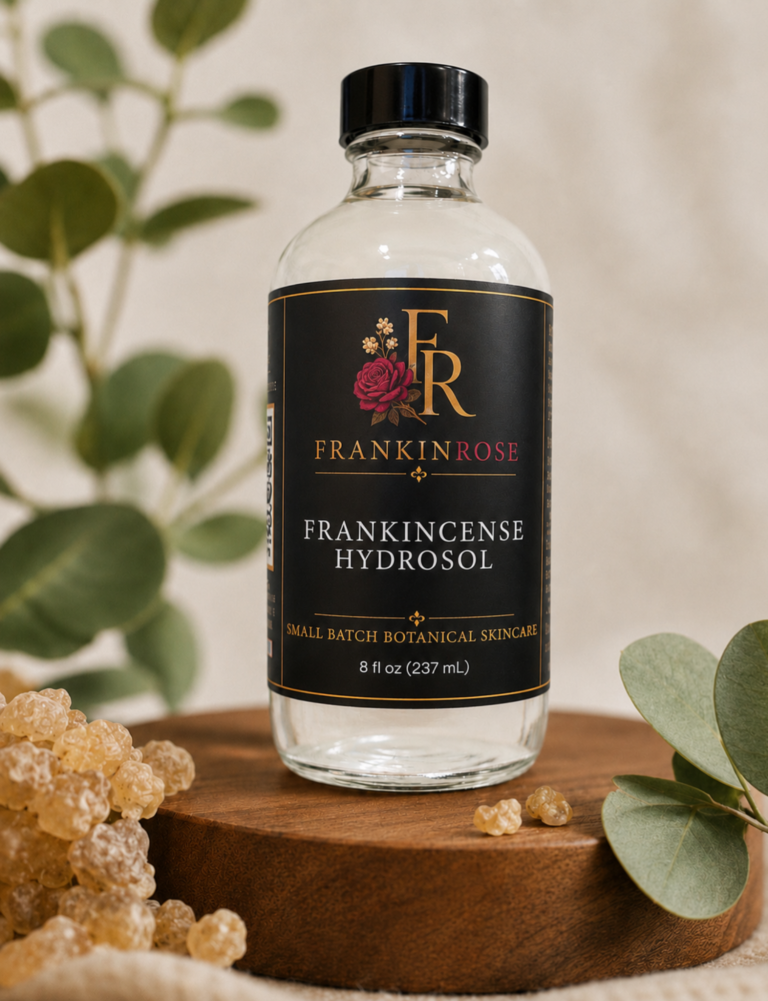
Frankincense Hydrosol Is Different From Frankincense Oil
Another important distinction involves frankincense hydrosol.
Hydrosol is a water-based aromatic distillate. Jojoba is oil-based.
Because water and oil naturally separate, pouring frankincense hydrosol directly into jojoba does not create a permanently blended facial product.
A stable product containing both a water phase and an oil phase generally requires appropriate formulation considerations, which can include:
- Emulsification
- Preservation
- Ingredient compatibility
- pH
- Manufacturing procedures
- Microbial control
- Stability testing
For a simple home skincare routine, it is often easier to use the two products sequentially rather than attempting to mix them in one bottle.
For example, a hydrosol can be applied first as the water-based step, followed by a few drops of jojoba-based facial oil.
How to Use Jojoba Oil and Frankincense on the Face
A simple facial routine does not require a large amount of oil.
After cleansing:
- Leave the skin slightly damp or apply an appropriate water-based skincare product.
- Dispense a small amount of the properly formulated jojoba and frankincense facial oil.
- Gently spread it across the face and neck.
- Massage lightly until the product is evenly distributed.
- Allow the oil to absorb before applying additional products as appropriate.
A few drops may be sufficient for many people.
Using excessive oil can leave the skin feeling greasy without necessarily providing additional benefit.
Can You Use Jojoba and Frankincense Every Day?
A properly formulated jojoba and frankincense product may be suitable for regular use for many people, depending on individual skin tolerance and the specific frankincense ingredient and concentration.
Frequency can be adjusted according to how the skin responds.
Some people may prefer facial oil:
- Once daily
- At night
- During dry weather
- After showering
- Whenever skin feels dry or tight
People with sensitive or reactive skin should be particularly cautious with fragranced ingredients and essential oils.
A patch test is a sensible precaution before applying a new leave-on product extensively.
Discontinue use if persistent redness, burning, itching, swelling, or other irritation develops.
Is Jojoba Oil Good for Dry Skin?
Jojoba can be particularly useful for dry-feeling skin because its emollient properties help soften the surface and reduce moisture loss.
For very dry skin, jojoba may work best when applied after a water-containing product rather than being used as the only skincare step.
A practical routine might consist of:
Cleanse → hydrosol or water-based moisturizer → jojoba-based facial oil
This layers water-based hydration with an emollient oil step.
Is Jojoba Oil Good for Oily Skin?
Having oily skin does not necessarily mean that every facial oil must be avoided.
Jojoba has a relatively lightweight texture, and some people with oily or combination skin enjoy using it in small amounts. However, individual responses vary significantly.
The appropriate amount is important. Someone with oily skin may need only one or two drops, while someone with dry skin may prefer slightly more.
People who are acne-prone should introduce any new leave-on product gradually and monitor their skin for congestion or irritation.
Can Jojoba Oil and Frankincense Help Mature-Looking Skin?
Jojoba can improve the feel and appearance of dry, rough skin by conditioning the surface and helping it retain moisture.
Well-moisturized skin often appears smoother and more supple than dry skin.
Frankincense is frequently incorporated into botanical skincare marketed toward mature-looking skin, but cosmetic language should remain realistic. Neither jojoba nor frankincense should be presented as permanently removing wrinkles or reversing the biological aging process.
A good mature-skin routine also includes measures with substantial practical value, particularly daily sun protection, gentle cleansing, adequate moisturization, and avoiding unnecessary irritation.
Can Jojoba and Frankincense Be Used Around the Eyes?
The eye area requires extra caution.
Essential oils and fragranced products can cause irritation if they migrate into the eyes. A product containing frankincense essential oil should therefore not be placed directly in the eyes or too close to the lash line.
When using any facial oil around the orbital area, use a very small amount and follow the directions provided with the finished product.
If a product causes stinging, burning, watering, or irritation, discontinue use around the eyes.
Should You Use Jojoba and Frankincense in the Morning or at Night?
Jojoba-based facial oils can be incorporated into either morning or evening skincare routines depending on the finished formulation and individual preference.
Many people prefer facial oils at night because they can apply the product after cleansing and leave it on while sleeping.
A basic nighttime routine may look like:
Cleanser → hydrosol or water-based skincare → facial oil
During the day, facial oil should not replace appropriate broad-spectrum sunscreen.
Can Jojoba Oil Be Combined With Frankincense and Myrrh?
Jojoba can also be used as a carrier in formulations containing frankincense and myrrh.
Frankincense and myrrh have historically been valued as aromatic resins and continue to be used in botanical and personal-care products.
As with frankincense alone, the form of each ingredient matters. Essential oils, extracts, infused oils, resins, and hydrosols have different characteristics and cannot automatically be substituted for one another.
At FrankinRose, we appreciate the simplicity of pairing traditional botanical ingredients with carefully chosen carrier oils rather than unnecessarily complicated ingredient lists.
Jojoba Oil vs. Castor Oil With Frankincense
Both jojoba and castor oil can be used in oil-based skincare, but they feel very different.
Jojoba oil is relatively light, fluid, and easy to spread.
Castor oil is considerably thicker and has a heavier, more occlusive skin feel.
Combining the two can create a texture that falls somewhere between them. Jojoba can reduce the heaviness of a castor-oil-rich formula, while castor oil can add body and richness.
The ideal combination depends on the desired texture and skin feel.
Jojoba Oil vs. Other Carrier Oils for Frankincense
Frankincense essential oil can be diluted in various suitable carrier oils. Jojoba is popular because of its texture and stability, but other carrier oils offer different characteristics.
For example:
Jojoba — lightweight, smooth, and relatively stable.
Castor oil — thick, rich, and highly emollient.
Prickly pear seed oil — lightweight and often used in premium facial oils.
Carrot seed carrier oil or properly formulated carrot-derived oils — can be incorporated into botanical skincare depending on the exact ingredient.
Choosing a carrier should be based on the finished product’s intended texture, ingredient composition, stability, and use.
Does Jojoba Oil Need a Preservative?
Pure jojoba and completely anhydrous oil blends generally present different microbial concerns from products containing water.
Traditional broad-spectrum preservation systems are primarily necessary for formulations containing water or water-based ingredients, where microorganisms have the conditions they need to grow.
However, that does not mean oil products can be handled carelessly.
Good manufacturing and storage practices still matter. Water should not be introduced into an oil product, containers should remain clean, and the formula should be protected from unnecessary contamination.
Antioxidants such as vitamin E may be used in some oil formulations to help manage oxidation, but vitamin E is not a broad-spectrum preservative.
That distinction is particularly important in handmade skincare.
How Should Jojoba and Frankincense Facial Oil Be Stored?
Oil-based skincare should generally be stored in a cool, dry location away from excessive heat and direct sunlight.
The cap or dropper should be closed securely after each use.
Avoid storing the bottle where it will repeatedly experience high temperatures, direct sunlight, or unnecessary moisture.
Watch for changes such as:
- Unusual odor
- Unexpected texture changes
- Significant color changes
- Contamination
- Damaged packaging
Follow the storage instructions and recommended period of use provided for the specific finished product.
Can You Mix Jojoba and Frankincense Yourself?
Jojoba can serve as a carrier for frankincense essential oil, but formulation should not be based on guesswork.
Essential oils are concentrated. Accurate measurement and conservative dilution are preferable to adding an arbitrary number of drops without considering the quantity of carrier oil, intended application, and essential oil specifications.
People who prefer the convenience of a finished facial product can choose a formula in which the botanical ingredients have already been incorporated at defined amounts.
Frequently Asked Questions About Jojoba Oil and Frankincense
Can I Mix Frankincense Essential Oil Directly Into Jojoba Oil?
Yes, jojoba can serve as a carrier for frankincense essential oil when the essential oil is appropriately diluted for the intended cosmetic use.
Can I Put Frankincense Essential Oil Directly on My Face?
Undiluted essential oil is generally not the preferred approach for facial skincare. A properly diluted finished formulation provides better control over the concentration applied to the skin.
Can I Use Jojoba Oil With Frankincense Hydrosol?
Yes, but they are best treated as separate skincare layers unless they are part of a professionally formulated emulsified product. Apply the water-based hydrosol first and follow with the jojoba-based oil.
Which Goes First, Frankincense Hydrosol or Jojoba Oil?
Use the water-based hydrosol first, followed by the oil-based product. The jojoba oil can then provide an emollient layer over the skin.
Can I Leave Jojoba and Frankincense on Overnight?
A properly formulated leave-on facial oil can generally be used as part of an overnight skincare routine when tolerated by the individual and used according to its directions.
Is Jojoba Oil the Same as an Essential Oil?
No. Jojoba is used as a carrier and emollient, whereas essential oils are concentrated aromatic substances derived from botanical materials.
Jojoba and Frankincense for a Simple Botanical Skincare Routine
The strength of the jojoba and frankincense pairing is its simplicity.
Jojoba provides a smooth, lightweight base that conditions the skin and helps reduce moisture loss. Frankincense contributes the distinctive botanical character that has made the resin an enduring ingredient in aromatic and personal-care traditions.
Used thoughtfully, the combination can fit easily into a minimalist skincare routine:
Cleanse → apply a water-based product if desired → apply a small amount of jojoba and frankincense facial oil → use appropriate sunscreen during daytime.
At FrankinRose, we believe botanical skincare is at its best when the ingredients and their purposes are clearly understood. Jojoba and frankincense complement one another particularly well in oil-based skincare, provided the frankincense ingredient is appropriate for the formulation and essential oils are used at suitable concentrations.
For anyone asking, “Is jojoba oil good with frankincense?”, the answer is yes: jojoba is one of the most practical carrier ingredients for incorporating frankincense into a simple facial oil, offering an elegant texture, emollient conditioning, and an easy way to include this traditional aromatic botanical in a modern skincare routine.