Featured Answer: How Should Frankincense Hydrosol Be Stored?
Frankincense hydrosol should be stored tightly closed in a clean container, protected from heat, direct sunlight, and unnecessary contamination. Refrigeration is an excellent storage choice, particularly after opening, because cooler temperatures can help maintain product quality. At FrankinRose, we recommend keeping frankincense hydrosol refrigerated when possible, using clean hands when handling the bottle, avoiding contact with the spray opening, and watching for noticeable changes in odor, color, clarity, or appearance. Always follow the storage directions and use-by guidance provided with the specific hydrosol, since shelf life varies according to formulation, processing, packaging, and preservation.
What Is Frankincense Hydrosol?
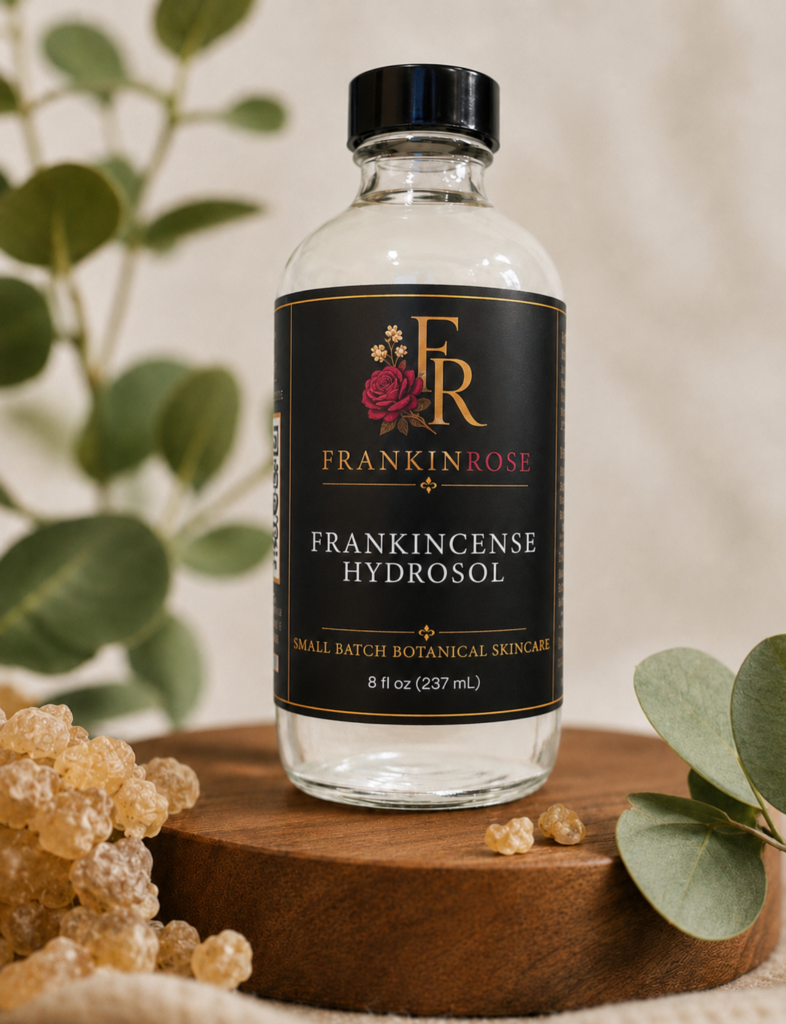
Frankincense hydrosol is an aromatic water produced during the distillation of frankincense botanical material. It contains water-soluble and dispersed aromatic constituents captured during the distillation process.
Unlike frankincense essential oil, hydrosol is predominantly water.
That distinction matters considerably when discussing storage.
Oil-based products and water-based botanical products behave differently. A facial oil, for example, does not provide the same environment for microbial growth as a water-rich product. Hydrosols require greater attention to clean handling, appropriate packaging, temperature, and contamination control.
At FrankinRose, we believe proper storage should be treated as part of the product’s everyday care rather than something considered only when a bottle has been sitting unused for a long period.
Should Frankincense Hydrosol Be Refrigerated?
We recommend refrigerating frankincense hydrosol when possible, especially after the product has been opened.
Refrigeration keeps the product in a cooler, more consistent environment and away from many of the temperature fluctuations common in bathrooms, bedrooms, kitchens, and vehicles.
A refrigerator also provides another practical benefit for facial use: the hydrosol feels pleasantly cool when misted onto the skin.
However, refrigeration should not be viewed as a substitute for appropriate formulation, hygienic production, clean packaging, or preservation when a preservative system is required.
Cold storage can help protect product quality, but refrigeration does not sterilize a hydrosol.
Microorganisms are not automatically eliminated simply because a product is kept cold.
For that reason, proper handling remains important even when frankincense hydrosol is stored in the refrigerator.
What Is the Best Temperature for Storing Frankincense Hydrosol?
Frankincense hydrosol should be protected from excessive heat and large temperature fluctuations.
For a product labeled for refrigerated storage, a normal refrigerator provides a cool, relatively stable environment.
The bottle should not be placed where it is likely to freeze unless the product manufacturer specifically indicates that freezing is acceptable.
Repeated cycles of warming and cooling should also be minimized.
For example, keeping a bottle refrigerated overnight, leaving it inside a hot vehicle all afternoon, and then returning it to the refrigerator is not an ideal storage routine.
Consistency is preferable.
Can Frankincense Hydrosol Be Stored at Room Temperature?
Whether a specific frankincense hydrosol can be stored at room temperature depends on its formulation, preservation system, packaging, manufacturing process, and validated shelf-life conditions.
Some commercially manufactured hydrosols are formulated and packaged for room-temperature storage.
Others may carry instructions recommending refrigeration, particularly after opening.
Consumers should therefore follow the storage directions provided by the manufacturer rather than assuming that every frankincense hydrosol has identical requirements.
At FrankinRose, when refrigeration is specified on our product instructions, we recommend following that guidance consistently.
Why Heat Is a Problem for Frankincense Hydrosol
Heat is generally undesirable for water-based botanical products.
A bottle should not routinely be stored:
- Inside a hot car
- Next to a sunny window
- Near a heater
- Beside a stove
- In direct sunlight
- In an outdoor storage area
- Anywhere experiencing prolonged high temperatures
Vehicles are particularly unsuitable storage locations because interior temperatures can rise dramatically.
If you carry frankincense hydrosol with you during the day, avoid leaving it inside a parked vehicle for extended periods.
Should Frankincense Hydrosol Be Kept Away From Sunlight?
Yes. We recommend keeping frankincense hydrosol away from prolonged direct sunlight.
A sunny bathroom windowsill may look attractive for displaying skincare products, but it exposes the bottle to both light and temperature fluctuations.
A better location is a refrigerator or another cool, protected storage area consistent with the product’s label directions.
Packaging can provide additional protection, but protective packaging does not make poor storage conditions irrelevant.
Even a dark or amber bottle should not routinely be left in direct sun or excessive heat.
What Type of Bottle Is Best for Frankincense Hydrosol?
Packaging plays an important role in protecting a hydrosol during normal use.
We prefer packaging that limits unnecessary exposure and makes the product easy to dispense without repeatedly opening the container.
A spray bottle is particularly convenient for facial hydrosols because the user can dispense the product without pouring it into their hands or repeatedly opening a wide-mouth container.
Glass packaging can also provide an attractive, substantial container for botanical skincare products.
Regardless of the material, the container should remain:
- Clean
- Properly closed
- Undamaged
- Protected from contamination
- Stored according to product directions
The spray mechanism should also be kept clean.
Why a Spray Bottle Helps Protect Frankincense Hydrosol
Every time a water-based skincare product is opened and exposed to fingers, reusable applicators, or surrounding surfaces, opportunities for contamination increase.
A spray bottle reduces direct contact with the bulk product.
For example, instead of removing a cap, pouring hydrosol onto the hand, and potentially touching the opening, the user can mist the product directly.
This is one reason we recommend avoiding contact with the spray nozzle or bottle opening.
Do not deliberately touch the nozzle to the face, hands, cotton pads, or other surfaces.
How to Keep Frankincense Hydrosol Clean After Opening
Good handling habits can help reduce unnecessary contamination.
We recommend:
- Washing hands before skincare routines
- Keeping the bottle tightly closed
- Avoiding direct contact with the spray opening
- Not inserting fingers into the bottle
- Not returning unused product to the bottle
- Keeping the bottle away from dirty surfaces
- Avoiding unnecessary transfer between containers
- Using clean containers if transferring is necessary
- Following the manufacturer’s storage instructions
One especially important rule is simple:
Never pour used or leftover hydrosol back into the original bottle.
Once product has contacted another container, applicator, skin surface, or surrounding environment, returning it to the original container can introduce contamination into the remaining product.
Can Frankincense Hydrosol Be Stored in the Bathroom?
The bathroom is convenient, but it may not always be the best place to store hydrosol.
Bathrooms can experience repeated changes in temperature and humidity, particularly when hot showers are used.
If the product’s directions call for refrigeration, the refrigerator is preferable to leaving the bottle on a bathroom counter.
If room-temperature storage is permitted by the manufacturer, choose a cool location away from direct sunlight, heaters, and excessive moisture.
Do not leave the bottle open while using it.
How Long Does Frankincense Hydrosol Last?
There is no universal shelf life that applies to every frankincense hydrosol.
Shelf life depends on factors such as:
- Manufacturing conditions
- Distillation process
- Sanitation
- Formulation
- Preservation system
- Packaging
- Storage temperature
- Exposure after opening
- Product testing
- Handling practices
This is why a homemade unpreserved hydrosol should not automatically be assigned the same shelf life as a commercially prepared and appropriately preserved product.
Consumers should follow the expiration date, best-by period, period-after-opening guidance, or other shelf-life instructions supplied with the individual product.
We do not recommend assuming that a hydrosol is safe simply because it still smells pleasant.
Does Refrigerated Frankincense Hydrosol Last Longer?
Cool storage can help maintain product quality, which is one reason we recommend refrigeration when indicated.
However, it is important not to interpret refrigeration as a guarantee of a specific shelf life.
The actual usable life of a hydrosol depends on the complete product system, including how it was manufactured, whether it contains an appropriate preservative system, how it was packaged, and how it has been handled.
Refrigeration is therefore best considered one part of proper storage, not the sole method of product protection.
How Can You Tell if Frankincense Hydrosol Has Changed?
Consumers should become familiar with the normal appearance and aroma of their product when it is first opened.
Before use, examine the hydrosol for significant or unexpected changes.
Potential warning signs can include:
- Unusual odor
- Unexpected change in color
- New or unusual cloudiness
- Visible growth
- Unexpected sediment or material
- Changes in the bottle contents
- Swelling or leaking packaging
- Significant change from the product’s original appearance
Some botanical products can naturally vary between batches, so a difference does not automatically indicate spoilage.
However, unexpected changes should not be ignored.
If a product appears substantially different from its normal condition or you suspect contamination, discontinue use.
Can You Tell if a Hydrosol Is Safe by Smelling It?
Smell can reveal obvious changes, but odor alone cannot confirm microbiological safety.
A product may not always develop a dramatic unpleasant smell when microbial contamination occurs.
The same principle applies to appearance.
A hydrosol that looks clear is not automatically proven to be free from problematic microbial growth.
This is why appropriate formulation, preservation, manufacturing hygiene, packaging, and storage are important for water-based skincare products.
Consumers should rely on the manufacturer’s shelf-life and storage instructions rather than using smell as the only test.
Does pH Tell You if Frankincense Hydrosol Is Still Good?
A pH reading can provide useful information about a formulation, but pH alone does not establish whether a cosmetic product is microbiologically safe.
A change in pH may indicate that something in the product has changed, but a stable pH does not prove the absence of microorganisms.
Similarly, measuring pH at home cannot replace appropriate microbial testing or product stability testing.
For everyday consumers, the better approach is to follow the manufacturer’s storage directions, avoid contamination, observe the labeled shelf-life guidance, and discontinue use if the product changes unexpectedly.
Should You Add Preservative to Frankincense Hydrosol at Home?
We do not recommend casually adding a preservative to a finished commercial hydrosol.
Preservation is part of the formulation process.
Preservatives have specific usage rates, compatibility requirements, and effective pH ranges. A preservative system should be selected and incorporated according to supplier specifications and appropriate cosmetic formulation practices.
Adding an arbitrary amount of preservative to a bottle at home does not automatically make the product properly preserved.
Consumers should purchase a product formulated for its intended storage and use rather than attempting to modify the preservation system after purchase.
Can You Freeze Frankincense Hydrosol?
We generally recommend following the manufacturer’s storage instructions instead of automatically freezing hydrosol.
Freezing may affect packaging and can create expansion inside the bottle. Repeated freezing and thawing is also unnecessary for a product intended for routine use.
If a manufacturer specifically recommends freezing for long-term storage, follow those directions.
Otherwise, refrigeration is the simpler choice when cold storage is recommended.
Can You Travel With Frankincense Hydrosol?
Yes, but temperature and cleanliness should still be considered.
When traveling:
- Keep the cap secured
- Protect the bottle from breakage
- Avoid prolonged exposure to heat
- Do not leave it in a hot vehicle
- Keep the nozzle clean
- Return it to recommended storage conditions when possible
For air travel, smaller containers may be useful, but transferring a hydrosol creates another opportunity for contamination.
If transferring product, use a clean, suitable container and avoid repeatedly pouring product between bottles.
Where Should You Store Frankincense Hydrosol in the Refrigerator?
Choose a clean location where the bottle can remain upright and protected.
Avoid placing it where it is likely to be knocked over, contaminated by food spills, or exposed to repeated temperature changes.
A dedicated section of the refrigerator door or a clean shelf can work well, depending on the refrigerator.
Make sure the cap or spray top is completely secured before returning the bottle to storage.
Keeping the product in a consistent location also makes it easier to incorporate into a daily skincare routine.
How Should Frankincense Hydrosol Be Used After Refrigeration?
Frankincense hydrosol can generally be used directly from the refrigerator when the product instructions permit refrigerated storage.
For facial application, close the eyes and mist according to the product directions.
The cool mist can feel refreshing, particularly in warm weather or as part of a morning or evening skincare routine.
After use:
Close the bottle → check the nozzle → return the hydrosol to the refrigerator.
There is usually no need to allow the bottle to reach room temperature before normal cosmetic use unless the product directions specify otherwise.
Common Frankincense Hydrosol Storage Mistakes
Even a carefully made botanical product can be handled poorly after purchase.
We recommend avoiding these common storage mistakes:
Leaving the Bottle in Direct Sunlight
A sunny windowsill exposes the product to unnecessary light and heat.
Keeping Hydrosol in a Hot Vehicle
Vehicle temperatures can rise quickly, particularly during warm weather.
Leaving the Bottle Open
Keep the container closed when it is not being used.
Touching the Spray Nozzle
Avoid repeatedly touching the dispensing area with fingers or skin.
Pouring Used Product Back Into the Bottle
Never return dispensed product to the original container.
Assuming Refrigeration Makes a Product Sterile
Refrigeration can support proper storage but does not sterilize a contaminated product.
Ignoring Unexpected Changes
Significant changes in smell, appearance, clarity, or packaging should be taken seriously.
Keeping a Bottle Indefinitely
Follow the product’s shelf-life guidance rather than assuming botanical water remains suitable forever.
Frequently Asked Questions About Storing Frankincense Hydrosol
Does Frankincense Hydrosol Need to Be Refrigerated?
Storage requirements vary by formulation. At FrankinRose, we recommend refrigeration when specified on the product directions, particularly after opening. Always follow the instructions provided with the individual hydrosol.
Can I Leave Frankincense Hydrosol on My Bathroom Counter?
Only if the specific product is intended for room-temperature storage. If refrigeration is recommended, return it to the refrigerator after use.
Can Frankincense Hydrosol Go Bad?
Yes. Frankincense hydrosol is a water-based botanical product and does not have an unlimited shelf life. Follow the manufacturer’s expiration or use-by guidance and proper storage instructions.
Does Refrigeration Preserve Frankincense Hydrosol?
Refrigeration can help maintain product quality, but it should not be considered a substitute for appropriate formulation and preservation.
Should Frankincense Hydrosol Be Stored in a Dark Bottle?
Light-protective packaging can be useful, but the product should still be protected from direct sunlight and excessive heat.
How Do I Know if My Frankincense Hydrosol Has Gone Bad?
Watch for unexpected changes in odor, color, clarity, appearance, or packaging. When contamination or spoilage is suspected, discontinue use rather than attempting to rescue the product.
Can I Keep Frankincense Hydrosol in My Skincare Refrigerator?
Yes, provided the refrigerator maintains appropriate cool storage conditions and the product’s instructions recommend or permit refrigeration.
How We Recommend Storing Frankincense Hydrosol at FrankinRose
At FrankinRose, we approach botanical skincare with an emphasis on careful handling and straightforward product care.
For frankincense hydrosol intended for refrigerated storage, our recommended routine is simple:
Keep it cool. Keep it closed. Keep the dispensing area clean. Protect it from direct sunlight and excessive heat. Follow the product’s shelf-life instructions.
A refrigerator provides a convenient location for customers who use frankincense hydrosol as part of their regular skincare routine.
The bottle can be removed, used as directed, closed securely, and returned to cold storage.
Proper Storage Helps Protect Your Frankincense Hydrosol
Frankincense hydrosol is fundamentally different from a bottle of facial oil because it is a water-based botanical product. Its storage and handling should reflect that difference.
For the best product care, we recommend protecting frankincense hydrosol from heat, prolonged direct sunlight, dirty surfaces, repeated unnecessary opening, and contact with the dispensing area.
When refrigeration is recommended, keep the bottle refrigerated consistently and return it promptly after use.
Most importantly, follow the directions supplied with the specific product rather than relying on a universal storage rule for every hydrosol.
At FrankinRose, we want customers to enjoy their botanical skincare products while also understanding the importance of proper handling. Thoughtful storage is a simple but valuable part of that routine.
Store your frankincense hydrosol properly, handle the bottle cleanly, follow the labeled shelf-life guidance, and discontinue use if you notice an unexpected change in the product.