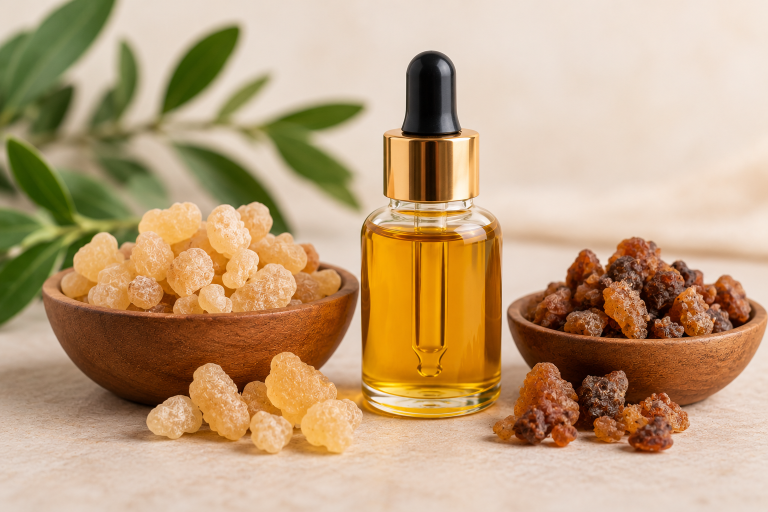

Coffee oil for skin is a rich botanical oil valued for its moisturizing properties, naturally occurring fatty acids, and antioxidant compounds. Made from coffee beans, coffee oil can be incorporated into a simple skincare routine to help soften, condition, and nourish dry or moisture-depleted skin while leaving the complexion looking smooth and radiant.
At FrankinRose, we appreciate skincare ingredients that can stand on their own. A high-quality coffee bean oil does not need an overly complicated formula to make a luxurious addition to a daily skincare routine. Its naturally rich composition and distinctive coffee aroma make it an appealing facial and body oil for people seeking simple, plant-based skincare.
Featured Answer: What Are the Benefits of Coffee Oil for Skin?
Coffee oil can benefit the skin by helping moisturize, soften, and condition it while supporting a smoother, more supple appearance. Coffee beans naturally contain fatty acids and antioxidant compounds, and coffee oil can help replenish oils at the skin’s surface and reduce the dry, tight feeling associated with moisture loss. When used appropriately, coffee oil can be applied to the face, neck, hands, and other dry areas as part of a daily skincare routine.
Its combination of nourishing lipids and a rich sensory experience makes coffee oil particularly attractive for dry, mature, or dull-looking skin.
What Is Coffee Oil?
Coffee oil is an oil derived from coffee beans. Depending on the product and extraction process, coffee oils can differ in color, aroma, texture, and composition.
Coffee beans contain natural lipids as well as numerous plant compounds. When the oil fraction is extracted, many of the oil-soluble components become part of the finished botanical oil.
The result can be a beautifully aromatic oil with a golden to deep brown appearance and a characteristic coffee scent.
Because extraction methods and coffee varieties differ, consumers should always review the specific product’s ingredient information rather than assuming every coffee oil is identical.
At FrankinRose, we favor straightforward skincare that allows customers to understand exactly what they are applying to their skin.
Coffee Oil Helps Moisturize Dry Skin
One of the most practical benefits of coffee oil for the face and body is moisturization.
Healthy-looking skin needs both water and lipids. While facial oils do not add water to the skin in the same way that water-based products do, oils can help condition the skin’s surface and reduce the feeling of dryness.
Coffee oil can be especially useful when applied after cleansing while the skin retains a small amount of moisture.
A few drops spread across slightly damp skin can create a comfortable, conditioned finish.
This makes coffee oil useful for areas prone to dryness, including the:
- Face
- Neck
- Décolletage
- Hands
- Elbows
- Cuticles
- Dry patches on the body
The amount required depends on skin type and personal preference. Facial oils are concentrated, so a small amount is often sufficient.
Coffee Oil Can Help Skin Feel Softer and Smoother
Dry skin can feel rough because the outermost surface lacks sufficient moisture and lipids.
Plant oils work as emollients, helping soften and smooth the skin’s surface.
Coffee oil can therefore be incorporated into skincare routines focused on maintaining a softer, more supple texture.
Rather than applying a large amount, we recommend beginning with just a few drops. Warm the oil between clean fingertips and gently press it onto the skin.
This allows a thin layer to be distributed evenly without unnecessarily saturating the complexion.
Coffee Oil Contains Naturally Occurring Fatty Acids
One reason botanical oils are so useful in skincare is their fatty acid composition.
Coffee oil contains naturally occurring fatty acids that contribute to its emollient characteristics. The precise fatty-acid profile varies according to the coffee species, bean processing, roasting, extraction method, and final oil.
These lipids help give coffee oil its conditioning properties and make it useful in products intended for dry or mature-looking skin.
Fatty acids also influence how an oil spreads, feels, and absorbs.
This is one reason two botanical oils can feel dramatically different even when both are used for moisturizing purposes.
Coffee Oil Provides Antioxidant Compounds
Coffee is widely recognized as a source of naturally occurring plant compounds with antioxidant activity.
Antioxidants are frequently used in skincare because they help address oxidative stress caused by free radicals.
Skin is continuously exposed to environmental factors, including ultraviolet radiation and pollution, that can contribute to oxidative stress. Antioxidant-containing skincare ingredients can complement a well-rounded skincare routine.
Coffee oil should not, however, be confused with sunscreen.
A facial oil does not replace broad-spectrum sunscreen, protective clothing, shade, or other appropriate sun-protection measures.
We consider botanical oils a nourishing component of skincare rather than a substitute for proven UV protection.
Coffee Oil for Mature-Looking Skin
As skin matures, it commonly becomes drier and may produce less of its natural surface oils.
That can make a nourishing facial oil particularly appealing.
Coffee oil can help condition dry mature skin and improve the appearance of softness and suppleness by providing emollient lipids to the skin’s surface.
It can also create an immediate cosmetic effect by smoothing dry surface texture, which may make the complexion appear more luminous.
It is important to distinguish these cosmetic benefits from claims that an oil can permanently erase wrinkles or reverse biological aging.
Coffee oil is best used as a moisturizing and conditioning botanical oil within a broader skincare routine.
Can Coffee Oil Make Skin Look More Radiant?
Well-moisturized skin generally reflects light differently than extremely dry skin.
When a facial oil smooths rough, dry surface texture, the complexion may appear healthier, softer, and more radiant.
Coffee oil can provide this type of natural-looking glow without requiring heavy makeup or complicated skincare layering.
For daytime use, apply only a small amount to avoid an excessively oily finish.
For nighttime use, slightly more may be appropriate for people with very dry skin.
Coffee Oil for the Face
Coffee oil can be used as a facial oil when the product is intended for cosmetic use and agrees with your skin.
After cleansing, place a small amount in the palm or on clean fingertips.
Gently press the oil across the:
Cheeks, forehead, jawline, neck, and other areas requiring additional moisture.
Avoid getting oil directly into the eyes.
People with combination skin may prefer applying coffee oil primarily to dry areas rather than across the entire face.
Those with naturally oily or acne-prone skin should introduce any new facial oil gradually and monitor how their skin responds.
How to Use Coffee Oil in a Skincare Routine
Coffee oil is easy to incorporate into an existing routine.
A simple routine can look like this:
Step 1: Cleanse
Wash the skin with a gentle cleanser appropriate for your skin type.
Step 2: Apply Water-Based Skincare
If you use a hydrosol, toner, or water-based serum, apply it before your facial oil.
Step 3: Apply Coffee Oil
While the skin is still slightly damp, apply a few drops of coffee oil.
Step 4: Gently Press Into the Skin
Massage or press the oil across the face and neck without aggressively pulling the skin.
Step 5: Use Sunscreen During the Day
Finish your morning routine with an appropriate broad-spectrum sunscreen.
Coffee oil can also be used at night as the final oil step in a simple skincare routine.
Can You Use Coffee Oil Every Day?
For many people, a cosmetic coffee oil can be used regularly if it is well tolerated.
Frequency depends on skin type, climate, other products being used, and personal preference.
Someone with very dry skin may enjoy using a facial oil every evening. Someone with combination or oily skin may prefer using only one or two drops or applying it less frequently.
There is no advantage to applying more oil than the skin comfortably needs.
Start small and adjust based on how your skin responds.
Is Coffee Oil Good for Dry Skin?
Coffee oil is especially appealing for dry and moisture-depleted skin because of its emollient properties.
Dry skin often feels tight after cleansing and may develop rough or flaky areas.
Applying coffee oil after a water-based skincare step can help condition the surface and leave skin feeling more comfortable.
For particularly dry skin, coffee oil can also be layered with a moisturizer rather than used alone.
A water-containing moisturizer supplies hydration, while an oil can provide additional emollience and help support a softer surface feel.
Is Coffee Oil Good for Oily Skin?
Having oily skin does not automatically mean all facial oils must be avoided.
However, skin responses vary considerably.
People with oily, blemish-prone, or acne-prone skin should introduce coffee oil cautiously. Begin with a very small amount and consider testing it on a limited area before applying it across the entire face.
If a product causes persistent congestion, irritation, or breakouts, discontinue use.
The goal is not to force a particular botanical oil into every skincare routine. The best routine is one that suits the individual’s skin.
Can Coffee Oil Be Used Around the Eyes?
The skin around the eyes is delicate, so extra care is appropriate.
A tiny amount of cosmetic facial oil can be gently applied around the orbital area if the product is suitable for facial use, but avoid applying it directly into the eyes or too close to the lash line.
Do not use large amounts.
If irritation develops, wash the area and discontinue use.
Coffee Oil for Hands and Cuticles
Coffee oil does not have to be limited to facial skincare.
It can make a convenient hand and cuticle oil, especially for people whose hands become dry from frequent washing.
Massage a small amount over the cuticles, nails, knuckles, and backs of the hands.
Using oil before bed can be particularly convenient because it has time to remain on the skin without immediately being washed away.
Coffee Oil for Body Care
Coffee oil can also be applied to dry body areas.
After showering, apply a small amount while the skin is still slightly damp.
Concentrate on areas that tend to become rough, such as the elbows, knees, hands, and legs.
Because botanical oils are concentrated, spreading a thin layer over damp skin can make a small amount go surprisingly far.
Coffee Oil vs. Coffee Scrubs
Coffee oil and coffee scrubs serve very different purposes.
A coffee oil is primarily used to condition and moisturize the skin.
A coffee scrub relies on ground coffee or other particles for physical exfoliation.
Aggressive scrubbing can irritate sensitive skin, especially when coarse particles are rubbed forcefully across the face.
For people primarily interested in the moisturizing qualities of coffee-derived skincare, a coffee oil offers those emollient benefits without requiring physical exfoliation.
Does Coffee Oil Contain Caffeine?
Coffee beans naturally contain caffeine, but the amount present in a finished coffee oil can vary substantially depending on the raw material and extraction process.
Consumers should not assume that every coffee oil contains a specific concentration of caffeine unless the manufacturer provides reliable product-specific information.
This distinction matters because coffee oil and caffeine extract are not automatically the same ingredient.
When evaluating skincare, we recommend focusing on the actual formulation and ingredient information provided for the specific product.
What Does Coffee Oil Smell Like?
One of the most distinctive characteristics of coffee oil is its aroma.
Depending on how it is produced, coffee oil may have a warm, roasted, nutty, earthy, or freshly brewed coffee-like scent.
The aroma can vary naturally between batches and extraction methods.
For coffee lovers, this sensory quality can make applying the oil an enjoyable part of a morning or evening skincare routine.
How Much Coffee Oil Should You Apply?
More is not necessarily better.
For facial use, begin with approximately two to three drops, adjusting according to the product, skin type, and size of the application area.
If the face remains excessively oily long after application, reduce the amount.
For the neck and décolletage, add another drop or two as necessary.
Body application naturally requires more, but applying the oil to slightly damp skin helps improve spreadability.
Patch Testing Coffee Oil Before Facial Use
Any new skincare product can potentially cause irritation or an individual reaction.
Before using coffee oil extensively, particularly on sensitive skin, perform a patch test according to appropriate cosmetic-use guidance.
Discontinue use if persistent redness, itching, swelling, burning, or other signs of irritation occur.
People with known allergies or significant dermatologic conditions should discuss new skincare products with an appropriate healthcare professional when necessary.
How Should Coffee Oil Be Stored?
Botanical oils should be protected from conditions that accelerate oxidation.
Store coffee oil tightly closed and away from excessive heat, direct sunlight, and moisture.
Avoid leaving the bottle open for extended periods.
A dropper should also be handled carefully. Avoid touching the dropper directly against the skin and then returning it to the bottle, as this can introduce contaminants.
Proper storage helps maintain the quality and sensory characteristics of the oil throughout its intended shelf life.
Why Choose Simple Botanical Skincare?
Complicated skincare formulas are not always necessary.
Single-ingredient and minimalist products make it easier to understand exactly what is being applied to the skin.
At FrankinRose, we focus on botanical skincare that celebrates ingredients such as coffee oil, carrot seed oil, prickly pear seed oil, black castor oil, frankincense, myrrh, and botanical hydrosols.
A simple routine can combine water-based hydration with nourishing botanical oils according to individual skin needs.
Adding Coffee Oil to Your FrankinRose Skincare Routine
Coffee oil can fit naturally into a minimalist routine.
After cleansing, apply your preferred FrankinRose botanical hydrosol or toner and allow the skin to remain slightly damp. Follow with a small amount of coffee oil and gently press it over the face and neck.
This approach combines a water-based skincare step with an emollient oil step.
Coffee oil can also be alternated with other botanical oils depending on how the skin feels throughout the year.
Dry winter conditions may call for a richer routine, while warmer months may require only a small amount.
The Benefits of Coffee Oil for Skin
The primary benefits of coffee oil for skin come from its ability to nourish and condition the skin with naturally occurring plant lipids while providing antioxidant-containing botanical compounds.
Used as part of a balanced skincare routine, coffee oil can help:
- Moisturize dry skin
- Soften rough-feeling areas
- Improve the appearance of smoothness and suppleness
- Condition mature-looking skin
- Support a naturally radiant appearance
- Provide emollient fatty acids
- Add antioxidant-containing botanical skincare to a routine
- Condition dry hands and cuticles
- Nourish dry areas of the body
At FrankinRose, we believe botanical skincare can be both luxurious and uncomplicated. Coffee oil offers a distinctive combination of rich texture, natural plant compounds, nourishing lipids, and the unmistakable character of coffee.
Whether applied as a facial oil, used on the neck and décolletage, massaged into dry hands, or incorporated into a nighttime routine, coffee oil provides a simple way to add botanical nourishment to everyday skincare.
For those looking for a straightforward plant-based oil that leaves skin feeling soft, conditioned, smooth, and beautifully nourished, coffee oil is an excellent ingredient to explore.