When purchasing frankincense hydrosol, the quality of the botanical ingredients is only one consideration. The type of bottle used to package frankincense hydrosol can influence its storage conditions, protection from environmental exposure, and overall product experience. Because hydrosols are delicate, water-based botanical distillates, selecting appropriate packaging is an important part of maintaining their quality.
Glass bottles have become a preferred packaging choice among many botanical skincare producers because of their chemical resistance, durability, and ability to preserve the natural character of water-based formulations. Unlike some packaging materials, glass provides a highly resistant barrier that helps minimize interactions between the container and its contents.
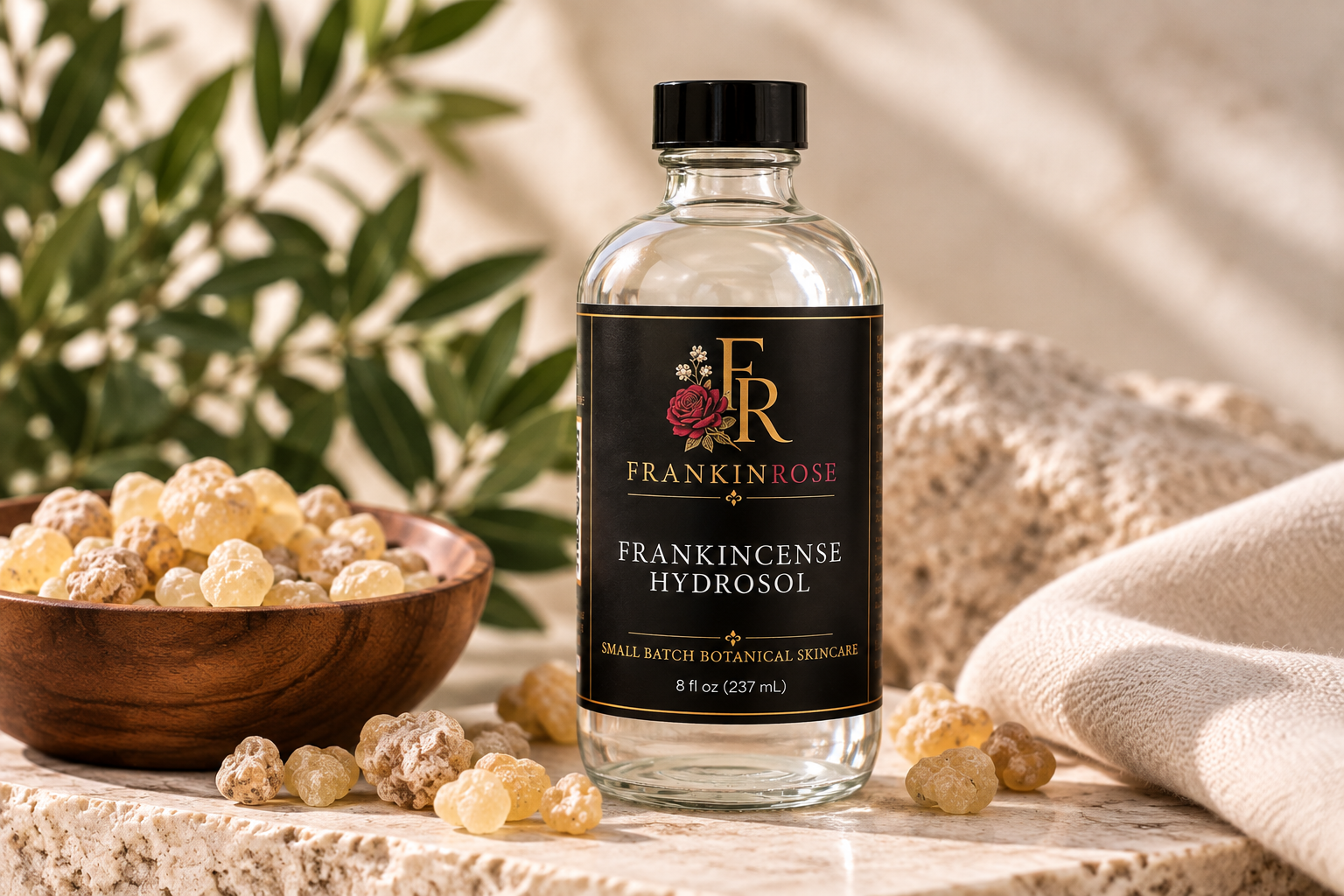
At FrankinRose, we appreciate the importance of thoughtful packaging for handmade botanical skincare. Our frankincense hydrosol is crafted using frankincense resin and traditional steam distillation techniques, then packaged in glass bottles to complement the simplicity and quality of our botanical products.
Understanding why glass packaging matters can help consumers make informed decisions when purchasing, storing, and using frankincense hydrosol.
Featured Answer: Should Frankincense Hydrosol Come in a Glass Bottle?
Yes, glass bottles are an excellent packaging choice for frankincense hydrosol because glass is chemically resistant, nonporous, and compatible with many water-based botanical products. Glass helps minimize packaging-related interactions and provides a dependable barrier against external moisture and gases. Amber or other light-protective glass may also reduce exposure to certain wavelengths of light. However, glass packaging alone does not prevent microbial contamination or guarantee a longer shelf life. Proper sanitation, secure closures, appropriate storage temperatures, and verified product stability remain essential for maintaining hydrosol quality.
Why Packaging Matters for Frankincense Hydrosol
Frankincense hydrosol is produced during the distillation of frankincense resin. As heated water or steam interacts with the botanical material, volatile aromatic compounds are carried into a condenser, where they cool and return to liquid form.
The resulting hydrosol contains water and small amounts of water-soluble or water-dispersed aromatic constituents derived from the resin.
Unlike concentrated essential oils, hydrosols are predominantly water.
This distinction makes packaging particularly important because water-based botanical products are susceptible to microbial contamination if they are not manufactured, handled, and stored appropriately.
The Delicate Nature of Botanical Hydrosols
Frankincense hydrosol has a distinctive aromatic profile that may include resinous, woody, fresh, and subtly earthy notes.
Its aroma can vary depending on the frankincense species, resin characteristics, distillation conditions, and the portion of distillate collected.
Because hydrosols contain relatively low concentrations of aromatic compounds, they should not be assumed to possess the same antimicrobial characteristics as concentrated essential oils.
A hydrosol’s natural botanical origin does not make it self-preserving.
Packaging should therefore be selected as part of a broader approach to product quality, cleanliness, and storage.
Benefits of Using Glass Bottles for Frankincense Hydrosol
Glass offers several practical advantages for packaging botanical waters and facial mists.
1. Glass Is Chemically Resistant
One of the primary benefits of glass packaging is its resistance to chemical interactions with many cosmetic ingredients.
Glass is generally inert under ordinary conditions encountered in cosmetic storage.
This means that appropriately selected glass containers are less likely to interact with the hydrosol or introduce packaging-related changes compared with certain incompatible materials.
For a botanical product such as frankincense hydrosol, this characteristic is particularly valuable.
Glass packaging helps preserve the intended formulation without relying on the compatibility characteristics of a particular plastic resin.
However, the complete packaging system must be considered, including the cap, liner, spray mechanism, and any components that contact the liquid.
2. Glass Provides an Effective Moisture and Gas Barrier
Glass is effectively impermeable to moisture and gases under normal storage conditions.
This helps protect the contents from environmental exchange through the container walls.
The overall performance of the package still depends on the closure.
A poorly fitted cap, leaking sprayer, or damaged seal can compromise an otherwise suitable glass bottle.
3. Glass Does Not Readily Absorb Aromatic Compounds
Some plastic packaging materials may absorb or interact with certain fragrance ingredients over time.
Glass generally offers strong resistance to this type of interaction.
Frankincense hydrosol contains subtle aromatic compounds that contribute to its characteristic scent.
Using a compatible glass container helps minimize the potential for packaging-related changes in aroma.
However, glass cannot prevent natural aromatic changes caused by oxidation, temperature exposure, or other formulation-related factors.
4. Glass Supports a Premium Botanical Skincare Experience
Glass packaging is often associated with traditional apothecary products, botanical preparations, and premium skincare.
Its weight, appearance, and smooth surface can complement products made with carefully selected botanical ingredients.
At FrankinRose, we value packaging that reflects the thoughtful nature of our handmade products.
Glass bottles provide a classic presentation while offering practical material benefits.
5. Glass Can Be Recycled
Glass is widely recyclable where appropriate recycling facilities and collection programs are available.
It can also be reused for suitable purposes after thorough cleaning.
However, glass is heavier than many plastic alternatives and may require additional protective shipping materials.
Its overall environmental impact depends on factors including transportation, manufacturing, recycling infrastructure, and reuse.
Is Amber Glass Better Than Clear Glass for Frankincense Hydrosol?
Both clear and amber glass can be suitable for frankincense hydrosol, but they offer different levels of light protection.
Amber Glass Bottles
Amber glass reduces the transmission of certain wavelengths of light, particularly in parts of the ultraviolet and visible spectrum.
This can be beneficial for products containing light-sensitive constituents.
Potential advantages include:
- Reduced exposure to some ultraviolet wavelengths.
- Additional protection from certain forms of light exposure.
- A traditional botanical skincare appearance.
- Less direct visibility of the product during storage.
However, amber glass does not block all light or eliminate the effects of heat and oxygen.
Clear Glass Bottles
Clear glass allows consumers to see the hydrosol’s appearance, including its clarity and color.
This can be useful when evaluating visible changes in a botanical product.
Clear glass is also commonly used in premium skincare packaging because of its clean, minimalist appearance.
Its primary limitation is that it offers less protection against light exposure than appropriately selected tinted glass.
Clear glass can be suitable when a hydrosol is stored away from direct sunlight and excessive heat, provided the product’s stability and packaging compatibility have been established.
Which Glass Bottle Is Best?
The most appropriate bottle depends on the formulation, intended storage conditions, light sensitivity, and packaging design.
Amber glass may provide an additional protective advantage for light-sensitive products, while clear glass offers visibility and a different aesthetic.
Neither option replaces proper storage or microbial quality control.
Glass vs. Plastic Bottles for Frankincense Hydrosol
Although glass is often preferred for botanical skincare, certain plastic containers can also be suitable when they have been evaluated for compatibility with the formulation.
The differences are important when comparing products.
| Packaging feature | Glass bottles | Plastic bottles |
|---|---|---|
| Chemical resistance | Generally excellent | Depends on plastic type and formulation |
| Moisture and gas barrier | Excellent through bottle walls | Varies by material |
| Aroma interaction | Generally low | May vary by polymer |
| Light protection | Depends on glass color | Depends on material and color |
| Weight | Heavier | Usually lighter |
| Breakage resistance | Can break if dropped | Often more impact-resistant |
| Recycling | Widely recyclable in many areas | Depends on resin and local programs |
| Shipping requirements | Often needs protective packaging | Usually requires less breakage protection |
Does Plastic Packaging Make Frankincense Hydrosol Unsafe?
Not necessarily.
Cosmetic-grade plastic packaging can be appropriate for hydrosols when the container and closure are compatible with the product.
Materials such as PET and HDPE are used in many cosmetic packaging applications.
The suitability of a particular container depends on its composition, the product formulation, storage conditions, and packaging compatibility testing.
Consumers should not assume that every plastic bottle is unsuitable or that every glass bottle automatically guarantees superior product quality.
Does Frankincense Hydrosol Last Longer in a Glass Bottle?
Glass can provide packaging compatibility and barrier advantages, but there is no universal evidence that simply transferring frankincense hydrosol into glass will extend its usable shelf life by a specific number of weeks or months.
Hydrosol stability depends on several interconnected factors.
These include:
- The microbial quality of the distillate.
- Cleanliness of the manufacturing environment.
- Sanitation of the bottle and closure.
- Whether an effective preservation system is present.
- The product’s pH and chemical composition.
- Storage temperature.
- Exposure to light and oxygen.
- Frequency of opening and handling.
- The effectiveness of the closure.
A hydrosol packaged in a properly sanitized glass bottle can still become contaminated if microorganisms are introduced during production or use.
Why Water-Based Products Need Special Care
Hydrosols contain substantial amounts of water, creating conditions in which microorganisms may grow if the formulation does not adequately control them.
Potential contaminants include bacteria, yeasts, and molds.
Contamination may occur without obvious changes in smell, color, or appearance.
Therefore, visual inspection alone cannot establish that a hydrosol is microbiologically safe.
Does Refrigeration Help?
Refrigeration can slow the growth of some microorganisms and certain chemical changes.
For hydrosols intended to be stored cold, maintaining consistent refrigeration is an important part of following the recommended storage conditions.
However, refrigeration is not a substitute for adequate preservation or demonstrated microbiological stability.
Some microorganisms can survive or grow at refrigeration temperatures.
At FrankinRose, we recommend following the storage instructions provided with each botanical product and treating handmade hydrosols as delicate water-based preparations.
Why Bottle Sanitation Matters for Handmade Frankincense Hydrosol
The cleanliness of the container is as important as the material from which it is made.
A glass bottle may be chemically compatible with hydrosol, but contamination can still occur if the container is not properly prepared before filling.
Cleaning vs. Sanitizing Glass Bottles
Cleaning removes visible dirt, dust, and residues.
Sanitizing or disinfecting reduces microorganisms using a validated method appropriate for the container and intended application.
These processes are not interchangeable.
For cosmetic production, bottle preparation should follow documented procedures designed to control contamination.
The Importance of Closures and Spray Tops
A glass bottle is only one part of the finished package.
Spray pumps, caps, dip tubes, and internal seals may contain plastic, rubber, or other materials.
These components must be compatible with the hydrosol and appropriately clean.
A contaminated spray assembly can introduce microorganisms into an otherwise clean product.
Why Repeated Opening Can Increase Contamination Risk
Each time a container is opened, there is an opportunity for contamination from hands, surrounding surfaces, or the environment.
Direct contact between fingers and the bottle opening should be avoided.
Packaging that minimizes unnecessary exposure may help reduce opportunities for contamination, although it does not make the product sterile.
Are Glass Spray Bottles Good for Frankincense Hydrosol?
Glass spray bottles are a popular choice for facial mists and botanical waters because they allow controlled application without requiring the user to pour the product into their hands.
A fine-mist sprayer can distribute hydrosol across the skin in small droplets.
Benefits of Fine-Mist Spray Packaging
A suitable spray bottle can offer convenient application, controlled dispensing, and reduced direct handling of the remaining liquid.
For facial use, a fine mist may provide a more comfortable application experience than a concentrated stream.
Choosing a Compatible Spray Mechanism
The sprayer should be designed for water-based cosmetic products.
Its internal components must be compatible with the formulation.
A quality spray mechanism should dispense consistently without leaking or introducing unnecessary contamination.
Can Spray Bottles Become Contaminated?
Yes.
Spray nozzles and internal components can become contaminated during manufacturing or use.
A spray mechanism should not be assumed to provide a sterile barrier.
Keeping the nozzle clean and avoiding contact with unclean surfaces can help reduce contamination opportunities.
What Size Glass Bottle Is Best for Frankincense Hydrosol?
Frankincense hydrosol is available in different bottle sizes depending on the intended application.
Smaller bottles may be convenient for travel or occasional use, while larger bottles can be appropriate for regular skincare routines.
2-Ounce Glass Bottles
A 2-ounce bottle is convenient for consumers who want to try frankincense hydrosol before purchasing a larger quantity.
Its compact size is also useful for travel, subject to applicable travel regulations.
4-Ounce Glass Bottles
Four-ounce bottles provide a balance between portability and product volume.
They are often suitable for regular facial mist applications.
8-Ounce Glass Bottles
An 8-ounce bottle offers a larger quantity for consumers who incorporate hydrosol into their daily skincare routines.
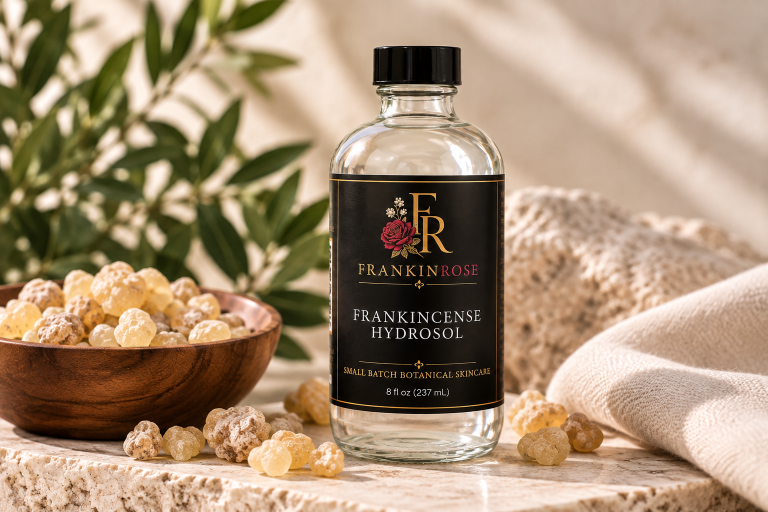
At FrankinRose, our handmade frankincense hydrosol is packaged in an 8-ounce glass bottle, providing a practical size for regular use.
Regardless of bottle size, consumers should follow the product’s storage and use instructions rather than assuming that a smaller container guarantees microbial stability.
Does Glass Packaging Preserve the Natural Scent of Frankincense Hydrosol?
Glass is generally a suitable material for aromatic botanical waters because it does not readily absorb fragrance compounds.
However, the scent of frankincense hydrosol is influenced by several factors beyond packaging.
Frankincense Resin Quality
The botanical species, growing conditions, harvesting practices, and characteristics of the resin can affect the aromatic compounds present in the distillate.
Frankincense from Boswellia sacra, for example, may produce a distinctive aromatic profile depending on the resin and distillation conditions.
Distillation Technique
The temperature, duration, equipment design, and collection method can influence the final hydrosol.
Different portions of a distillation may exhibit variations in aroma.
Storage Conditions
Heat, oxygen exposure, and light may contribute to changes in aromatic compounds over time.
Glass packaging helps minimize certain packaging interactions, but it cannot prevent every chemical change.
Natural Variations Between Batches
Handmade botanical products may vary slightly between batches because the starting botanical material is not identical every time.
Natural aroma variation should not automatically be interpreted as a quality problem.
However, unexpected odors, cloudiness, or visible growth should be treated as warning signs, and a product should not be used when contamination is suspected.
Should Frankincense Hydrosol Be Stored in the Refrigerator?
Refrigeration is often recommended for delicate hydrosols, particularly when they are formulated without conventional cosmetic preservatives.
Cold storage may help slow certain deterioration processes, but the appropriate storage instructions should be based on the product’s formulation and stability evaluation.
Recommended Storage Practices
For hydrosols labeled for refrigerated storage, we recommend:
- Keeping the bottle refrigerated at the temperature specified on the label.
- Closing the bottle securely after use.
- Avoiding direct sunlight and unnecessary heat exposure.
- Keeping the spray nozzle or bottle opening clean.
- Avoiding contact between the dispenser and unclean surfaces.
- Following the manufacturer’s stated use-by date and handling instructions.
Do not assume that an unpreserved hydrosol is safe for a particular number of weeks or months without supporting stability and microbiological testing.
Can Frankincense Hydrosol Be Stored in Metal Containers?
Metal containers may be suitable for certain cosmetic formulations, but their compatibility depends on the type of metal, protective lining, and product composition.
Some metals may react with water-based products, particularly under certain pH or storage conditions.
This can potentially affect the container, the formulation, or both.
Glass offers an alternative that generally requires fewer concerns about corrosion of the bottle itself.
However, the closure and dispensing components still require compatibility evaluation.
For handmade botanical skincare, glass is often a practical and attractive packaging choice.
What Should You Look for When Buying Frankincense Hydrosol in a Glass Bottle?
Packaging is one indicator of product presentation and material selection, but consumers should evaluate the entire product.
Botanical Identification
Look for information identifying the frankincense species used in production.
Frankincense may come from several Boswellia species, including Boswellia sacra, Boswellia carteri, and others.
Botanical identification helps consumers understand the source material.
Clear Ingredient Information
A product label should accurately identify its ingredients.
Consumers should be able to distinguish a genuine distillation-derived hydrosol from a product made by mixing essential oil, fragrance, or other aromatic ingredients into water.
These products are not necessarily equivalent.
Appropriate Packaging
A clean, properly sealed glass bottle with a compatible closure is a positive packaging characteristic.
Consumers should also inspect the bottle for cracks, leaks, or damaged seals.
Storage Instructions
Water-based botanical products should include appropriate storage guidance.
This is especially important when the product is intended to be refrigerated.
Manufacturer Information
Look for clear information identifying the responsible business and providing a way to contact it.
Transparent product information helps consumers make informed purchasing decisions.
Product Freshness and Quality Controls
Where available, information about batch identification, production practices, microbial quality testing, and shelf-life evaluation can provide additional confidence.
A glass bottle should not be treated as proof that these quality controls have been performed.
Why FrankinRose Uses Glass Bottles for Handmade Frankincense Hydrosol
At FrankinRose, we appreciate the relationship between botanical ingredients, traditional distillation, and thoughtful packaging.
Our handmade frankincense hydrosol reflects our interest in creating botanical skincare products with a straightforward approach to ingredients and presentation.
We use glass bottles because they offer several qualities that align with our product philosophy.
A Traditional Botanical Presentation
Glass has a long history of use in apothecary preparations, perfumes, and botanical products.
Its classic appearance complements the character of frankincense and other plant-derived ingredients.
A Compatible Container for Botanical Water
Glass offers strong chemical resistance and an effective barrier through the container walls.
These characteristics make it a practical packaging material for many water-based botanical formulations.
A Thoughtful 8-Ounce Size
Our 8-ounce glass bottles provide a convenient quantity for consumers who enjoy incorporating frankincense hydrosol into their skincare routines.
Respect for the Natural Character of Frankincense
We value the distinctive aroma and botanical character of frankincense hydrosol.
Our packaging selection is intended to complement the product while recognizing that appropriate manufacturing controls and storage remain essential.
Frequently Asked Questions About Frankincense Hydrosol Packaging
Is glass better than plastic for frankincense hydrosol?
Glass offers excellent chemical resistance and barrier properties, making it a strong packaging choice for frankincense hydrosol. However, compatible cosmetic-grade plastic can also be suitable. Product stability depends on the complete formulation and packaging system.
Does frankincense hydrosol need an amber glass bottle?
Not necessarily. Amber glass provides additional protection against certain wavelengths of light, but clear glass may also be suitable when the product is appropriately formulated, packaged, and stored.
Can frankincense hydrosol go bad in a glass bottle?
Yes. Glass does not prevent microbial contamination or eliminate chemical deterioration. Hydrosol quality depends on manufacturing controls, preservation, handling, storage, and demonstrated stability.
Does glass packaging prevent bacteria from growing in hydrosol?
No. Glass is nonporous and can be cleaned and sanitized using appropriate methods, but it does not inherently prevent microbial growth inside a water-based product.
Should frankincense hydrosol be refrigerated after opening?
Follow the manufacturer’s storage instructions. Refrigeration is commonly recommended for delicate hydrosols, particularly unpreserved formulations, but it does not guarantee microbiological safety.
Can I transfer frankincense hydrosol into another glass bottle?
Transferring hydrosol introduces additional contamination risks. It is generally preferable to keep the product in its original packaging. If transferring is necessary, appropriate sanitation and compatible packaging are important, but safe handling cannot guarantee sterility.
Is an 8-ounce glass bottle a good size for frankincense hydrosol?
An 8-ounce bottle is a practical size for regular use. However, the amount purchased should be appropriate for the product’s validated shelf life and recommended storage conditions.
Does frankincense hydrosol contain essential oil?
A genuine frankincense hydrosol may contain small quantities of volatile aromatic constituents, including trace dispersed oil components, depending on the distillation process. It is not equivalent to concentrated frankincense essential oil.
Does glass packaging make frankincense hydrosol more natural?
No. The natural origin and composition of a hydrosol depend on its ingredients and production method. Glass is a packaging material and does not determine whether the contents are natural.
Can clear glass affect the quality of frankincense hydrosol?
Clear glass allows more light to reach the product than amber glass. Depending on the formulation, prolonged light exposure may contribute to chemical changes. Storing clear glass bottles away from direct sunlight is a sensible precaution.
Choose Thoughtfully Packaged Frankincense Hydrosol From FrankinRose
Frankincense hydrosol can benefit from glass packaging because glass provides excellent chemical resistance, dependable barrier properties, and a classic presentation suited to botanical skincare.
However, the bottle is only one part of product quality. Appropriate manufacturing practices, clean packaging components, secure closures, responsible storage, and verified stability are equally important.
At FrankinRose, we value the simplicity of botanical skincare and the distinctive qualities of traditionally distilled frankincense hydrosol.
Our handmade frankincense hydrosol is packaged in an 8-ounce glass bottle, reflecting our preference for practical, thoughtfully selected materials.
We believe consumers should understand not only what goes into their botanical skincare products but also how those products are packaged, stored, and maintained.
Explore FrankinRose Frankincense Hydrosol and discover our approach to handmade botanical skincare.
Visit www.frankinrose.com to learn more about our frankincense hydrosol and botanical skincare collection.