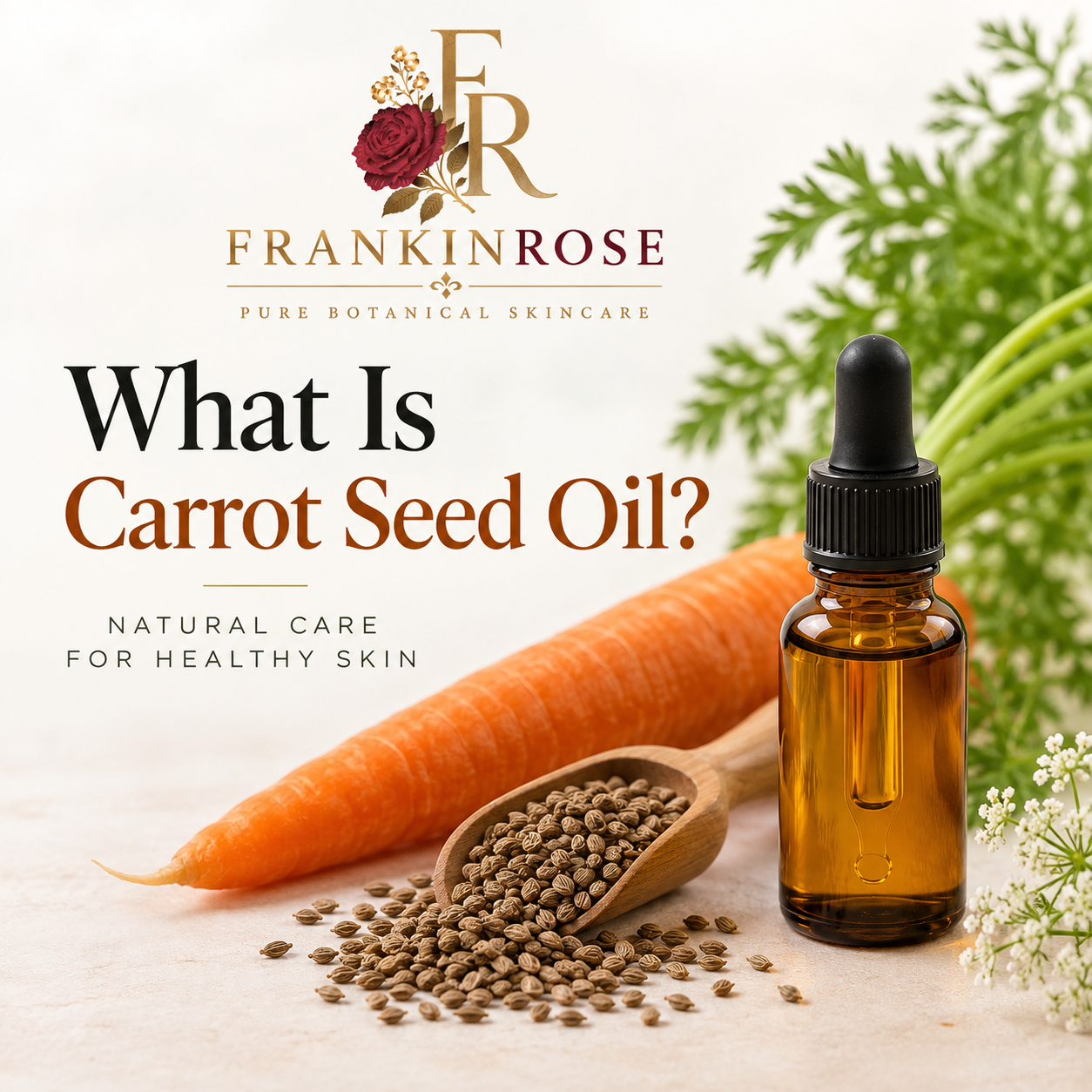
Carrot seed oil is a botanical oil derived from the seeds of the carrot plant, Daucus carota. It is valued in skincare for its naturally occurring fatty acids and other plant compounds, making it an appealing ingredient for facial oils, body oils, and other oil-based skincare products. Unlike carrot root oil, which is commonly produced by infusing carrot root into a carrier oil, true carrot seed oil comes specifically from the seeds of the carrot plant.
At FrankinRose, we believe understanding the ingredients used in botanical skincare is an important part of building a simple and intentional skincare routine. Carrot seed oil stands out because a small amount can provide rich emollient properties without requiring a complicated ingredient list.
Featured Answer: What Is Carrot Seed Oil?
Carrot seed oil is an oil obtained from the seeds of the Daucus carota plant. In skincare, it is primarily used as an emollient to help soften, condition, and support the skin’s moisture barrier. Pure carrot seed oil should not be confused with carrot seed essential oil or carrot root-infused oil, as these are different products with different compositions and uses.
Where Does Carrot Seed Oil Come From?
Carrot seed oil originates from the seeds produced by the carrot plant. Although carrots are best known for their orange roots, the plant eventually produces flowers and seeds when allowed to complete its natural growing cycle.
The seeds can then be processed to obtain oil for cosmetic applications. When shopping for carrot seed oil, it is important to determine exactly what type of product is being offered because the term “carrot oil” is sometimes used broadly.
Three products are particularly easy to confuse:
Carrot seed oil is derived from carrot seeds and may be sold as a carrier or cosmetic oil.
Carrot seed essential oil is a highly concentrated volatile oil produced through processes such as steam distillation and is not the same as a fatty carrier oil.
Carrot root oil or carrot-infused oil generally consists of carrot root infused into another carrier oil, such as sunflower oil.
Understanding these distinctions is especially important when selecting a product intended for direct application to the face or body.
What Is the INCI Name for Carrot Seed Oil?
The cosmetic ingredient name commonly associated with carrot seed oil is:
Daucus Carota Sativa (Carrot) Seed Oil
For a product consisting solely of certified organic carrot seed oil, consumer-facing packaging may also identify it as Organic Carrot Seed Oil, provided the organic claim is properly supported by the supplier’s documentation and applicable certification requirements.
We always recommend checking the supplier’s specification sheet, Certificate of Analysis, or cosmetic documentation before relying solely on a common product name. This helps confirm exactly what is inside the bottle.
Carrot Seed Oil Benefits for Skin
Carrot seed oil is primarily valuable in skincare because of its emollient and conditioning properties. Oils help reduce the dry, rough feeling that can occur when the skin lacks sufficient surface lipids.
Helps Soften Dry Skin
One of the simplest reasons to use carrot seed oil is its ability to make skin feel softer.
When an oil is spread across the skin, it creates a light lipid layer that can improve the feel of rough or dry areas. This makes carrot seed oil particularly attractive for people building minimalist routines centered around botanical oils.
Supports the Skin’s Moisture Barrier
Healthy-looking skin depends heavily on an effective skin barrier.
The outermost layer of the skin helps regulate moisture loss while protecting the underlying skin. Botanical oils can supplement naturally occurring surface lipids and help reduce the tight, uncomfortable feeling associated with dryness.
Carrot seed oil can therefore be used as part of a routine designed to seal in moisture and condition the skin.
Leaves Skin Feeling Smooth and Conditioned
A facial oil does not need dozens of ingredients to serve a useful purpose.
A quality carrot seed oil can provide lubrication and emollience that leaves the surface of the skin feeling smoother. This can be particularly noticeable when a few drops are applied after a water-based moisturizer.
Provides Naturally Occurring Plant Compounds
Botanical seed oils contain a complex mixture of naturally occurring compounds. Their exact composition can vary according to the plant variety, geographic origin, harvest, extraction process, storage conditions, and refinement.
This natural variation is one reason we believe sourcing and handling matter when choosing botanical skincare ingredients.
Carrot Seed Oil vs. Carrot Seed Essential Oil
The distinction between carrot seed oil and carrot seed essential oil is extremely important.
A cosmetic carrier oil is primarily composed of lipids and can generally form the base of an oil-based skincare product.
An essential oil is composed primarily of concentrated volatile aromatic compounds. Essential oils are significantly more concentrated and generally require careful formulation and dilution before topical use.
Consumers should therefore never assume that instructions for a carrot seed carrier oil automatically apply to carrot seed essential oil.
When purchasing carrot seed oil for facial use, read the ingredient statement carefully. If the product says Daucus Carota Sativa (Carrot) Seed Oil, examine the supplier’s documentation to determine the extraction method and confirm whether it is a carrier oil or essential oil.
Carrot Seed Oil vs. Carrot Oil
“Carrot oil” is another term that can create confusion.
Some products marketed as carrot oil are actually carrot root extracts or infusions in another carrier oil. For example, carrot material may be infused into sunflower, soybean, olive, or another vegetable oil.
That doesn’t necessarily make the product undesirable, but it does mean it is not a single-ingredient pure carrot seed oil.
We recommend reading the complete ingredient list rather than relying only on the product name.
If multiple oils appear on the ingredient statement, you are purchasing a blend or infusion rather than pure carrot seed oil.
How to Use Carrot Seed Oil on Your Face
Carrot seed oil can fit easily into a simple skincare routine.
For a pure cosmetic-grade carrier oil intended for direct topical use, begin with a few drops. Gently press or massage the oil over clean skin.
One useful approach is applying facial oil while the skin is still slightly damp or after applying a water-based moisturizer. Oils are excellent at providing emollience and helping reduce moisture loss, but they do not replace water in the skin.
This is why pairing an oil with a hydrating step can work particularly well for people experiencing dryness.
A basic routine might look like:
- Cleanse the face gently.
- Apply a hydrating mist, hydrosol, serum, or moisturizer if desired.
- Place a few drops of carrot seed oil into clean fingertips.
- Gently press the oil into the face and neck.
- Allow it to absorb before applying additional products.
When trying any new skincare product, patch testing first is a sensible precaution.
Can Carrot Seed Oil Be Used Every Day?
A properly formulated cosmetic carrot seed carrier oil may be incorporated into a daily skincare routine if it agrees with your skin.
However, skincare needs vary considerably.
Someone with very dry skin may prefer using facial oil morning and evening, while someone with combination or oilier skin may prefer using only one or two drops at night.
More is not necessarily better. Facial oils spread easily, and a small quantity can often cover the entire face.
We recommend beginning conservatively and adjusting according to how your skin responds.
Is Carrot Seed Oil Good for Mature Skin?
Carrot seed oil can be an appealing choice for mature and dry-feeling skin because emollient oils help soften and condition the skin.
As skin changes with age, dryness may become more noticeable. An oil-based finishing step can help improve surface softness and create a smoother, more supple feel.
It is important, however, to distinguish cosmetic benefits from medical or anti-aging claims. A botanical oil can moisturize, condition, and improve the appearance and feel of dry skin, but it should not be presented as reversing the biological aging process.
For mature skin, we particularly like the simplicity of pairing a hydrating product with a small amount of facial oil to help lock in moisture.
Does Carrot Seed Oil Moisturize the Skin?
Carrot seed oil primarily acts as an emollient and moisture-sealing oil.
There is an important distinction between adding water to the skin and helping prevent water from escaping.
Water-based moisturizers, hydrosols, and hydrating serums provide a different function from oils. Facial oils contain little or no water. Instead, they can help condition the skin and support the lipid portion of a moisturizing routine.
For this reason, carrot seed oil can be particularly useful as the final step after applying a hydrating product.
Can You Use Carrot Seed Oil Around the Eyes?
The skin surrounding the eyes is delicate, so products used in this area should be applied carefully.
If a cosmetic-grade carrot seed carrier oil is intended for facial use, only a very small quantity should be needed. Avoid direct contact with the eyes, lash line, and inner eye area.
Anyone with particularly sensitive skin should patch test before introducing a new botanical oil around delicate facial areas.
Can Carrot Seed Oil Be Used on Hair?
Carrot seed carrier oil can also be incorporated into hair and scalp care.
Oils are commonly applied to dry hair ends to improve softness, reduce the appearance of dryness, and provide shine. Depending on hair type, only one or two drops may be necessary.
It can also be incorporated into an oil blend for the scalp or used as a pre-shampoo oil treatment.
People with fine hair should begin with a particularly small amount because botanical oils can weigh down finer strands when overapplied.
Is Carrot Seed Oil the Same as Carrot Seed Essential Oil?
No.
This is one of the most important points for consumers researching carrot seed products.
Carrot seed carrier oil and carrot seed essential oil are not interchangeable.
A carrier oil is lipid-based and can be used as the primary ingredient in many cosmetic oil products. An essential oil is a highly concentrated aromatic material and requires different formulation considerations.
Always check the ingredient declaration and product directions before applying either product to your skin.
Does Carrot Seed Oil Work as Sunscreen?
Carrot seed oil should not be used as a replacement for tested sunscreen.
Online claims sometimes suggest that carrot seed oil provides a high natural SPF. Consumers should be cautious with these claims.
An oil does not become a reliable sunscreen simply because a particular plant compound demonstrates certain properties in laboratory research. Sunscreen products must be properly formulated and tested to determine their SPF and broad-spectrum protection.
For everyday sun protection, we recommend using an appropriately tested broad-spectrum sunscreen according to its labeled directions.
Carrot seed oil can still be part of your skincare routine, but it should not replace your sunscreen.
What Does Carrot Seed Oil Smell Like?
The scent of carrot seed oil can vary according to its source and processing.
Unrefined botanical oils may retain more of their natural aroma, while refined oils may have considerably less scent.
The aroma should also not be confused with carrot seed essential oil, which is much more concentrated and aromatic.
Because botanical ingredients naturally vary between harvests and suppliers, slight differences in color, aroma, and texture can occur.
How Should Carrot Seed Oil Be Stored?
Botanical oils should generally be protected from excessive heat, direct sunlight, air exposure, and moisture.
Keep the bottle tightly closed when it is not being used and store it in a cool, dry location away from prolonged sunlight.
Dark or amber glass bottles can also help limit unnecessary light exposure.
Always follow the specific storage instructions provided with the product.
How Long Does Carrot Seed Oil Last?
Shelf life depends on factors including extraction, refinement, antioxidant content, packaging, storage conditions, and the age of the oil when purchased.
Rather than assuming every carrot seed oil has an identical shelf life, we recommend following the manufacturer’s or supplier’s documented shelf-life information.
Changes in odor can be an important indication that a botanical oil has oxidized. An oil that develops a distinctly rancid or unpleasant smell should no longer be used.
Keeping the cap securely closed and storing the bottle away from heat and light can help maintain quality.
How to Choose a Quality Carrot Seed Oil
When purchasing carrot seed oil, look beyond the front label.
We recommend checking the complete ingredient statement, botanical name, extraction information when available, country of origin, supplier documentation, packaging, and storage recommendations.
If you specifically want a single-ingredient product, make sure another carrier oil does not appear on the ingredient list.
For organic products, look for appropriate documentation supporting the organic claim rather than relying exclusively on marketing language.
Transparency matters with botanical oils because similar product names can describe very different ingredients.
Why We Like Simple Botanical Oils at FrankinRose
At FrankinRose, we are drawn to skincare that allows the botanical ingredient itself to remain the focus.
Carrot seed oil fits naturally into that philosophy.
Rather than building an unnecessarily complicated routine, a carefully selected botanical oil can provide a straightforward way to soften and condition the skin.
We believe customers should also know exactly what they are putting on their skin. That means clearly distinguishing between carrot seed oil, carrot seed essential oil, and carrot-infused oils rather than treating them as interchangeable products.
Frequently Asked Questions About Carrot Seed Oil
What is carrot seed oil made from?
Carrot seed oil is obtained from the seeds of the carrot plant, Daucus carota. The exact characteristics of the finished oil depend on its extraction and processing method.
What is carrot seed oil used for?
Cosmetic carrot seed carrier oil can be used to soften and condition the skin, complement a moisturizing routine, and add emollience to facial, body, and hair-care products.
Can I put carrot seed oil directly on my face?
If you have a cosmetic-grade carrot seed carrier oil specifically intended for direct topical use, it may be applied according to the manufacturer’s directions. Carrot seed essential oil is different and should not be treated as an undiluted facial carrier oil.
Is carrot seed oil good for dry skin?
Carrot seed oil can be particularly appealing for dry-feeling skin because oils provide emollience and help reduce moisture loss from the skin’s surface.
Should carrot seed oil be applied before or after moisturizer?
Facial oils are generally most useful after water-based hydration or moisturizer because the oil can act as a finishing emollient layer.
Is carrot seed oil good for mature skin?
It can be a useful option for mature skin that feels dry because botanical oils can help the skin feel softer, smoother, and more conditioned.
Does carrot seed oil contain SPF?
Carrot seed oil should not be relied upon as sunscreen unless it is part of a finished sunscreen formulation that has undergone appropriate SPF testing. Use a tested broad-spectrum sunscreen for sun protection.
Is carrot seed oil the same as carrot oil?
Not necessarily. Products marketed simply as “carrot oil” may contain carrot root infused into another vegetable oil. Always read the complete ingredient statement.
What is the ingredient name for carrot seed oil?
The cosmetic ingredient name commonly used for carrot seed oil is Daucus Carota Sativa (Carrot) Seed Oil.
Carrot Seed Oil: Simple Botanical Care for Skin
Carrot seed oil offers a simple way to incorporate a plant-based emollient oil into a skincare routine. Derived from carrot seeds, it can help soften, condition, and improve the feel of dry skin while complementing water-based hydration.
The most important step is choosing the right product. Carrot seed carrier oil, carrot seed essential oil, and carrot root-infused oil are different ingredients, even though their names are often used interchangeably online.
At FrankinRose, we believe botanical skincare is at its best when ingredients are easy to understand and products serve a clear purpose. A quality carrot seed oil can provide exactly that: a straightforward botanical option for people looking to add nourishing emollience to their face, body, or hair-care routine.