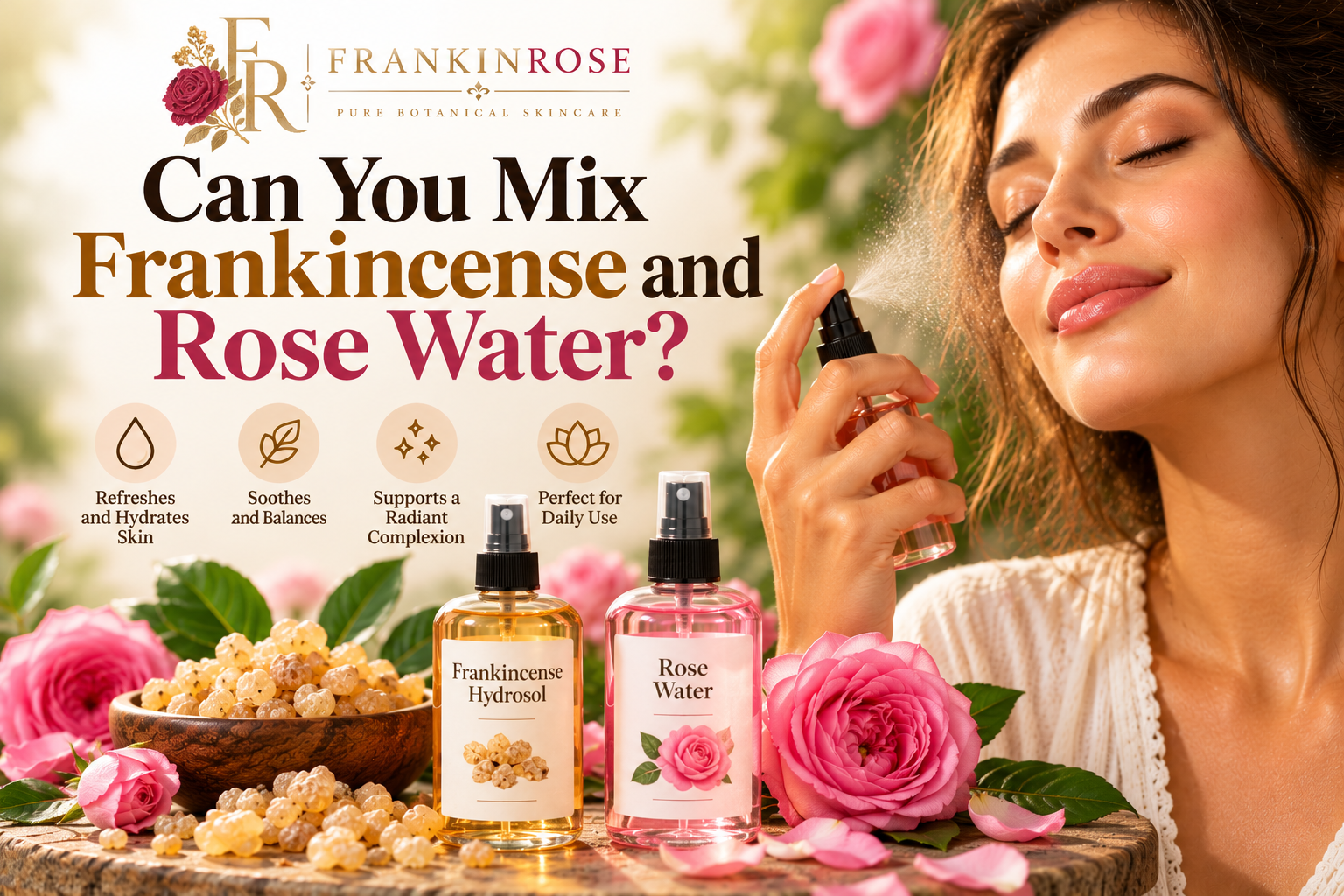
Yes, frankincense hydrosol and rose water can be combined in a facial mist or toner-style skincare product when both ingredients are suitable for cosmetic use and the finished water-based formula is properly prepared, preserved, and stored. The combination brings together the warm, resinous character of frankincense with the delicate floral qualities of rose, creating a refreshing botanical water that can be applied after cleansing and before facial oils, moisturizers, or other skincare products.
At FrankinRose, frankincense and rose are at the heart of our approach to botanical skincare. We appreciate these botanicals individually, but combining them creates an especially enjoyable daily skincare ritual. A properly formulated frankincense and rose botanical toner can provide a lightweight water-based step that leaves the complexion feeling fresh, comfortable, and prepared for moisturizing products.
There is, however, an important distinction between mixing frankincense hydrosol with rose hydrosol and simply adding concentrated frankincense essential oil to rose water. These are not the same type of formulation.
Featured Answer: Can You Mix Frankincense and Rose Water?
Yes. Frankincense hydrosol can be mixed with rose water or rose hydrosol to create a refreshing botanical facial mist or toner. Because both ingredients are water-based, they combine easily. However, any water-based cosmetic mixture must be handled carefully because it can support microbial growth. If the mixture will be stored rather than used immediately, it should be properly formulated with an appropriate broad-spectrum preservation system and stored according to the finished product’s directions. Frankincense essential oil should not simply be added directly to rose water because essential oil does not dissolve evenly in water without an appropriate solubilizing or emulsifying system.
For everyday skincare, a professionally prepared product offers more consistency than casually mixing ingredients without considering preservation, compatibility, and stability.
Frankincense Hydrosol and Frankincense Essential Oil Are Different
Before combining frankincense with rose water, it is important to understand which type of frankincense ingredient is being used.
Frankincense hydrosol is an aromatic water produced during distillation.
Frankincense essential oil is a concentrated oil-based aromatic material.
The two behave very differently in a formulation.
Hydrosol is primarily water and can readily blend with another water-based ingredient such as rose hydrosol.
Essential oil does not dissolve in water. If essential oil is simply dropped into rose water and shaken, the oil may temporarily disperse into small droplets, but it will separate again.
This creates the possibility of concentrated essential oil contacting the skin.
For that reason, we do not consider “add a few drops of essential oil to a bottle of water” equivalent to a properly formulated facial mist.
What Is Rose Water?
The term rose water can describe different products.
Traditional rose water may be produced through distillation of rose petals, in which case it can be considered a type of rose hydrosol.
Other commercial products sold as rose water may be formulated using water, fragrance, extracts, essential oils, preservatives, or other ingredients.
When selecting rose water for skincare, always read the ingredient list.
At FrankinRose, we are particularly interested in botanical distillates because they capture the character of the plant in a gentle, water-based form.
A true rose hydrosol has a delicate botanical aroma that can vary according to the rose material, distillation process, and batch.
Why Combine Frankincense and Rose Hydrosols?
Frankincense and rose create a complementary botanical pairing.
Rose provides a soft, recognizable floral profile, while frankincense contributes a warmer, resinous, earthy aromatic character.
From a skincare perspective, both can function as lightweight water-based ingredients in a facial mist or toner-style formula.
The combination can be used to:
- Refresh the complexion after cleansing
- Provide a light water-based skincare layer
- Prepare slightly damp skin for facial oil
- Create a botanical toner-style step
- Refresh the face during a skincare routine
- Complement dry or mature-skin routines
- Provide an aromatic botanical experience
The finished product should feel light rather than oily because the hydrosol components are predominantly water.
Is Frankincense and Rose Water Good for Your Face?
A properly formulated frankincense and rose hydrosol product can be incorporated into facial skincare when the ingredients are suitable for cosmetic use and tolerated by the individual.
The combination works especially well between cleansing and moisturizing.
After washing the face, lightly mist or apply the botanical water. While the complexion remains slightly damp, follow with a moisturizer or facial oil.
This creates a simple layering sequence:
Cleanser → Frankincense & Rose Botanical Water → Moisturizer or Facial Oil
For daytime use, finish with appropriate broad-spectrum sunscreen.
How to Use Frankincense and Rose Water in Your Skincare Routine
A botanical facial mist does not require a complicated application technique.
Step 1: Cleanse the Skin
Begin with a gentle cleanser appropriate for your skin type.
Remove makeup, sunscreen, excess oil, and daily buildup.
Step 2: Apply Frankincense and Rose Water
Lightly mist the face and neck or apply the product with clean hands.
Avoid spraying directly into the eyes.
Step 3: Leave the Skin Slightly Damp
There is no need to wait until every trace of moisture has evaporated.
Step 4: Apply Your Facial Oil or Moisturizer
Follow with a small amount of your preferred moisturizer or botanical facial oil.
Step 5: Apply Sunscreen During the Day
A botanical hydrosol does not provide adequate UV protection and should never replace sunscreen.
Can You Use Frankincense and Rose Water Every Day?
Yes, a properly formulated frankincense and rose hydrosol product can generally be used daily if your skin tolerates it well.
Many people may prefer using it once or twice a day.
Morning use can provide a refreshing first skincare layer, while evening use can follow cleansing before a richer nighttime moisturizer or facial oil.
People with sensitive skin should introduce new products gradually.
Even botanical ingredients can cause individual reactions, so discontinue use if persistent redness, burning, itching, swelling, or irritation occurs.
Can You Use Frankincense and Rose Water Twice a Day?
For skin that tolerates the product, using it morning and evening can fit easily into a daily skincare routine.
In the morning:
Cleanse → Frankincense & Rose Water → Moisturizer → Sunscreen
At night:
Cleanse → Frankincense & Rose Water → Facial Oil or Moisturizer
The product does not need to be heavily applied.
A fine mist or light layer is generally sufficient.
Should You Apply Frankincense and Rose Water Before Facial Oil?
Yes. Apply the water-based product first.
Facial oils work particularly well as a later step because they provide emollient lipids to the skin’s surface.
Applying oil to slightly damp skin also helps a small amount spread more easily.
At FrankinRose, we appreciate the simplicity of combining a botanical water with a botanical oil because the two products provide distinctly different textures.
A hydrosol provides the water-based layer, while facial oil provides the oil-based conditioning layer.
Can You Mix Frankincense and Rose Water With Jojoba Oil?
Frankincense and rose water can be used in the same skincare routine as jojoba oil, but water and jojoba oil will not remain uniformly mixed in a simple bottle without an appropriate formulation system.
For home skincare, it is easier to use them as separate steps.
Apply the frankincense and rose water first.
Then apply a few drops of jojoba oil while the skin remains slightly damp.
This avoids the formulation challenges involved in trying to create a stable oil-and-water mixture.
Can You Use Frankincense and Rose Water With Facial Oil?
Yes. This is one of the most practical ways to incorporate the botanical combination into skincare.
After applying your frankincense and rose botanical water, follow with a facial oil suited to your skin.
Depending on individual preference, this could include:
Jojoba oil, prickly pear seed oil, carrot seed oil, coffee oil, or a properly formulated frankincense and myrrh facial oil.
Only a small amount of oil is usually necessary for facial use.
Start with a few drops and adjust according to your skin.
Frankincense and Rose Water for Dry Skin
Dry skin can benefit from routines that combine a water-based step with an appropriate moisturizer or emollient oil.
Frankincense and rose water can provide the first lightweight layer.
Follow it with a moisturizer or facial oil to help leave the skin feeling softer and more comfortable.
This is particularly useful after cleansing, when dry skin may feel tight.
Instead of waiting until the hydrosol completely evaporates, apply the next product while the complexion remains slightly damp.
Frankincense and Rose Water for Mature-Looking Skin
Mature skin frequently becomes drier as natural skin characteristics change over time.
A simple routine built around gentle cleansing, water-based skincare, moisturizing, and sun protection can help maintain a comfortable, healthy-looking complexion.
Frankincense and rose hydrosols can provide an enjoyable botanical step without making unrealistic anti-aging claims.
We prefer to describe the benefits accurately: a well-formulated botanical water can help refresh the complexion and support a soft, hydrated, radiant appearance when paired with appropriate moisturizing products.
Can Frankincense and Rose Water Help Skin Look Glowing?
Hydrated, well-moisturized skin often appears smoother and more radiant than extremely dry skin.
A frankincense and rose botanical mist can contribute to this type of routine by providing a water-based layer before moisturizer or facial oil.
The oil or moisturizer applied afterward can then condition the skin’s surface.
Together, these steps can help create the soft, naturally dewy appearance many people associate with glowing skin.
Can You Mix Frankincense Essential Oil Directly Into Rose Water?
We do not recommend simply adding frankincense essential oil directly to rose water and treating the mixture as a finished facial product.
Essential oils are oil-soluble materials and do not properly dissolve in plain water.
Shaking the bottle may temporarily disperse droplets, but this does not create a stable solution.
A properly formulated product containing essential oil and water requires an appropriate system to disperse or solubilize the oil safely and consistently.
This is one reason using frankincense hydrosol with rose hydrosol is fundamentally different from mixing essential oil into water.
Does Frankincense and Rose Water Need a Preservative?
This is an extremely important formulation consideration.
Water-based cosmetic products are susceptible to microbial contamination.
Once water-containing ingredients are combined, the resulting product must be evaluated as a finished formulation.
A product intended to be stored for repeated use generally requires an appropriate preservation strategy unless it is manufactured, packaged, and validated under another system specifically designed to maintain microbiological safety.
Simply refrigerating a homemade water-based cosmetic does not automatically make it microbiologically safe for an extended period.
A preservative must also be suitable for the formula’s pH, ingredients, intended use, packaging, and manufacturing conditions.
For commercial products, proper formulation and appropriate testing are far preferable to guessing about preservation.
Why pH Matters in Frankincense and Rose Water Formulations
The pH of a finished water-based cosmetic can affect ingredient compatibility, preservative performance, product stability, and how the formulation interacts with the skin.
The pH of individual hydrosols does not automatically predict the exact pH of the finished mixture.
Once ingredients are combined, the finished product should be evaluated as its own formulation.
This is especially important when a preservative has a specified effective pH range.
For a commercial botanical toner or mist, formulation decisions should therefore be based on the completed product rather than assumptions about individual ingredients.
How Long Does Frankincense and Rose Water Last?
Shelf life depends on several variables, including:
The formulation, preservation system, manufacturing conditions, packaging, storage temperature, ingredient quality, contamination exposure, and stability of the finished product.
There is no single universal shelf life for every frankincense and rose water mixture.
A professionally prepared product should include appropriate storage and usage information.
Changes in smell, appearance, texture, clarity, or packaging should be taken seriously.
Should Frankincense and Rose Water Be Refrigerated?
Follow the storage instructions for the specific product.
Fresh, unpreserved botanical distillates and professionally preserved cosmetic formulations can have very different storage requirements.
Refrigeration may help keep some products cool and pleasant to apply, but refrigeration should not be treated as a replacement for an appropriate preservation system in a stored water-based cosmetic.
Keep the bottle closed and protect it from unnecessary heat and contamination.
How to Store a Frankincense and Rose Facial Mist
Proper handling helps maintain product quality.
Store the bottle according to the manufacturer’s directions and avoid:
- Leaving the container open
- Touching the spray opening with unclean hands
- Allowing water or other products to enter the bottle
- Exposing the product to excessive heat
- Storing it in direct sunlight unless the packaging is designed for those conditions
A spray bottle can be particularly convenient because it reduces the need to repeatedly touch the product during use.
Frankincense and Rose Hydrosol vs. Traditional Toner
A traditional facial toner can contain a wide variety of ingredients.
Some toners focus on hydration. Others contain exfoliating acids, astringents, humectants, botanical extracts, or treatment ingredients.
A frankincense and rose hydrosol product offers a simpler botanical approach.
It can provide a refreshing water-based step without necessarily performing the same function as an exfoliating or treatment toner.
People who prefer minimalist skincare may appreciate the simplicity of using a botanical mist before their moisturizer or facial oil.
Patch Testing Frankincense and Rose Water
Even gentle botanical products may not agree with every person’s skin.
Before incorporating a new frankincense and rose product into daily facial skincare, consider patch testing according to appropriate cosmetic-use guidance.
Pay attention to signs of irritation such as:
Persistent redness, itching, burning, swelling, or discomfort.
If irritation occurs, discontinue use.
Anyone with significant allergies, highly reactive skin, or a diagnosed skin condition should seek appropriate professional advice when necessary.
A Simple Frankincense and Rose Skincare Routine
At FrankinRose, we appreciate skincare routines that are easy to understand and easy to maintain.
A simple botanical routine might look like this:
Morning Routine
Gentle Cleanser → Frankincense & Rose Toner or Hydrosol → Moisturizer or Facial Oil → Broad-Spectrum Sunscreen
Evening Routine
Cleanser → Frankincense & Rose Toner or Hydrosol → Frankincense & Myrrh Facial Oil
This creates a straightforward combination of water-based and oil-based botanical skincare.
The FrankinRose Approach to Frankincense and Rose
Frankincense and rose inspired the identity of FrankinRose because the two botanicals create such a distinctive pairing.
Frankincense contributes its deep, resinous character, while rose provides a softer floral profile.
We use these botanicals as inspiration for uncomplicated skincare centered around hydrosols, botanical toners, and facial oils.
Rather than relying on unnecessary complexity, we focus on creating routines where each product has a clear role.
A botanical water refreshes the skin.
A facial oil conditions it.
Together, they create a simple ritual that can be repeated morning and evening.
Can You Mix Frankincense and Rose Water? Yes—When It Is Properly Formulated
Frankincense hydrosol and rose hydrosol can be combined beautifully in a botanical facial mist or toner-style skincare product. Because both are water-based distillates, they are naturally suited to this type of formulation.
The important distinction is between combining hydrosols and simply dropping concentrated frankincense essential oil into rose water.
For a stored cosmetic product, preservation, pH, ingredient compatibility, cleanliness, packaging, and stability must also be considered.
When properly formulated, a frankincense and rose botanical water can become an easy daily skincare step—used after cleansing, before moisturizer or facial oil, and whenever the complexion needs a refreshing botanical touch.
At FrankinRose, we believe the combination captures what botanical skincare can be at its best: simple, aromatic, purposeful, and beautifully rooted in the plants themselves.