Featured Answer: What Is Frankincense?
Frankincense is a natural aromatic resin harvested from trees belonging to the Boswellia genus. The resin forms when the bark of a Boswellia tree is carefully cut or tapped, allowing a sticky sap to emerge. As the sap is exposed to air, it gradually hardens into fragrant resin droplets commonly called frankincense tears. For thousands of years, frankincense has been valued for its distinctive aroma and its use in incense, perfumes, traditional preparations, ceremonial practices, and botanical skincare.
At FrankinRose, we appreciate frankincense in one of its most traditional forms: the natural resin itself. Understanding where frankincense comes from, how it is harvested, and how resin differs from frankincense essential oil and hydrosol helps explain why this remarkable botanical has remained valuable for generations.
Where Does Frankincense Come From?
Frankincense comes from Boswellia trees, a group of trees and shrubs adapted to hot, dry, and rocky environments. Several Boswellia species produce aromatic resin that is commercially known as frankincense.
Important frankincense-producing regions include parts of the Arabian Peninsula, Somalia, Somaliland, Ethiopia, and other areas of northeastern Africa. These challenging landscapes are part of what makes Boswellia trees so fascinating. They can grow in conditions where many other plants struggle to survive.
Different regions and Boswellia species can produce resins with noticeably different characteristics. The resin may vary in color, aroma, size, texture, and chemical composition depending on the species, growing environment, harvest conditions, and resin grade.
This is one reason the word “frankincense” does not necessarily describe one completely uniform botanical ingredient.
What Is Frankincense Made From?
Frankincense is the hardened oleo-gum-resin of the Boswellia tree.
It is not a flower, seed, leaf, or manufactured fragrance. The raw material originates within the tree and is released when the bark is tapped.
Fresh Boswellia exudate begins as a sticky liquid. As it sits in the open air, volatile components begin to evaporate and the material gradually becomes firmer. Eventually, it forms the recognizable pieces of dried frankincense resin.
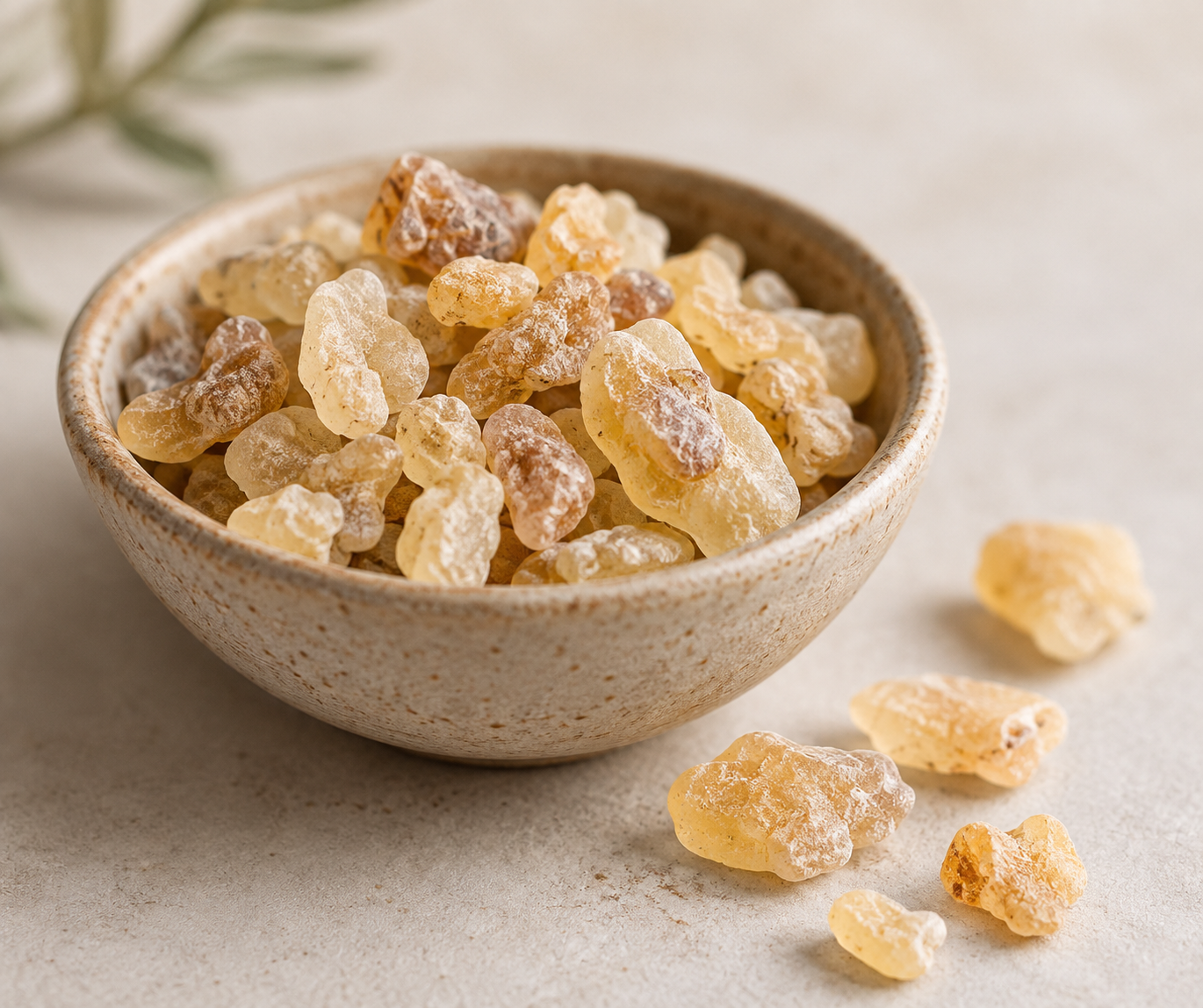
These pieces are often called frankincense tears because of their rounded or droplet-like appearance.
Natural frankincense resin contains a complex mixture of components rather than a single compound. Its composition depends heavily on the particular Boswellia species and source.
How Is Frankincense Harvested?
Traditional frankincense harvesting involves making controlled cuts in the bark of a mature Boswellia tree.
The tree responds by releasing resin around the damaged area. The resin is initially soft and sticky, but exposure to the surrounding air causes it to harden.
Once sufficiently dried, the hardened resin can be collected.
The general process can be summarized as:
Boswellia tree → bark tapping → resin exudation → natural hardening → collection → sorting
Harvesting practices can differ considerably by region. The timing and frequency of tapping can also affect the tree and the resulting resin.
Responsible sourcing is particularly important because overharvesting can place stress on Boswellia populations. Frankincense may seem abundant once packaged for sale, but every resin tear ultimately comes from a living tree.
What Does Frankincense Look Like?
Raw frankincense usually looks very different from the polished bottles of frankincense products people encounter in skincare stores.
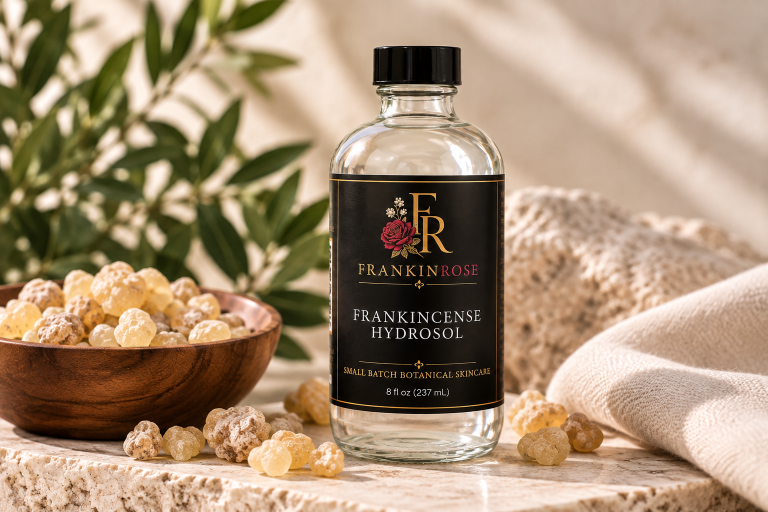
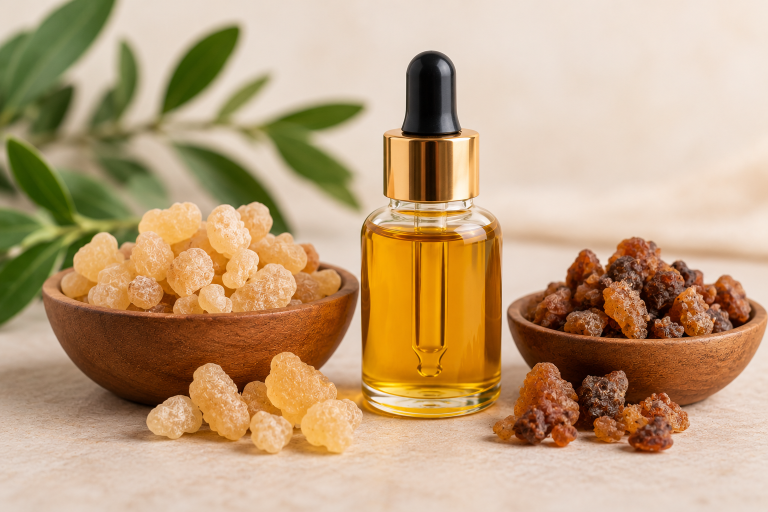
Frankincense resin generally consists of irregular hardened pieces or tears. Depending on the species and grade, colors can range from pale cream and yellow to amber, golden brown, greenish hues, or darker brown.
Some pieces are translucent, while others are cloudy or opaque.
Natural variation is normal.
Because frankincense is a botanical material, authentic resin does not need to look perfectly identical from piece to piece. Size, shape, color, and aroma can vary from one harvest to another.
What Does Frankincense Smell Like?
Frankincense has a complex aroma that is difficult to capture with a single description.
It is frequently described as:
- Resinous
- Woody
- Earthy
- Warm
- Balsamic
- Slightly citrus-like
- Fresh or pine-like, depending on the variety
The aroma of raw resin can also differ considerably from the smell of burned frankincense, frankincense essential oil, or a water-based frankincense distillate.
This distinction is especially important when exploring botanical skincare. A finished frankincense product should not necessarily smell exactly like frankincense incense.
What Is Boswellia?
Boswellia is the botanical genus containing the trees that produce frankincense resin.
There are numerous Boswellia species, but several are particularly well known for commercial frankincense production.
These include Boswellia sacra, Boswellia carteri, Boswellia frereana, and Boswellia serrata.
The botanical identity matters because different species can have different aromatic and chemical profiles.
The growing region, climate, soil, harvesting practices, storage, age of the resin, and processing method can create additional variation.
When we discuss frankincense at FrankinRose, we believe understanding the botanical material is more meaningful than treating “frankincense” as simply another fragrance.
Is Frankincense a Resin or an Essential Oil?
Frankincense is fundamentally a resin.
Frankincense essential oil is a product that can be produced from frankincense resin through distillation.
This distinction is important.
The resin is the original botanical material produced by the Boswellia tree. Essential oil is one fraction obtained when that resin undergoes processing such as steam or hydrodistillation.
That means raw frankincense resin and frankincense essential oil are related, but they are not interchangeable substances.
Frankincense Resin vs. Frankincense Essential Oil
Frankincense resin is the hardened aromatic material collected from a Boswellia tree.
Frankincense essential oil is the concentrated volatile oil obtained from the resin through distillation.
During distillation, heat and water or steam help release volatile aromatic compounds from the resin. Those compounds travel with the vapor, are cooled in a condenser, and return to liquid form.
The concentrated volatile oil can then separate from the water portion.
Consequently, a bottle of frankincense essential oil does not contain every constituent originally present in whole frankincense resin.
This is an important distinction when comparing frankincense products.
What Is Frankincense Hydrosol?
A frankincense hydrosol is the aromatic water-based distillate produced during the distillation of frankincense resin.
Hydrosols are sometimes casually referred to as floral waters, although frankincense obviously does not come from a flower. “Botanical distillate” or “hydrosol” is therefore a more accurate description.
During distillation, steam carries volatile aromatic compounds away from the frankincense resin. When that vapor cools and condenses, a water-based distillate is collected.
This distillate can contain water-compatible aromatic constituents and extremely small amounts of volatile components associated with the botanical.
The result is fundamentally different from concentrated essential oil.
Frankincense Hydrosol vs. Frankincense Essential Oil
One of the most common sources of confusion surrounding frankincense is the difference between frankincense hydrosol and frankincense essential oil.
Frankincense essential oil is concentrated and oil-based. Frankincense hydrosol is predominantly water-based and substantially more dilute.
This difference changes how the two products are formulated and used.
A hydrosol can work naturally as a facial mist, refreshing botanical water, or water-based step in a skincare routine. Essential oils generally require appropriate formulation and dilution before topical application.
Consumers should therefore avoid assuming that directions intended for frankincense hydrosol automatically apply to frankincense essential oil—or vice versa.
How Is Frankincense Used in Skincare?
Frankincense appears in many types of modern botanical skincare, including facial oils, hydrosols, facial mists, creams, serums, balms, soaps, and botanical blends.
How it functions within a product depends on its form.
For example, frankincense essential oil may be incorporated at a low concentration into an oil-based formulation. A frankincense hydrosol can serve as a lightweight water-based botanical product.
This versatility has helped frankincense find a place in contemporary skincare alongside its much older aromatic and traditional uses.
At FrankinRose, our interest is especially focused on bringing traditional botanical ingredients into simple skincare routines without losing sight of where those ingredients originated.
What Does Frankincense Do for Your Face?
Frankincense is widely incorporated into botanical skincare products intended to support the appearance and feel of healthy-looking skin.
However, it is important to distinguish traditional reputation from scientifically established medical effects.
Cosmetic frankincense products should not be treated as medications or cures for skin disease.
Within a skincare routine, the experience also depends heavily on the form of frankincense being used and the other ingredients in the formulation.
A frankincense hydrosol, for example, provides a very different skincare experience from a facial oil containing frankincense.
For consumers interested in a simple botanical routine, frankincense-based products can be incorporated alongside cleansing, moisturizing, and appropriate sun protection.
Is Frankincense Good for Mature Skin?
Frankincense has become especially popular in skincare marketed toward mature and dry-looking skin.
Facial oils containing frankincense are commonly paired with nourishing carrier oils such as jojoba oil, castor oil, and other botanical oils. In these formulations, much of the moisturizing and emollient effect comes from the carrier oils themselves.
Hydrosols provide another approach. Instead of adding an oil-based product immediately after cleansing, a botanical hydrosol can be used as a lightweight facial mist before applying facial oil or moisturizer.
At FrankinRose, we believe it is useful for consumers to understand exactly which type of frankincense product they are purchasing rather than relying on the word “frankincense” alone.
Can Frankincense and Rose Be Used Together?
Frankincense and rose can be combined in botanical skincare, particularly in hydrosols, facial mists, oils, and other cosmetic formulations.
The combination also creates an interesting contrast.
Frankincense contributes its distinctive resinous, woody, and earthy aromatic character, while rose introduces a softer floral profile.
Both botanicals also have exceptionally long histories of use in fragrance, personal care, and traditional preparations.
For FrankinRose, this pairing reflects exactly what inspires our approach to botanical skincare: recognizable botanicals, thoughtful preparation, and small-batch products made with care.
How Do You Use Frankincense Hydrosol on Your Face?
Frankincense hydrosol can be incorporated into a simple skincare routine as a facial mist or botanical toner step, depending on the formulation and product directions.
A typical routine may look like this:
Cleanse → mist with hydrosol → allow it to absorb slightly → apply facial oil or moisturizer → use sunscreen during daytime
It can also be used as a refreshing facial mist during the day when appropriate for the particular formulation.
Always follow the instructions supplied with the finished product because preservation systems, ingredients, concentrations, and recommended storage conditions can differ between manufacturers.
Does Frankincense Hydrosol Smell Like Frankincense Essential Oil?
Not necessarily.
This surprises many people when they experience a genuine botanical distillate for the first time.
Because a hydrosol is predominantly water and captures a different balance of aromatic constituents than essential oil, its fragrance can be much softer and more subtle.
The aroma may also have watery, earthy, resinous, woody, or slightly herbal characteristics that are less obvious in concentrated essential oil.
Natural botanical materials also vary from harvest to harvest.
Therefore, expecting every genuine frankincense product to smell exactly the same can create an unrealistic standard.
Why Has Frankincense Been Valued for Thousands of Years?
Frankincense has occupied an extraordinary position in human history.
Its aromatic resin has been traded across long-distance routes and used in incense, perfumery, cultural traditions, religious ceremonies, and traditional preparations.
Long before essential oils were packaged in modern glass bottles, people were collecting, trading, burning, and working with frankincense resin.
Its historical importance also explains why frankincense continues to attract attention today.
Modern consumers may encounter frankincense primarily through skincare or aromatherapy, but the ingredient itself belongs to a botanical tradition stretching back thousands of years.
Is All Frankincense the Same?
No. Not all frankincense is identical.
Differences can result from the Boswellia species, geographical origin, climate, growing conditions, harvesting practices, resin grade, age, storage conditions, and processing method.
The final product matters as well.
Raw resin, essential oil, hydrosol, infused oil, fragrance oil, and finished skincare containing frankincense are entirely different products.
When shopping for frankincense skincare, we recommend reading the ingredient list and product description rather than making a decision based solely on the word “frankincense” on the front of the bottle.
What Should You Look for in Frankincense Skincare?
Transparency is important with botanical skincare.
Consumers should be able to determine what type of frankincense is being used, what other ingredients are present, how the product should be used, and how it should be stored.
This is particularly important when comparing hydrosols with essential oils.
If a product is described as a frankincense hydrosol, it should not simply be water fragranced with frankincense essential oil and presented as though it were a true distillate. A genuine hydrosol is produced through the distillation process itself.
Similarly, concentrated essential oils require different considerations than water-based hydrosols.
Understanding these distinctions makes it much easier to choose a product appropriate for your skincare routine.
The FrankinRose Approach to Frankincense
At FrankinRose, we are inspired by the simplicity of traditional botanicals and the care involved in transforming natural materials into thoughtfully prepared skincare.
Frankincense is particularly meaningful to us because it begins in such a recognizable, minimally processed form: resin harvested from the Boswellia tree.
Rather than viewing frankincense simply as a trendy skincare ingredient, we appreciate the complete journey—from tree to resin and from resin to finished botanical preparation.
Our approach centers on small-batch botanical skincare made with care, including products inspired by frankincense, rose, and complementary botanical ingredients.
We believe customers deserve to understand what they are putting on their skin, where the ingredients originate, and how different botanical preparations differ from one another.
Frequently Asked Questions About Frankincense
What is frankincense in simple terms?
Frankincense is a natural aromatic resin obtained from Boswellia trees. The tree releases resin when its bark is tapped, and the resin gradually hardens into pieces commonly called frankincense tears.
Is frankincense a plant?
Frankincense itself is not a plant. It is resin produced by trees belonging to the Boswellia genus.
Is frankincense an oil?
Raw frankincense is a resin, not an oil. Frankincense essential oil is distilled from frankincense resin.
What is frankincense hydrosol?
Frankincense hydrosol is a water-based aromatic distillate produced during the distillation of frankincense resin.
Can frankincense be used on the face?
Frankincense is used in many cosmetic products designed for facial application. Appropriate use depends on the formulation. A finished frankincense hydrosol and concentrated frankincense essential oil, for example, should not be treated as interchangeable products.
Can you use frankincense hydrosol every day?
A properly formulated frankincense hydrosol intended for facial use may be suitable for regular use according to its product directions. Individual skin sensitivities vary, so patch testing a new skincare product is sensible.
Is frankincense good for mature skin?
Frankincense is frequently included in botanical skincare designed for mature-looking skin. The overall cosmetic effect depends on the complete formulation rather than frankincense alone.
What is the difference between frankincense resin and frankincense essential oil?
Frankincense resin is the original hardened material collected from the Boswellia tree. Frankincense essential oil is a concentrated volatile fraction obtained by distilling the resin.
What is the difference between frankincense hydrosol and essential oil?
Frankincense hydrosol is predominantly water-based and dilute, while frankincense essential oil is a highly concentrated mixture of volatile aromatic compounds. They have different properties, concentrations, and applications.
Does frankincense hydrosol smell like incense?
Not necessarily. Hydrosol can have a softer, earthier, more subtle botanical aroma than burned frankincense resin or concentrated essential oil.
Discover Frankincense Through Botanical Skincare
Frankincense begins with something remarkably simple: a resilient Boswellia tree producing aromatic resin.
From that resin can come incense, essential oil, hydrosol, fragrance preparations, and carefully formulated skincare.
Understanding these differences provides a much clearer answer to the question, “What is frankincense?”
It is not simply an essential oil or modern beauty ingredient. Frankincense is first and foremost a natural Boswellia resin with a history stretching across generations, cultures, and traditional uses.
At FrankinRose, we celebrate that botanical heritage through thoughtfully prepared, small-batch skincare inspired by ingredients such as frankincense and rose. By keeping the connection between the original botanical and the finished product at the center of what we create, we offer a simpler way to experience one of the world’s most enduring natural ingredients.