A Complete Guide to the Frankincense Tree and Its Resin
Featured Answer: What Is Boswellia Sacra?
Boswellia sacra is a species of tree in the Burseraceae family that produces the aromatic resin commonly known as frankincense. Native primarily to parts of the Arabian Peninsula, particularly Oman and Yemen, Boswellia sacra grows in hot, dry, rocky environments and releases resin when its bark is carefully tapped. The resin gradually hardens into pieces known as frankincense tears, which have been collected and traded for thousands of years for incense, perfumery, traditional preparations, and aromatic products.
At FrankinRose, we believe understanding frankincense begins with understanding the tree itself. Frankincense does not begin as an essential oil in a bottle. It begins as a natural resin produced by remarkable Boswellia trees that have adapted to some of the world’s most challenging growing conditions.
What Is the Boswellia Sacra Tree?
Boswellia sacra is one of the best-known frankincense-producing Boswellia species. It is a relatively small tree adapted to arid landscapes, rocky slopes, cliffs, valleys, and other environments receiving limited rainfall.
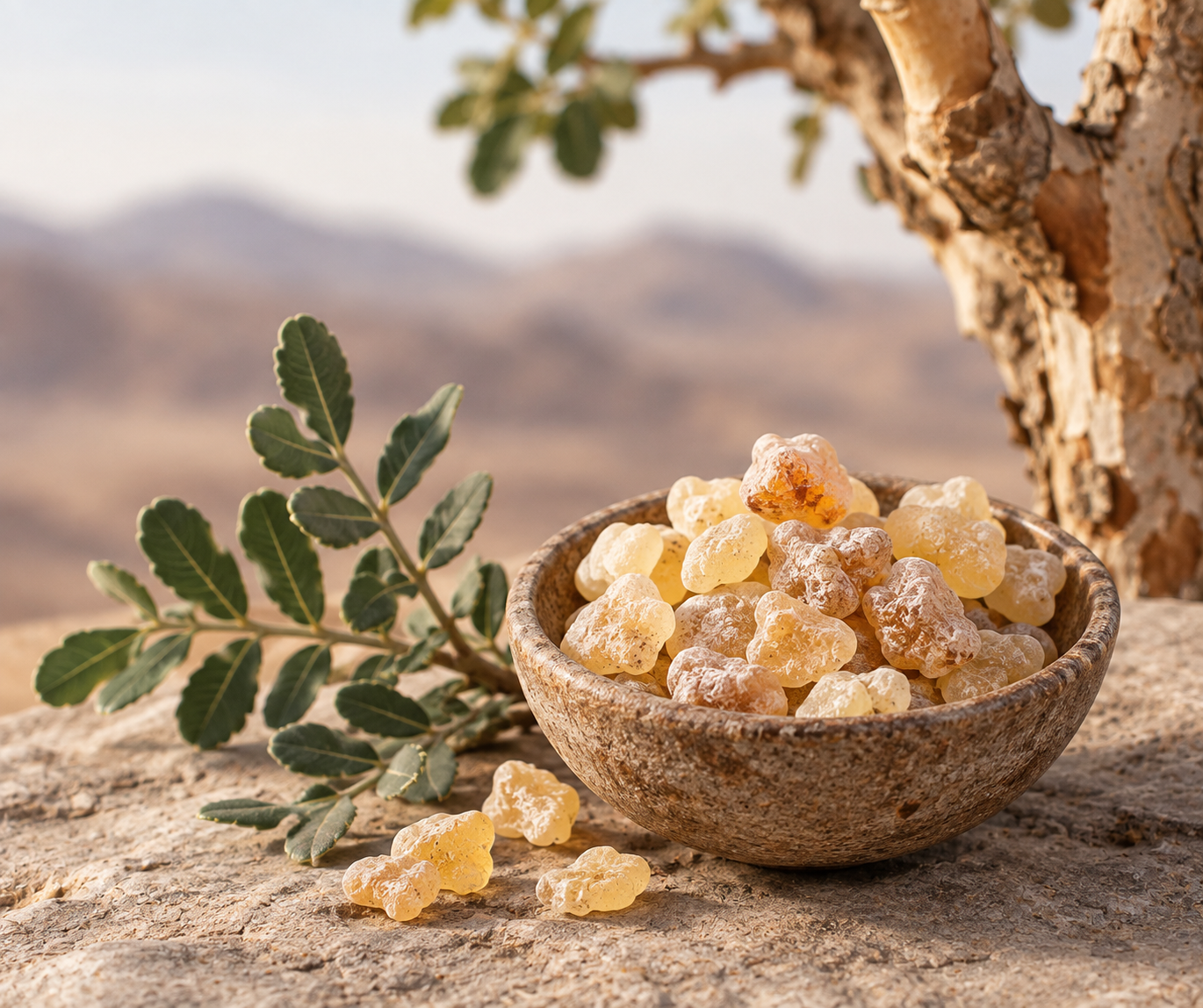
Rather than producing frankincense as a fruit or seed, the tree contains a natural oleo-gum-resin within its tissues. When the bark is deliberately tapped, the tree releases this resinous material.
Initially, the exudate is sticky and soft. Exposure to the surrounding air causes it to gradually harden. Once sufficiently dried, the resin can be collected and sorted.
These hardened pieces are the natural frankincense resin that humans have valued for generations.
The process can be summarized simply:
Boswellia sacra tree → bark tapping → resin exudation → drying → frankincense tears → sorting and use
Understanding this process makes an important distinction clear: Boswellia sacra is the tree, while frankincense is the aromatic resin obtained from it.
Where Does Boswellia Sacra Grow?
Boswellia sacra is strongly associated with the southern Arabian Peninsula, especially Oman and Yemen.
The tree is particularly famous for its historical association with Dhofar in southern Oman, a region with a long tradition of frankincense production and trade.
Boswellia sacra thrives under conditions that would be difficult for many familiar garden plants. It is adapted to high temperatures, limited rainfall, rocky ground, and nutrient-poor soils.
Its ability to grow in seemingly inhospitable environments is one of the defining characteristics of the species.
Some Boswellia trees appear to emerge directly from rocky hillsides. Their root systems can anchor themselves into crevices and uneven terrain, allowing the plants to survive in landscapes where water and fertile soil are scarce.
This close relationship between frankincense and its growing environment is one reason geographical origin has historically played an important role in how frankincense resin is identified, traded, and valued.
Is Boswellia Sacra the Same as Frankincense?
Not exactly.
Boswellia sacra is a botanical species that produces frankincense resin.
Frankincense is the aromatic resinous material collected from certain trees belonging to the Boswellia genus.
This distinction is similar to differentiating a plant from the botanical ingredient obtained from that plant.
When a Boswellia sacra tree is tapped, resin emerges from the bark. Once the material hardens and is harvested, it becomes one of the types of natural resin sold and used as frankincense.
The words are closely related, but they do not describe exactly the same thing.
How Does Boswellia Sacra Produce Frankincense Resin?
The production of frankincense begins inside the living tree.
During traditional harvesting, carefully placed incisions are made in the bark. The tree responds by releasing its natural resin.
The fresh resin is generally soft and sticky. As it remains exposed to the air, it loses moisture and volatile components and becomes increasingly solid.
The hardened resin can eventually be removed from the tree.
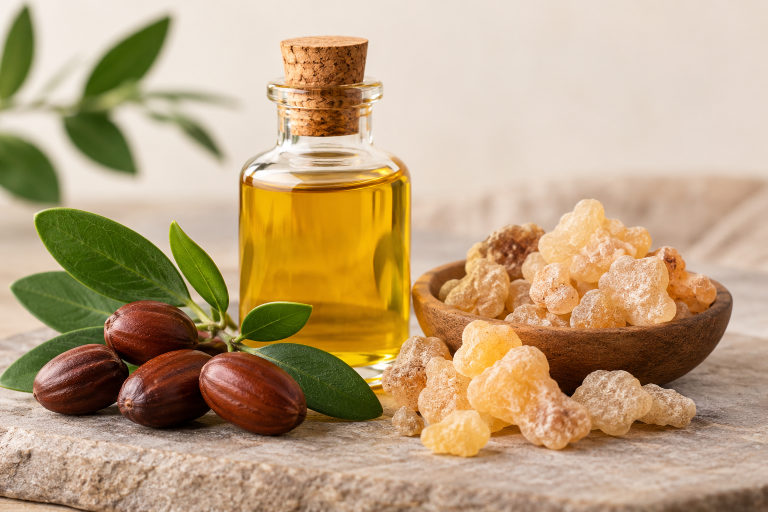
Individual pieces frequently develop the rounded or irregular shapes that have led them to be called frankincense tears.
The resin may then be cleaned and sorted according to characteristics such as size, color, clarity, and overall appearance.
Frankincense resin is therefore not manufactured in the conventional sense. It is a naturally occurring botanical material collected from a tree and subsequently cleaned, sorted, and processed according to its intended use.
What Does Boswellia Sacra Frankincense Look Like?
Boswellia sacra resin does not necessarily have one uniform appearance.
Individual frankincense tears can differ in:
- Size
- Shape
- Transparency
- Color
- Texture
- Aroma
Depending on harvest and grade, pieces may appear cream, pale yellow, golden, amber, or slightly greenish.
Some resin tears are relatively translucent, while others are cloudy or opaque.
This natural variation is important when evaluating frankincense. Botanical materials are not expected to resemble identical factory-produced pieces.
Growing conditions, harvesting period, age, storage, sorting, and other variables can all influence the appearance of the finished resin.
What Does Boswellia Sacra Smell Like?
Boswellia sacra frankincense is known for a distinctive resinous and aromatic fragrance.
Descriptions commonly include characteristics such as:
- Fresh
- Woody
- Resinous
- Balsamic
- Earthy
- Citrus-like
- Slightly pine-like
The exact aroma can vary depending on the resin and how it is experienced.
Raw resin, heated resin, burning frankincense, distilled frankincense essential oil, and frankincense hydrosol do not necessarily smell identical.
This is particularly relevant for botanical skincare.
A person familiar with burning frankincense incense may expect a frankincense hydrosol to have exactly the same aroma. However, distillation captures a different balance of aromatic constituents, and the resulting water-based distillate can smell considerably softer, earthier, or more subtle.
Boswellia Sacra vs. Other Types of Frankincense
Boswellia sacra is only one member of the larger Boswellia genus.
Other well-known frankincense-producing species include Boswellia carteri, Boswellia frereana, and Boswellia serrata.
Although all may be associated with the general term “frankincense,” they are not botanically identical.
Different species can have different geographical distributions, resin characteristics, aromatic profiles, and chemical compositions.
This is why simply seeing “frankincense” on a product does not necessarily tell the complete botanical story.
Boswellia Sacra vs. Boswellia Carterii
The relationship between Boswellia sacra and Boswellia carteri, often written Boswellia carterii, can be confusing because botanical classifications and commercial naming conventions have not always been consistent.
The names have historically been treated differently by various sources, and Boswellia carteri has sometimes been treated as synonymous with Boswellia sacra rather than as a clearly separate species.
For consumers, this creates an important lesson: commercial frankincense terminology does not always map neatly onto botanical taxonomy.
When botanical identity matters, it is useful to consider the scientific name, geographical origin, supplier documentation, and processing method together rather than relying solely on a common name.
Boswellia Sacra vs. Boswellia Serrata
Boswellia serrata is another important Boswellia species, but it is strongly associated with the Indian subcontinent and has its own traditional history.
Boswellia sacra, by contrast, is associated primarily with the Arabian Peninsula.
Both trees produce resin that may broadly be described as frankincense, but they should not automatically be treated as interchangeable.
The botanical species, geographical source, resin composition, and intended application can differ.
This is particularly important when researching scientific literature because research performed using an extract from one Boswellia species should not automatically be assumed to apply identically to every other form of frankincense.
Boswellia Sacra vs. Boswellia Frereana
Boswellia frereana is another frankincense-producing species and is particularly associated with northern Somalia.
Its resin has traditionally been valued for aromatic and cultural uses.
Boswellia sacra has a different natural geographical distribution and can produce resin with a different aromatic profile.
These distinctions demonstrate why frankincense is better understood as a botanical category of related resins rather than one perfectly uniform substance.
How Is Boswellia Sacra Resin Turned Into Essential Oil?
Frankincense resin can be distilled to produce frankincense essential oil.
During steam or hydrodistillation, heat helps release volatile aromatic compounds from the resin. Those compounds travel with water vapor through the distillation apparatus.
The vapor then enters a condenser, where cooling causes it to return to liquid form.
The concentrated volatile oil can separate from the water portion of the distillate.
This oil is what consumers generally recognize as frankincense essential oil.
However, it is important to remember that essential oil represents only certain volatile constituents obtained from the original resin. It is not identical to whole Boswellia sacra resin.
What Is Boswellia Sacra Hydrosol?
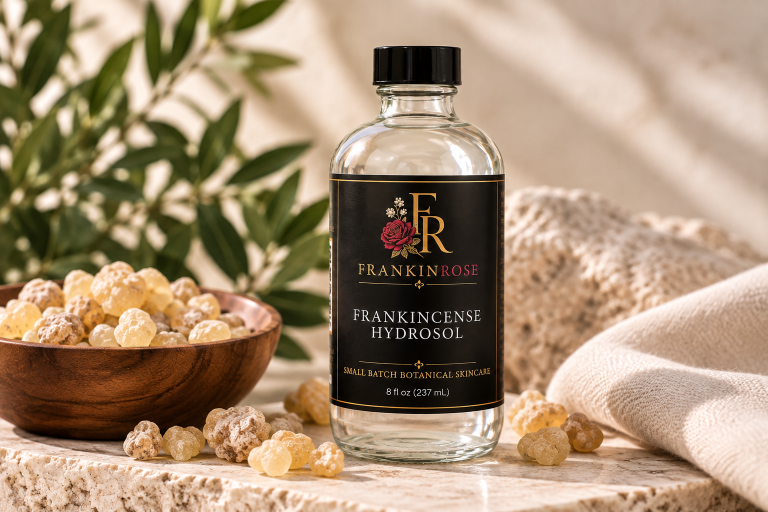
When frankincense resin is distilled, the process can also produce a water-based aromatic distillate commonly called frankincense hydrosol.
A hydrosol is substantially different from essential oil.
The essential oil is concentrated and consists primarily of volatile oil-soluble aromatic constituents. The hydrosol is predominantly water and contains a much more dilute collection of volatile and water-compatible components captured during distillation.
This makes frankincense hydrosol particularly interesting for botanical skincare because it can be incorporated into products such as facial mists and toner-style preparations.
At FrankinRose, our appreciation of frankincense extends beyond the finished product. We value understanding the complete journey from Boswellia tree to resin to botanical distillate.
Is Boswellia Sacra Used in Skincare?
Frankincense-derived ingredients are used in numerous modern skincare and personal-care formulations.
Depending on the product, frankincense may appear as:
Frankincense essential oil, frankincense hydrosol, botanical extracts, aromatic preparations, facial oils, facial mists, creams, balms, soaps, and serums.
The form matters.
A concentrated essential oil is fundamentally different from a water-based hydrosol. A botanical extract may be different from both.
Consumers should therefore examine the complete ingredient list and product description rather than assuming that every product containing frankincense provides the same composition or experience.
Is Boswellia Sacra Good for Your Face?
Boswellia-derived ingredients are widely used in cosmetic formulations, particularly products designed for mature-looking, dry, or dull-looking skin.
However, the skincare characteristics of a finished product depend on far more than the botanical name.
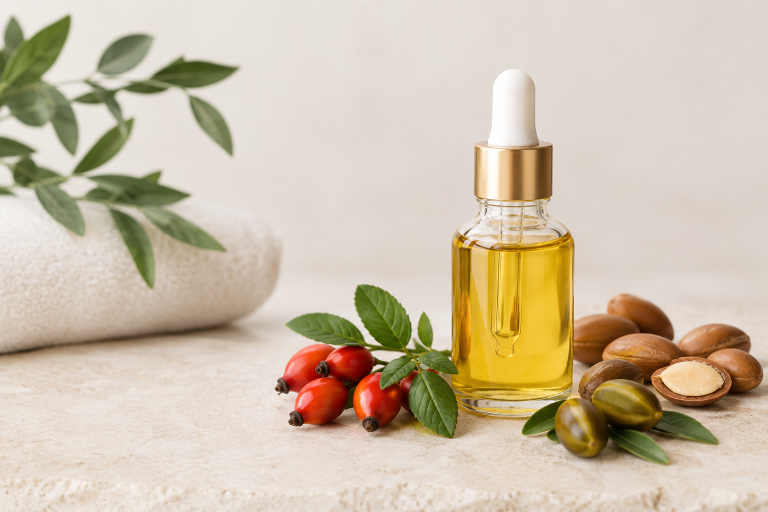
For example, a facial oil containing frankincense may also contain carrier oils such as jojoba or castor oil. Those carrier oils contribute substantially to the moisturizing and emollient characteristics of the finished formulation.
A frankincense hydrosol provides a completely different experience because it is predominantly water-based.
At FrankinRose, we believe consumers benefit from understanding these differences instead of treating every frankincense product as interchangeable.
Boswellia Sacra Resin vs. Frankincense Essential Oil
The distinction between resin and essential oil is particularly important.
Boswellia sacra resin is the natural material produced by the tree.
Frankincense essential oil is a concentrated aromatic product obtained through distillation of the resin.
The essential oil does not contain every substance present in the original resin because only certain compounds pass through the distillation process.
For example, discussions of whole Boswellia resin or specialized Boswellia extracts should not automatically be applied to frankincense essential oil.
The source may be the same tree, but the resulting materials are chemically and functionally different.
Boswellia Sacra Resin vs. Frankincense Hydrosol
Frankincense hydrosol represents another distinct form of Boswellia.
The progression can be understood as:
Boswellia sacra tree → frankincense resin → distillation → essential oil + aromatic water-based distillate
The resin is the original botanical material.
The essential oil contains concentrated volatile aromatic compounds.
The hydrosol is predominantly water and contains a much more dilute selection of components captured during distillation.
Understanding these differences is particularly valuable when selecting frankincense products for skincare.
Why Is Boswellia Sacra Historically Important?
Frankincense has been traded and valued for thousands of years.
The resin played an important role in ancient trade networks connecting southern Arabia with other parts of the Middle East, Mediterranean world, Africa, and Asia.
Its portability and powerful aroma made dried resin particularly well suited to long-distance trade.
Frankincense became associated with incense, perfumery, religious ceremonies, cultural traditions, and traditional preparations.
This history occurred long before modern essential-oil production or contemporary botanical skincare.
When we hold a piece of natural frankincense resin today, we are looking at essentially the same type of botanical material that people collected, transported, traded, and valued many generations ago.
Is Boswellia Sacra the Frankincense Mentioned in the Bible?
Frankincense is mentioned repeatedly in biblical texts and was a highly valued aromatic substance in the ancient Near East.
The best-known reference for many people is the gift of frankincense presented to Jesus by the Magi, alongside gold and myrrh.
Frankincense also appears in descriptions of incense and offerings in the Hebrew Bible.
However, identifying ancient frankincense references with a single modern botanical species requires caution. Multiple Boswellia species were available through ancient trade networks, and historical texts generally did not use modern botanical taxonomy.
It is therefore more accurate to say that Boswellia sacra is one of the important frankincense-producing species associated with the regions involved in the historic frankincense trade, rather than claiming that every ancient reference specifically identifies Boswellia sacra.
Is Boswellia Sacra the Same as Myrrh?
No.
Frankincense and myrrh are both aromatic resins, but they come from different plants.
Frankincense comes from Boswellia trees, while myrrh generally comes from trees and shrubs belonging to the Commiphora genus.
Both have long histories in incense, fragrance, cultural traditions, and personal care, which is why they are frequently mentioned together.
Their botanical origins, aromatic profiles, and chemical compositions are nevertheless different.
This combination of similarity and contrast is one reason frankincense and myrrh continue to be paired in modern botanical products, including facial oils.
How Can You Tell What Type of Frankincense Is in a Product?
The best place to start is the product’s ingredient information and botanical identification.
Look for details such as:
Boswellia species, botanical ingredient name, geographical source when provided, type of preparation, and whether the ingredient is a resin, essential oil, hydrosol, or extract.
The word “frankincense” by itself provides limited information.
A product containing frankincense fragrance is not necessarily equivalent to a product distilled from genuine Boswellia resin.
Similarly, water containing added frankincense essential oil should not automatically be described as a true frankincense hydrosol. A genuine hydrosol is created as part of the botanical distillation process.
Frequently Asked Questions About Boswellia Sacra
What is Boswellia sacra used for?
Boswellia sacra produces frankincense resin, which has historically been used for incense, fragrance, cultural and religious traditions, perfumery, and traditional preparations. Today, the resin can also be distilled to create frankincense essential oil and aromatic water-based distillates used in personal-care products.
What part of Boswellia sacra is frankincense?
Frankincense is the aromatic resin released by the tree, rather than its leaves, flowers, fruit, or seeds.
Where does Boswellia sacra come from?
Boswellia sacra is native primarily to parts of the southern Arabian Peninsula, especially Oman and Yemen.
Is Boswellia sacra real frankincense?
Yes. Boswellia sacra is a recognized frankincense-producing Boswellia species. It is one of several species capable of producing resin commonly known as frankincense.
Is Boswellia sacra an essential oil?
No. Boswellia sacra is a tree species. Frankincense essential oil can be produced by distilling resin harvested from a frankincense-producing Boswellia tree.
Is Boswellia sacra the same as Boswellia serrata?
No. They are different Boswellia species with different geographical distributions and botanical characteristics.
What are frankincense tears?
Frankincense tears are hardened pieces of resin collected from Boswellia trees. They develop after the sticky resin released from the tree is exposed to air and gradually solidifies.
Can Boswellia sacra be used in skincare?
Ingredients derived from frankincense-producing Boswellia trees can be incorporated into skincare formulations. Examples include frankincense essential oil and frankincense hydrosol. Appropriate use depends on the form and formulation.
Does Boswellia sacra hydrosol smell like frankincense?
A frankincense hydrosol can have a recognizable resinous botanical aroma, but it may smell softer, earthier, or less intense than concentrated frankincense essential oil or burning resin.
What is the difference between Boswellia and frankincense?
Boswellia is the botanical genus of trees and shrubs. Frankincense is the aromatic resin obtained from certain Boswellia species.
From the Boswellia Sacra Tree to Modern Botanical Skincare
The story of frankincense begins long before a finished skincare product reaches a bottle.
It begins with a Boswellia tree growing in an arid landscape, producing a natural aromatic resin beneath its bark.
That resin is carefully harvested, allowed to harden, collected, and ultimately used in numerous ways. It can remain as whole frankincense resin, be burned as incense, or undergo distillation to create aromatic preparations such as essential oil and hydrosol.
At FrankinRose, this connection to the original botanical material is an important part of how we view frankincense.
We believe botanical skincare becomes more meaningful when consumers understand where an ingredient originates and recognize the difference between the tree, the resin, the essential oil, the hydrosol, and the finished skincare product.
Boswellia sacra provides an extraordinary example.
A small tree capable of surviving rocky, dry landscapes produces a resin that has traveled ancient trade routes, appeared in cultural and religious traditions, perfumed homes and sacred spaces, and eventually found a place in modern botanical skincare.
That enduring journey is what makes Boswellia sacra and frankincense far more than simply another ingredient name on a cosmetic label.