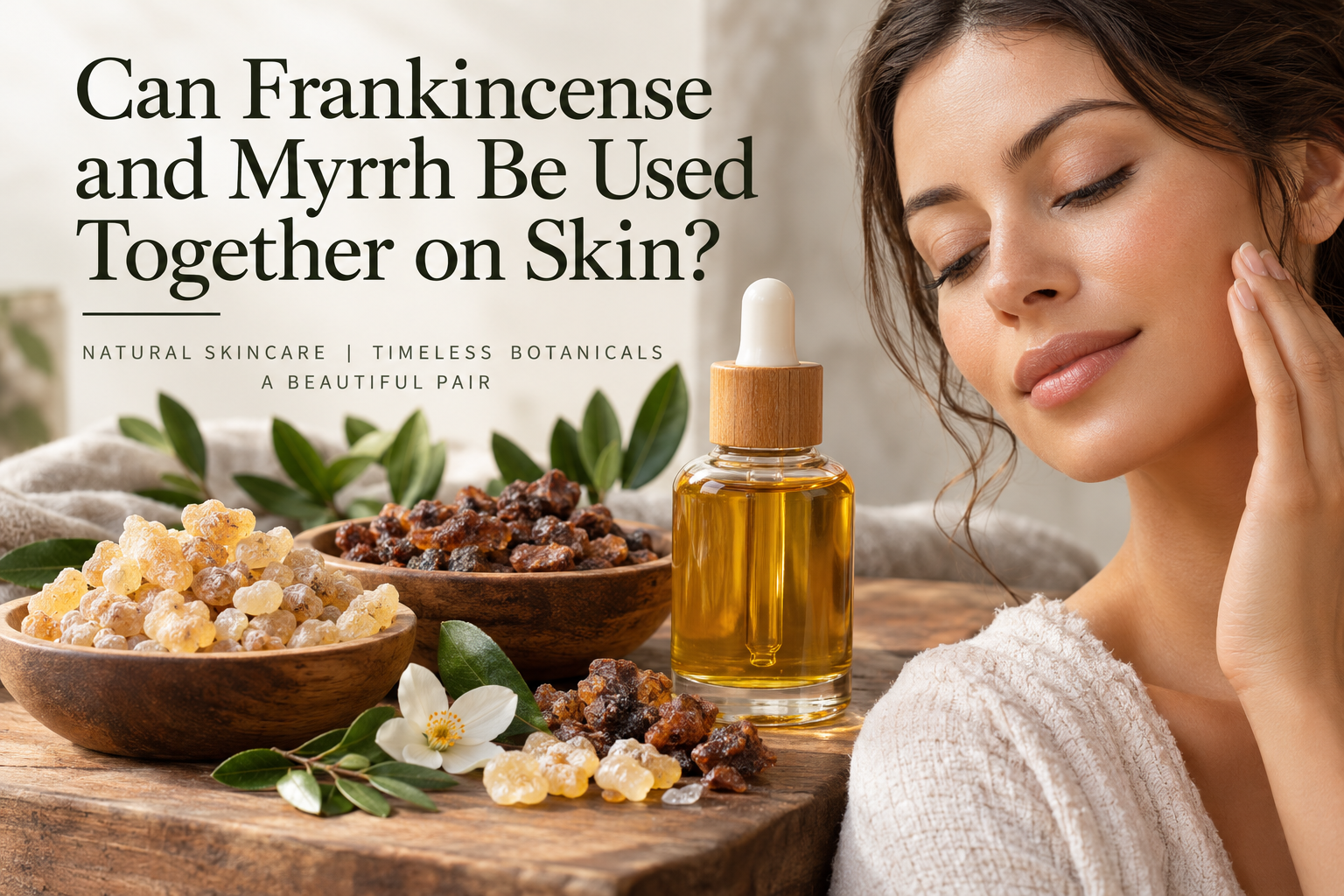
Featured Answer: Can You Use Frankincense and Myrrh Together on Your Skin?
Yes, frankincense and myrrh can be used together on the skin when they are properly formulated and diluted for topical use. These two aromatic resins have been paired for centuries and remain popular ingredients in modern botanical skincare. When incorporated into a suitable carrier oil, frankincense and myrrh can complement a simple moisturizing routine by helping condition the skin, soften its feel, and support a smoother, more supple-looking complexion.
At FrankinRose, we believe the most practical way to enjoy frankincense and myrrh in facial skincare is through a thoughtfully formulated facial oil. A carrier such as jojoba oil provides the base, while properly diluted frankincense and myrrh contribute their distinctive botanical character.
For most people, the important considerations are proper dilution, ingredient quality, skin sensitivity, and consistent use rather than applying concentrated essential oils or resin extracts directly to the face.
Why Are Frankincense and Myrrh Used Together in Skincare?
Frankincense and myrrh are both aromatic resins obtained from trees, but they have different characteristics. Frankincense comes from trees belonging to the Boswellia genus, while myrrh is obtained from trees belonging to the Commiphora genus.
Together, they create a distinctive botanical combination with a warm, resinous aroma.
Frankincense is frequently found in facial oils, serums, balms, and other botanical skincare preparations. Myrrh is similarly used in cosmetic formulations designed to condition dry or mature-looking skin.
Combining the two allows them to be incorporated into a single skincare step instead of requiring separate products.
What Does Frankincense Do for the Skin?
Frankincense has a long history of cosmetic and aromatic use. In modern skincare, it is commonly incorporated into products intended to condition the skin and improve the appearance of softness and suppleness.
When properly diluted in a facial oil, frankincense can become part of a routine focused on maintaining a healthy-looking complexion.
People commonly choose frankincense skincare when their goals include:
- Supporting soft, conditioned skin
- Improving the appearance of dry or dull-looking skin
- Maintaining a smooth and supple complexion
- Adding botanical ingredients to a minimalist skincare routine
- Using a facial oil as the final moisturizing step
- Supporting the appearance of mature skin
Frankincense should not be confused with a moisturizer that supplies water to the skin. Facial oils primarily provide emollient and occlusive benefits, helping soften the skin and reduce the loss of moisture from its surface.
For this reason, applying facial oil to slightly damp skin or after a water-based moisturizer can work particularly well.
What Does Myrrh Do for the Skin?
Myrrh has been used historically in aromatic preparations, perfumes, ointments, and personal-care products. In contemporary botanical skincare, myrrh is particularly appealing in formulations created for dry, rough, or mature-looking skin.
Its rich resinous character pairs naturally with frankincense.
Rather than treating myrrh as a stand-alone miracle ingredient, we prefer to consider it part of a complete formulation. The carrier oils and other ingredients surrounding it are equally important because they determine how the finished product spreads, absorbs, feels, and interacts with the skin.
A properly formulated frankincense and myrrh facial oil can therefore provide a straightforward way to combine these botanicals with moisturizing plant oils.
Can Frankincense and Myrrh Be Applied Directly to the Face?
Concentrated essential oils should generally not be applied undiluted directly to facial skin.
Essential oils contain concentrated aromatic compounds, and greater concentration does not automatically mean greater skincare benefit. Excessive concentrations can increase the possibility of irritation, redness, burning, or sensitization.
The face can be particularly sensitive, especially around the eyes, lips, and nose.
A properly formulated facial oil distributes aromatic ingredients throughout a carrier oil. This creates a product that is easier to spread evenly and more appropriate for routine cosmetic use.
At FrankinRose, we favor a simple principle: botanical ingredients should be used thoughtfully rather than simply at the highest possible concentration.
Why Jojoba Oil Works Well With Frankincense and Myrrh
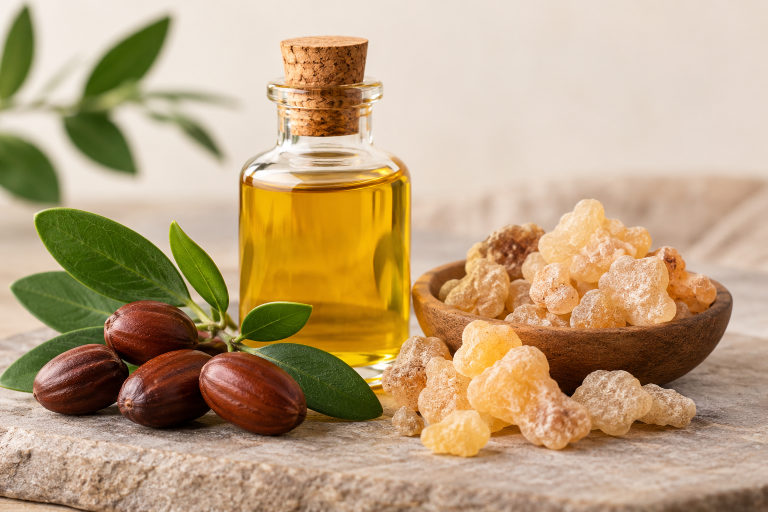
One of the most useful carrier ingredients for a frankincense and myrrh facial oil is jojoba oil.
Despite commonly being called an oil, jojoba is technically a liquid wax composed largely of wax esters. Its texture and stability have made it extremely popular in facial and body-care formulations.
Jojoba spreads easily across the skin and can provide an elegant base for concentrated botanical ingredients.
In a frankincense and myrrh formulation, jojoba serves several important purposes. It dilutes the aromatic ingredients, helps distribute them evenly, provides emollience, and gives the finished facial oil a smooth application.
This is why the carrier oil should never be treated as an unimportant filler. It forms the majority of most facial-oil formulas and has a major influence on how the product performs.
Frankincense, Myrrh, Jojoba, and Castor Oil for Facial Care
A facial oil can also combine jojoba oil and castor oil to create a richer texture.
Castor oil is substantially thicker than many lightweight facial oils. Including it alongside jojoba can create a more substantial skin feel that may appeal to people who prefer richer facial oils, particularly for nighttime application.
This combination allows each ingredient to serve a different purpose within the formula:
Jojoba oil provides a smooth, easily spreadable foundation.
Castor oil contributes richness and a more substantial texture.
Frankincense contributes its characteristic botanical and aromatic qualities.
Myrrh adds another deep resinous botanical component.
Together, these ingredients can create a concentrated facial oil that requires only a small amount per application.
How to Use Frankincense and Myrrh Facial Oil
Using a frankincense and myrrh facial oil does not require a complicated skincare routine.
Begin with clean skin. After cleansing, gently pat the face so that it is no longer dripping wet but may remain slightly damp. Apply a small amount of facial oil to the fingertips and gently distribute it across the face and neck.
A few drops may be sufficient depending on the formulation and the individual’s skin.
Rather than heavily coating the face, begin conservatively. More can always be added if necessary.
The oil can also be applied after a hydrating toner, hydrosol, serum, or moisturizer. In this type of routine, the facial oil is usually one of the final steps.
A simple routine could be:
- Cleanse the skin
- Apply a water-based toner or hydrosol, if desired
- Apply any water-based serum or moisturizer
- Finish with a small amount of frankincense and myrrh facial oil
- During the daytime, use an appropriate broad-spectrum sunscreen as directed
This approach provides both water-based hydration and oil-based conditioning instead of expecting facial oil to perform every function in a skincare routine.
Can You Use Frankincense and Myrrh Facial Oil Every Day?
A properly formulated facial oil may be suitable for daily cosmetic use for people whose skin tolerates its ingredients.
Some people prefer applying facial oils once daily in the evening. Others use a small amount in both their morning and nighttime routines.
There is no universal application schedule that is ideal for every complexion.
Someone with very dry skin may enjoy more frequent application, while a person with oily or combination skin may prefer only a few drops at night.
The amount should also change with the seasons. Skin that feels comfortable during humid summer weather may need additional emollient support during dry winter conditions or in low-humidity environments.
Consistency is generally more useful than applying excessive quantities at once.
Is Frankincense and Myrrh Good for Mature-Looking Skin?
Frankincense and myrrh facial oils are particularly popular among people interested in mature-skin routines.
As skin changes with age, it may feel drier or less supple. A well-formulated facial oil can provide emollience that helps the skin feel softer and appear smoother.
This does not mean that frankincense or myrrh should be presented as reversing the biological aging process. Cosmetic skincare is better evaluated by realistic outcomes such as softness, smoothness, suppleness, comfort, and overall appearance.
A facial oil can also complement other established elements of a mature-skin routine, including gentle cleansing, moisturization, sun protection, and appropriately selected active skincare products.
Can Frankincense and Myrrh Help Dry Skin?
A facial oil containing frankincense and myrrh may be particularly appealing when skin feels dry, tight, or rough.
The primary benefit comes from the oil-based formula’s ability to condition and soften the skin.
For very dry skin, we generally prefer layering facial oil rather than relying on oil alone.
For example, a water-based product can be applied first, followed by facial oil. This provides moisture to the skin before adding an emollient layer.
People experiencing persistent cracking, inflammation, unexplained peeling, severe itching, or painful dryness should not assume the problem is simply cosmetic dryness. Those symptoms can warrant evaluation by a qualified healthcare professional.
Can Frankincense and Myrrh Be Used on Sensitive Skin?
Sensitive skin requires additional caution.
Botanical does not automatically mean non-irritating. Essential oils, fragrances, botanical extracts, and even carrier oils can cause reactions in some individuals.
Before applying a new frankincense and myrrh product broadly across the face, consider performing a patch test according to the product directions.
Discontinue use if persistent redness, burning, swelling, itching, or other signs of irritation occur.
People with known allergies or highly reactive skin should carefully review the complete ingredient list before using any new skincare product.
Extra caution should also be taken around the eyes and other delicate areas.
Can Frankincense and Myrrh Be Used With Rose Water or Hydrosol?
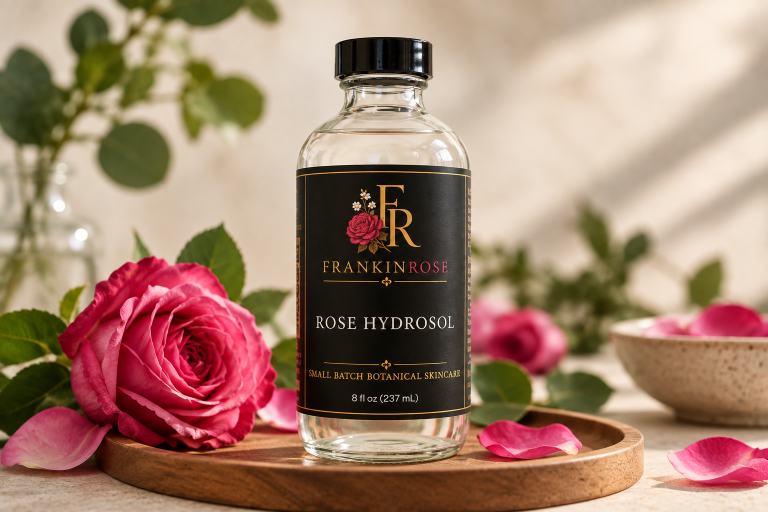
Yes. An oil-based frankincense and myrrh product can be incorporated into the same skincare routine as rose hydrosol or another water-based facial mist, provided the individual products are appropriate for the user’s skin.
The order matters.
A hydrosol is primarily water-based, while a facial oil is oil-based. We generally recommend using the water-based product first and the facial oil afterward.
For example, mist clean skin lightly with a hydrosol, allow it to settle onto the skin, and then gently press a small amount of facial oil over the face.
This creates a simple botanical routine without requiring numerous products.
What Does Frankincense and Myrrh Smell Like Together?
Frankincense and myrrh create a deep, warm, resinous aroma.
Frankincense can have fresh, woody, resinous, citrus-like, or balsamic nuances depending on the material and source. Myrrh tends to smell deeper, earthier, warmer, and sometimes slightly bitter or smoky.
Together, they produce an aroma quite different from conventional perfumed skincare.
People accustomed to heavily fragranced commercial cosmetics may initially find genuine resin-derived aromas unusual. Botanical materials naturally have their own aromatic profiles, and variations can occur between batches and sources.
How Long Does Frankincense and Myrrh Facial Oil Last?
The usable life of a facial oil depends on its complete formulation, packaging, storage conditions, ingredient freshness, and exposure to heat, light, air, and contamination.
Facial oils should generally be kept tightly closed and stored away from excessive heat and direct sunlight.
Avoid introducing water into the bottle, and do not touch the dropper directly against the face if doing so could contaminate the applicator.
Changes in odor, appearance, or texture can indicate that an oil has deteriorated. Always follow the storage instructions and period-of-use information provided with the specific product.
Can Frankincense and Myrrh Replace Moisturizer?
It depends on what the skin needs.
Facial oils are excellent emollients, but oils and conventional moisturizers do not function identically. A traditional moisturizer usually contains water, humectants, emollients, and other components in an emulsion.
A pure or primarily oil-based product contains little or no water.
For someone with dry or dehydrated skin, applying a facial oil over a moisturizer or water-based product may provide better results than replacing every moisturizing product with oil.
Other people may find that a few drops of facial oil provide all the conditioning they want.
The best approach is based on how the skin responds rather than assuming one routine is universal.
When Should Frankincense and Myrrh Facial Oil Be Applied?
Evening application is particularly convenient because facial oil can remain on the skin overnight without interfering with makeup or daytime activities.
However, facial oil can also be used during the day.
When used in a morning routine, apply only a small amount and allow it to absorb before continuing with other products. Broad-spectrum sunscreen remains an essential separate step and should not be replaced by botanical oils.
Frankincense, myrrh, jojoba, castor oil, and similar botanical oils should never be treated as substitutes for tested sunscreen.
Who May Enjoy a Frankincense and Myrrh Facial Oil?
A properly formulated frankincense and myrrh facial oil may appeal to adults looking for:
- A botanical facial oil
- A richer product for dry or mature-looking skin
- A minimalist skincare routine
- A facial oil containing jojoba
- A warm, naturally resinous aroma
- A final conditioning step after a toner or hydrosol
- A simple alternative to heavily fragranced cosmetic oils
Individual skin responses vary, so a product that feels excellent on one person’s skin may not be ideal for another.
Frequently Asked Questions About Frankincense and Myrrh for Skin
Can I Mix Frankincense and Myrrh for My Face?
Yes, but concentrated aromatic ingredients should be properly diluted in a suitable carrier rather than casually applying undiluted essential oils to facial skin. A professionally formulated facial oil provides a more convenient option.
Can I Use Frankincense and Myrrh Around My Eyes?
Avoid getting essential oils or facial oils into the eyes. The immediate eye area is delicate, and products should only be used there when their directions specifically indicate that application is appropriate.
Can I Use Frankincense and Myrrh at Night?
Yes. Nighttime is a popular time to apply facial oil because it can serve as the final conditioning step after cleansing and water-based skincare.
Can I Use Frankincense and Myrrh With Jojoba Oil?
Yes. Jojoba is an excellent carrier for facial-oil formulations because of its stability, spreadability, and pleasant skin feel.
Can Frankincense and Myrrh Be Used With Castor Oil?
Yes. Castor oil can be combined with lighter carrier oils such as jojoba to produce a richer facial-oil texture. Because castor oil is thick, the overall formulation determines how the finished product feels on the skin.
Should I Put Frankincense and Myrrh Oil on Wet or Dry Skin?
Facial oil can be applied to dry skin, but many people enjoy applying it to slightly damp skin or after a water-based moisturizer or hydrosol.
How Much Frankincense and Myrrh Facial Oil Should I Use?
Start with a small amount, often only a few drops depending on the formulation. Facial oils spread easily, and applying more product does not necessarily produce better results.
FrankinRose Frankincense & Myrrh Facial Oil
At FrankinRose, we appreciate skincare routines that are uncomplicated, botanical, and purposeful. Frankincense and myrrh naturally fit this philosophy because they can be incorporated into a simple facial oil without requiring an elaborate multi-step regimen.
Our approach focuses on pairing distinctive botanicals with carefully selected carrier oils to create a product that is pleasant to use and easy to incorporate into everyday skincare.
A frankincense and myrrh facial oil can be used after cleansing, layered over a hydrosol or moisturizer, or incorporated into an evening routine as a final conditioning step.
The objective is straightforward: soft, comfortable, supple-looking skin supported by a thoughtfully formulated botanical oil.
Final Answer: Can Frankincense and Myrrh Be Used Together on Skin?
Yes. Frankincense and myrrh can be used together on the skin when incorporated into an appropriately formulated and diluted topical product. Their warm resinous character makes them a natural pairing for botanical facial oils, particularly when combined with carrier ingredients such as jojoba oil and castor oil.
For facial application, we recommend avoiding undiluted essential oils and choosing a formulation specifically intended for topical skincare. Begin with a small amount, patch test when appropriate, and discontinue use if irritation develops.
For people who enjoy botanical skincare, frankincense and myrrh facial oil can provide a simple way to condition dry or mature-looking skin while adding two of the world’s most recognizable aromatic resins to an everyday skincare routine.
At FrankinRose, we believe effective botanical skincare does not need to be complicated. A carefully formulated facial oil, a few drops at a time, and a consistent routine can provide an elegant approach to maintaining soft, smooth, conditioned, and healthy-looking skin.